
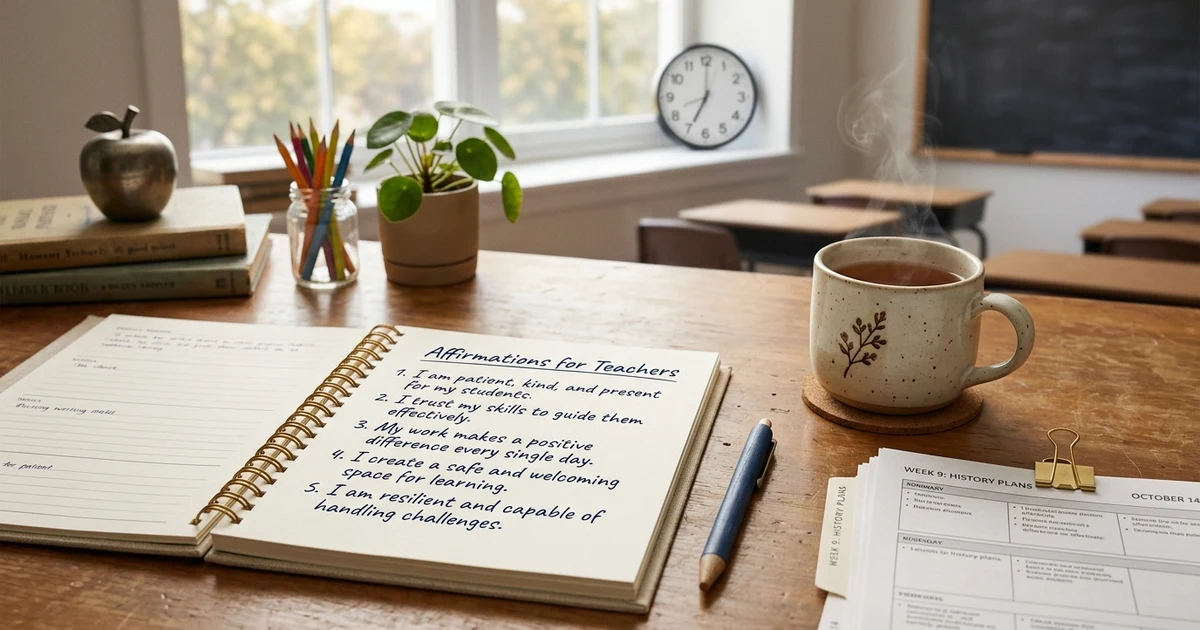
Teaching is meaningful work, but it can also be demanding. Between lesson planning, classroom management, grading, and supporting students, teachers often spend so much time encouraging others that they forget to encourage themselves. Affirmations for teachers offer a simple way to pause, recognize their efforts, and approach each school day with greater patience and confidence.
These positive statements are not about pretending every day is easy. They are reminders that progress matters, mistakes can teach valuable lessons, and teachers deserve the same kindness they give their students. Whether you are a new educator, an experienced teacher, or someone preparing for a challenging school day, these affirmations can help you reconnect with your purpose and acknowledge the difference you make.
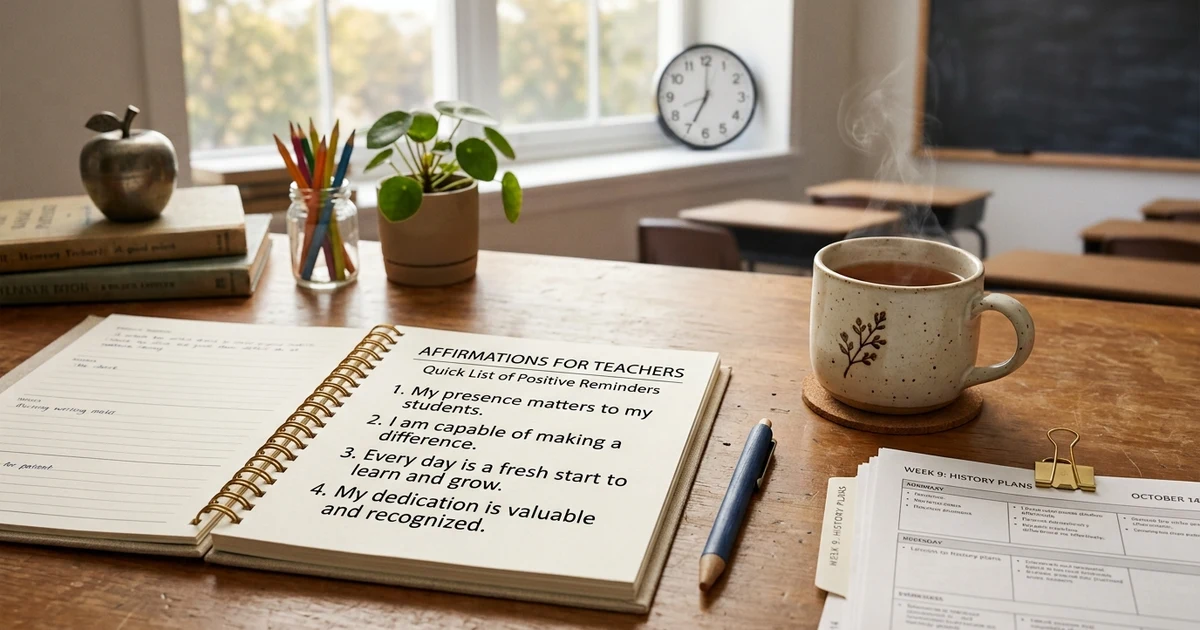
Affirmations for Teachers: Quick List of Positive Reminders
Here are some simple affirmations for teachers that you can read before class, during a break, or at the end of a long day.
- I make a meaningful difference in my students’ lives.
- I bring patience and care into my classroom.
- I am learning and growing alongside my students.
- My efforts matter, even when results take time.
- I can handle challenges one step at a time.
- I deserve patience and understanding, too.
- I create opportunities for students to learn and grow.
- I can be firm and kind at the same time.
- I do not need to be a perfect teacher to be effective.
- I recognize the progress I make each day.
- I can learn from difficult classroom moments.
- My worth is not measured by one lesson or one day.
- I give myself permission to take meaningful breaks.
- I can adapt when a lesson does not go as planned.
- I bring valuable skills and perspectives to my work.
- I celebrate small steps toward progress.
- I can ask for help when I need it.
- I approach my students with curiosity and respect.
- I am allowed to learn new teaching methods.
- I can end the school day without solving everything.
Choose one or two statements that feel believable and relevant to your current situation. You do not have to repeat every affirmation to benefit from the practice.
Best Affirmations for Teachers by Situation
Different school days bring different challenges. A teacher preparing for a new class may need confidence, while someone managing a stressful week may need patience and reassurance. Choosing an affirmation that fits the moment can make it easier to use naturally.
Positive Affirmations for Teachers
Positive affirmations can help you remember the strengths, values, and intentions you bring to your classroom.
- I bring enthusiasm and care to my teaching.
- I help create a welcoming learning environment.
- My words can encourage students to keep trying.
- I notice and appreciate the effort my students make.
- I can bring a fresh perspective to a familiar lesson.
- I make room for questions, curiosity, and creativity.
- I contribute something valuable to my school community.
- I can find meaning in small moments of progress.
- I approach my responsibilities with care and intention.
- I am proud of the effort I put into my work.
Short Affirmations for Teachers
Short affirmations are easy to remember when you have limited time between lessons or a busy schedule.
- I am capable.
- My work matters.
- I can begin again.
- Progress takes time.
- I choose patience.
- I can adapt.
- I am still learning.
- I deserve rest.
- Small steps count.
- I can ask for help.
- I trust my preparation.
- I lead with kindness.
- I can stay present.
- I welcome growth.
- I give myself grace.
Write your favorite short affirmation on a sticky note, place it inside your planner, or use it as a reminder on your desk.
Powerful Affirmations for Teachers Facing Challenges
Some days require extra encouragement. These affirmations can help you respond to difficulties without expecting yourself to feel positive all the time.
- A difficult day does not define me as a teacher.
- I can respond to challenges without judging myself harshly.
- I can change my approach when something is not working.
- I do not have to solve every problem immediately.
- I can remain open to feedback and new ideas.
- I can learn from mistakes without letting them define me.
- I can protect my time and energy with healthy boundaries.
- I am allowed to seek support from colleagues.
- I can focus on what is within my control.
- I can acknowledge frustration and still choose a constructive next step.
- I can make progress without having every answer.
- I can recognize when I need rest rather than more effort.
These statements are especially useful after a difficult lesson, an unexpected classroom incident, or a day when your plans do not work as expected.
Daily Affirmations for Teachers
A daily affirmation can serve as a small routine that helps you set an intention before the school day begins.
- Today, I will focus on progress rather than perfection.
- I will listen carefully before responding.
- I will give my students opportunities to learn from mistakes.
- I will stay flexible when plans change.
- I will recognize effort as well as achievement.
- I will speak to myself with the same kindness I offer others.
- I will take one task at a time.
- I will make space for questions and different perspectives.
- I will remember that learning takes time.
- I will give myself credit for what I accomplish today.
You can choose a new affirmation each morning or repeat the same one throughout the week.
Affirmations for New Teachers
Starting a teaching career involves learning classroom routines, understanding student needs, and building confidence through experience. These affirmations offer realistic encouragement for beginners.
- I am allowed to be a beginner.
- I do not need to know everything on my first day.
- Each lesson helps me understand my students better.
- I can ask experienced teachers for guidance.
- I can improve my classroom management over time.
- I can learn from feedback without taking it as a personal failure.
- I am developing my own teaching style.
- Preparation helps me feel more confident.
- I can adjust my plans when students need something different.
- My willingness to learn is a valuable strength.
- I can build trust with students one interaction at a time.
- Experience will help me develop new skills.
Remember that confidence often develops through practice. You do not need to feel completely confident before you begin learning.
Affirmations for Experienced Teachers
Experienced educators also need encouragement. Years of teaching can bring new responsibilities, changing expectations, and the challenge of keeping lessons engaging.
- My experience gives me valuable insight.
- I can continue growing throughout my career.
- I can try new methods without dismissing what already works.
- I recognize how much I have learned over the years.
- I can share my knowledge while remaining open to new ideas.
- I am allowed to change routines that no longer serve my classroom.
- I can support new teachers without carrying every responsibility myself.
- I bring perspective to challenging situations.
- I can celebrate my professional growth.
- I deserve opportunities to learn and recharge.
Your experience is valuable, and you can still make room for curiosity, change, and personal development.
Affirmations for Teachers Experiencing Stress
Teaching can involve emotional demands, tight deadlines, and competing priorities. These statements encourage a more balanced response to stressful moments.
- I can pause before responding to a difficult situation.
- I can take a few slow breaths and return to the present.
- I do not have to finish everything at once.
- I can separate urgent tasks from less important ones.
- I am allowed to acknowledge that today feels difficult.
- I can ask someone to help me find a solution.
- I can take a short break when circumstances allow.
- I can set reasonable expectations for myself.
- I can leave some tasks for another day when appropriate.
- I deserve support during demanding seasons of teaching.
- I can focus on the next manageable step.
- Rest is a reasonable part of caring for myself.
Affirmations are not a substitute for practical support. If stress is persistent or overwhelming, speaking with a trusted person, school leader, or qualified professional may also help.
Affirmations for Teachers Before Class
A few encouraging words before students arrive can help you set an intention for the lesson ahead.
- I am prepared to begin.
- I can explain ideas in more than one way.
- I can listen when students need clarification.
- I will make room for questions.
- I can adjust the lesson when necessary.
- I can respond to unexpected moments calmly.
- I will treat students with fairness and respect.
- I can encourage participation without demanding perfection.
- I will focus on helping students understand.
- I can learn something from this class, too.
Choose one statement and repeat it while arranging your materials or reviewing your lesson plan.
Affirmations for Teachers After a Difficult Day
It can be tempting to replay every mistake after leaving school. These affirmations encourage reflection without harsh self-judgment.
- I can learn from today without criticizing myself all evening.
- One difficult interaction does not erase my efforts.
- I can reflect on what happened and choose a next step.
- I am allowed to stop working when my workday ends.
- I can recognize what went well, even if the day was challenging.
- I do not need to carry every classroom problem home.
- Tomorrow gives me another opportunity to try a different approach.
- I can forgive myself for being human.
- I can make changes without dwelling on every mistake.
- I deserve time for interests and relationships outside teaching.
A helpful evening habit is to write down one thing that went well, one thing you learned, and one task to address tomorrow. This keeps reflection practical instead of turning it into endless self-criticism.
Affirmations for Teachers Who Feel Unappreciated
Not every teaching effort receives recognition. These affirmations can help you remember that your value is not determined entirely by praise from other people.
- My effort has value, even when it goes unnoticed.
- I can recognize my own progress.
- I deserve respectful treatment at work.
- I can celebrate the difference I make in small ways.
- I can seek feedback from people I trust.
- I do not need everyone’s approval to grow professionally.
- I can acknowledge my contributions without feeling boastful.
- I deserve a supportive working environment.
- I can communicate my needs respectfully.
- I can appreciate my work while recognizing its challenges.
Self-encouragement does not mean accepting unfair treatment or ignoring workplace problems. It can help you approach those concerns with greater clarity.
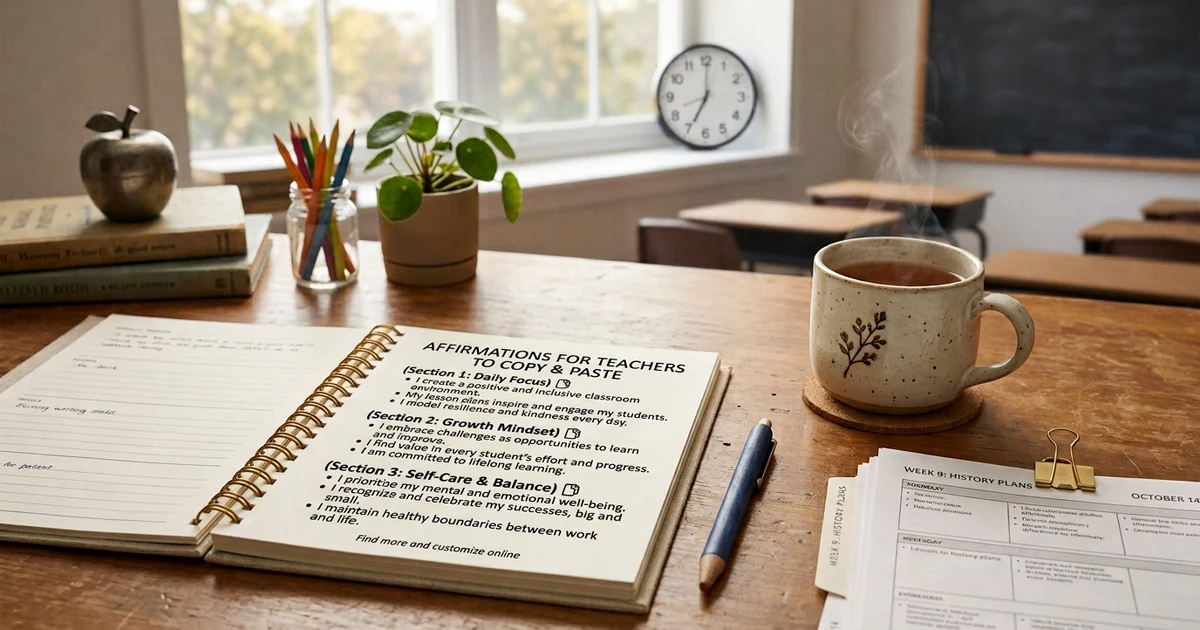
Affirmations for Teachers to Copy and Paste
If you want a ready-to-use list, the following affirmations can be copied into a journal, notes app, classroom planner, or printable page.
- I make a difference through the care I bring to teaching.
- I can create meaningful learning experiences.
- I welcome questions and encourage curiosity.
- I can learn from every teaching experience.
- I respect the different ways my students learn.
- I can be patient with myself and others.
- I do not need to compare my classroom with someone else’s.
- I can make thoughtful decisions even when circumstances change.
- I can acknowledge my limitations without overlooking my strengths.
- I can ask for support when a challenge feels too big.
- I am building skills that will serve me throughout my career.
- I can balance high expectations with compassion.
- I can make adjustments without seeing them as failures.
- I am more than my to-do list.
- I can take pride in consistent effort.
- I deserve time to recharge.
- I can focus on meaningful progress.
- I can make room for creativity in my teaching.
- I can listen, learn, and respond with care.
- I can give myself the same encouragement I give my students.
- I can handle one difficult moment at a time.
- I can set boundaries that support my well-being.
- I can celebrate the small victories of the school day.
- I can keep learning without expecting perfection.
- I can finish today knowing that I made an effort.
Choose the phrases that sound natural to you. You can also edit them so they reflect your own teaching style, responsibilities, and values.
How to Use Affirmations for Teachers Naturally
Affirmations work best as a realistic self-reflection habit rather than a requirement to feel happy or confident all the time. The goal is to practice helpful self-talk that supports your actions.
1. Choose an affirmation you believe
Start with a statement that feels possible, even if you do not fully believe it yet.
For example, if “I am always confident in my classroom” feels unrealistic, try “I am learning to handle classroom challenges with greater confidence.”
A believable statement is easier to connect with than one that conflicts strongly with your current experience.
2. Connect it to a real action
Pair your affirmation with something practical.
For example:
- Affirmation: “I can make this lesson easier to understand.”
- Action: Prepare a simple example or visual explanation.
- Affirmation: “I can manage my workload one step at a time.”
- Action: Choose the three most important tasks for the day.
This approach turns encouragement into a useful reminder that supports your decisions.
3. Repeat it at a convenient time
You might read an affirmation:
- While preparing your classroom.
- Before students enter.
- During a lunch break.
- Before a parent-teacher meeting.
- While reflecting on the day.
- Before planning the next week’s lessons.
There is no single correct time or number of repetitions. Choose a routine that fits your schedule.
4. Write it down
Writing an affirmation in a planner or journal gives you a reminder to revisit. You could keep a small list of statements that help you with confidence, patience, boundaries, or professional growth.
5. Change it when your needs change
An affirmation that helps during the first week of school may not address your needs during exam season. Review your choices occasionally and select phrases that match your current challenges.
Gentle Tips for Choosing the Right Teacher Affirmations
Not every positive statement will feel helpful to every teacher. Use these tips to make your affirmations more personal and realistic.
Use supportive language. Choose words that encourage rather than criticize you. “I am learning to respond patiently” may feel more useful than “I must never lose patience.”
Focus on what you can influence. You cannot control every student response, school policy, or classroom disruption. You can focus on your preparation, communication, and next steps.
Keep the wording simple. Short sentences are easier to remember during a busy school day.
Make room for difficult feelings. You can feel frustrated and still be a caring teacher. An affirmation should not require you to deny your emotions.
Personalize the message. If you struggle with workload, choose reminders about boundaries and priorities. If you are a new teacher, focus on learning and asking for help.
Connect encouragement with reality. Affirmations can remind you of your intentions, but they do not guarantee particular classroom outcomes. Let them support your efforts rather than become another standard you must meet.

What to Avoid When Using Affirmations for Teachers
Affirmations are intended to encourage you, not add pressure to an already demanding job. A few common mistakes can make the practice less useful.
Avoid unrealistic promises
Statements such as “Every student will succeed because of me” place responsibility for every outcome on one person. A more balanced alternative is “I can provide opportunities, encouragement, and support for my students to learn.”
Avoid expecting constant positivity
Teachers experience frustration, uncertainty, and disappointment like everyone else. You do not have to feel positive every day to be committed to your students.
Avoid using affirmations to ignore problems
If your workload is unreasonable, you lack necessary resources, or you need additional classroom support, positive self-talk alone will not resolve those issues. Practical changes and support matter.
Avoid comparing yourself with other teachers
Every classroom has different needs, and every educator has a different set of experiences. Focus on your own development rather than expecting your teaching journey to look like someone else’s.
Avoid turning affirmations into another obligation
You do not need a long morning routine or a perfect journal. One useful sentence may be enough for a busy day. If the practice starts to feel like another task, simplify it or take a break.
Printable Affirmations for Teachers: Simple Ideas
A printable affirmation sheet can make it easier to keep encouraging statements somewhere visible. You do not need special materials or an elaborate design to create one.
Here are a few practical ideas:
- Desk reminder: Print three short affirmations and place them near your lesson planner.
- Teacher planner page: Add a weekly affirmation beside your priorities.
- Reflection sheet: Include prompts such as “What went well today?” and “What will I try next time?”
- Staff encouragement cards: Share appropriate, supportive phrases with colleagues.
- Journal page: Write one affirmation and a small action you can take to support it.
- Classroom inspiration board: Display inclusive messages about effort, curiosity, patience, and learning.
- End-of-week reflection: Pair an affirmation with one achievement and one lesson learned.
For a simple printable, choose a clear font, leave enough space between statements, and use a layout that is easy to read. Black-and-white pages can be practical for everyday printing.
If you create a shared staff resource, choose wording that respects different experiences and avoids suggesting that teachers should simply tolerate excessive workloads or difficult working conditions.
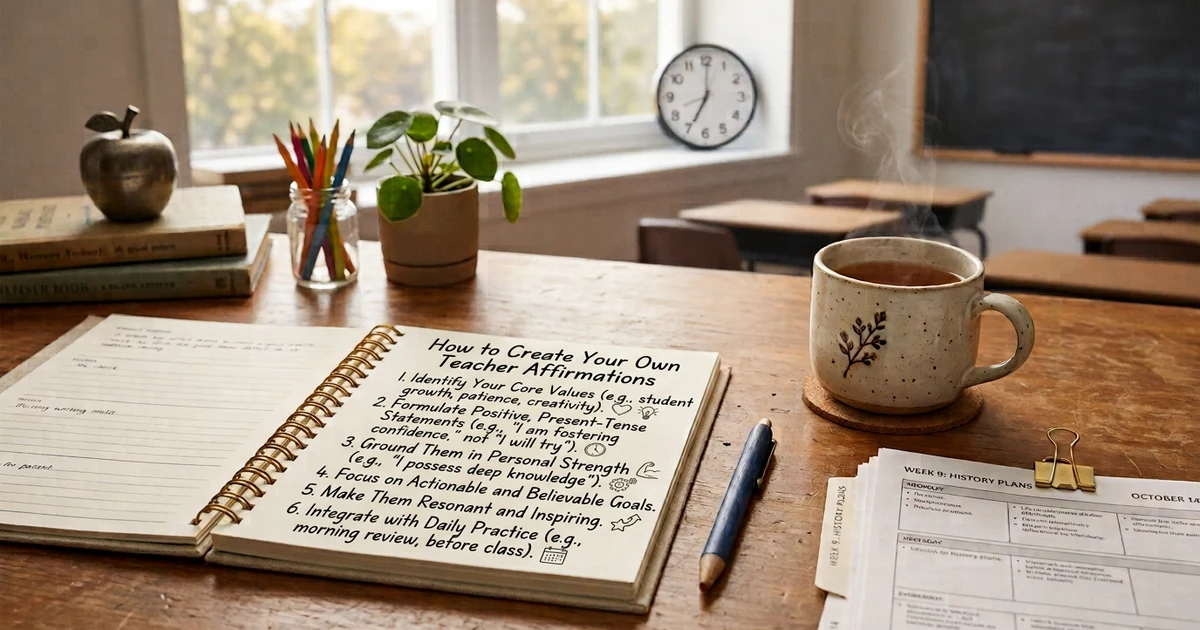
How to Create Your Own Affirmations for Teachers
You can write personal affirmations by identifying a challenge and turning it into a realistic, supportive statement.
Try this simple three-step method.
Step 1: Name the challenge.
For example, you might feel nervous about speaking with parents, managing a busy classroom, or trying a new teaching method.
Step 2: Identify the reminder you need.
Ask yourself what would help you respond constructively. You might need to remember that preparation helps, mistakes are part of learning, or you can ask for support.
Step 3: Write a realistic statement.
Turn that reminder into a short sentence.
| Challenge | Personal affirmation |
|---|---|
| Feeling nervous before class | I can prepare carefully and take the lesson one step at a time. |
| A lesson did not go well | I can learn from this experience and adjust my approach. |
| Too many tasks | I can prioritize what matters most today. |
| Comparing myself with colleagues | I can focus on my own professional growth. |
| Feeling exhausted | I deserve rest and reasonable boundaries. |
| Asking for assistance | Seeking support is a responsible choice. |
Read your statement and ask whether it feels encouraging without pretending the challenge does not exist. If it sounds too strong, make it gentler.
For instance, “I am an outstanding teacher in every situation” could become “I am developing the skills to respond more confidently to different classroom situations.”
The most useful affirmation is one that helps you approach a real situation with greater clarity, patience, or willingness to take action.
Conclusion
Affirmations for teachers can provide simple reminders of patience, professional growth, and the importance of treating yourself with kindness. From short daily statements to encouraging words for stressful moments, the right affirmation can help you pause, reflect, and choose a constructive next step.
Remember that being a good teacher does not mean having every answer or getting every lesson right. You can learn from difficult days, ask for help, celebrate small victories, and protect time for your own well-being. Choose a few affirmations from this list that feel meaningful to you, save them in your planner, and return to them whenever you need encouragement. Save the list so you can revisit your favorite reminders throughout the school year.
Frequently Asked Questions About Affirmations for Teachers
1. What are affirmations for teachers?
Affirmations for teachers are short, positive statements that encourage helpful self-talk, professional confidence, patience, and reflection. Teachers can use them to remember their strengths, recognize their efforts, and approach challenges with a more balanced mindset.
2. What is the best affirmation for a teacher?
A useful all-purpose affirmation is: “I do not need to be a perfect teacher to make a meaningful difference.” It acknowledges that teaching can be challenging while reminding educators that progress, care, and consistent effort matter.
3. What are some short affirmations for teachers?
Examples include “My work matters,” “I can adapt,” “Progress takes time,” “I deserve rest,” and “I can begin again.” Short statements are easy to remember before class or during a busy school day.
4. How can teachers use daily affirmations?
Teachers can read one affirmation before class, write it in a planner, or revisit it during a break. Connecting the statement to a practical action, such as preparing a lesson or setting a boundary, can make the habit more meaningful.
5. Do affirmations help teachers feel more confident?
Affirmations may help teachers practice more supportive self-talk and reflect on their abilities. Their usefulness varies, and they are not a guarantee of confidence or classroom success. Preparation, experience, feedback, and support also contribute to professional growth.
6. What are good affirmations for new teachers?
Good affirmations for new teachers include “I am allowed to be a beginner,” “I can learn from feedback,” and “I do not need to know everything on my first day.” These statements encourage growth without creating unrealistic expectations.
7. What affirmations can teachers use during stressful days?
Teachers might use statements such as “I can focus on the next manageable step,” “I do not have to solve everything immediately,” and “I can ask for support.” These reminders can complement practical stress-management strategies and appropriate workplace support.
8. Can teachers use affirmations after a difficult lesson?
Yes. A statement such as “I can learn from today without judging myself harshly” can encourage constructive reflection. Consider identifying what happened, what you learned, and one adjustment to try next time.
9. Can I make a printable affirmation list for teachers?
Yes. Select a few relevant statements, arrange them on a simple page, and print the list for your desk, planner, or journal. You can also create affirmation cards or a weekly reflection sheet for personal use or colleagues.
10. How often should teachers repeat affirmations?
There is no required frequency. Some teachers prefer one statement each morning, while others use affirmations only when they need encouragement. Choose a routine that feels natural and helpful rather than treating repetition as a strict rule.