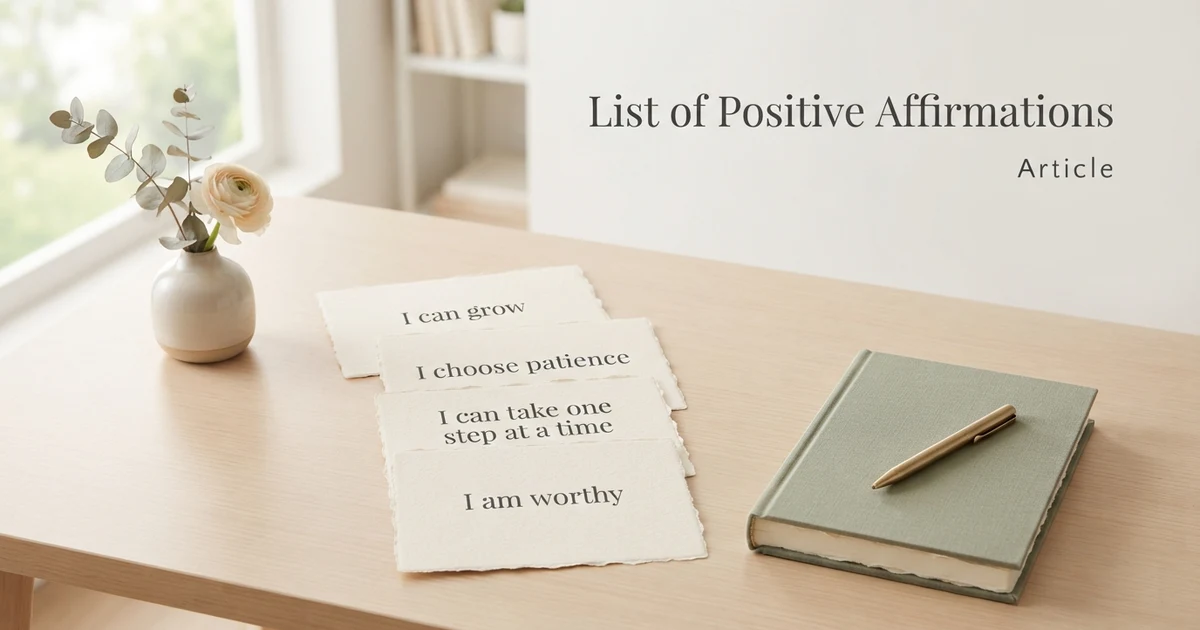
A list of positive affirmations can give you simple, encouraging statements to repeat, write down, or keep nearby during your day. Affirmations are a form of positive self-talk that can help you focus your attention on helpful thoughts, personal values, and realistic intentions. They do not need to sound dramatic or perfect. The most useful affirmations are often short, believable, and easy to connect with.
Whether you are new to affirmations or want fresh phrases for daily use, this list includes simple examples for confidence, self-love, calm, motivation, work, relationships, and everyday mindset support.
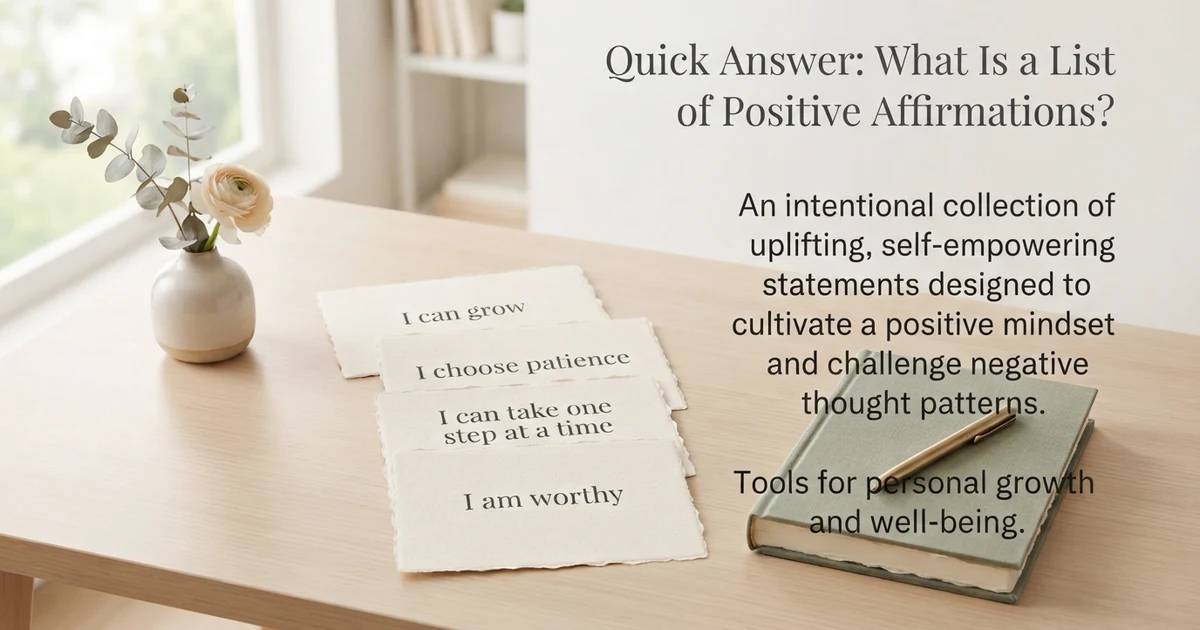
Quick Answer: What Is a List of Positive Affirmations?
A list of positive affirmations is a collection of short, encouraging statements written in a positive and intentional way. People may read, repeat, write, or personalize these statements as part of their daily routine.
For example:
- I am learning and growing every day.
- I can take things one step at a time.
- I trust myself to make thoughtful choices.
- I am worthy of kindness and respect.
- I can begin again when I need to.
- My effort matters.
- I give myself permission to rest.
- I can focus on what I can control.
- I am becoming more confident in myself.
- Today, I will treat myself with patience.
Affirmations are best viewed as self-talk and mindset tools rather than promises that a particular outcome will happen.
What Does a List of Positive Affirmations Mean?
The meaning is simple: a list of positive affirmations brings several supportive statements together so they are easy to read and use.
An affirmation usually describes a helpful thought, quality, intention, or perspective. Instead of focusing only on what feels difficult, an affirmation can direct attention toward qualities such as patience, confidence, courage, gratitude, or self-respect.
For example, instead of saying:
I never make mistakes.
A more realistic affirmation could be:
I can learn from my mistakes and keep moving forward.
The second statement does not require you to believe that you are perfect. It gives you a practical thought to return to.
Short List of Positive Affirmations
If you want a quick list to save or copy, start here:
- I am capable of learning new things.
- I can handle today one step at a time.
- I believe in my ability to grow.
- I deserve kindness and respect.
- I am allowed to make mistakes.
- I can choose patience.
- My voice matters.
- I am learning to trust myself.
- I can focus on what matters today.
- I am proud of the effort I make.
- I can ask for help when I need it.
- I give myself room to grow.
- I can start again.
- I am worthy of healthy relationships.
- I can be patient with myself.
- I am becoming more comfortable with who I am.
- I can make thoughtful choices.
- I appreciate the progress I make.
- I can face challenges with courage.
- I choose to speak to myself with kindness.
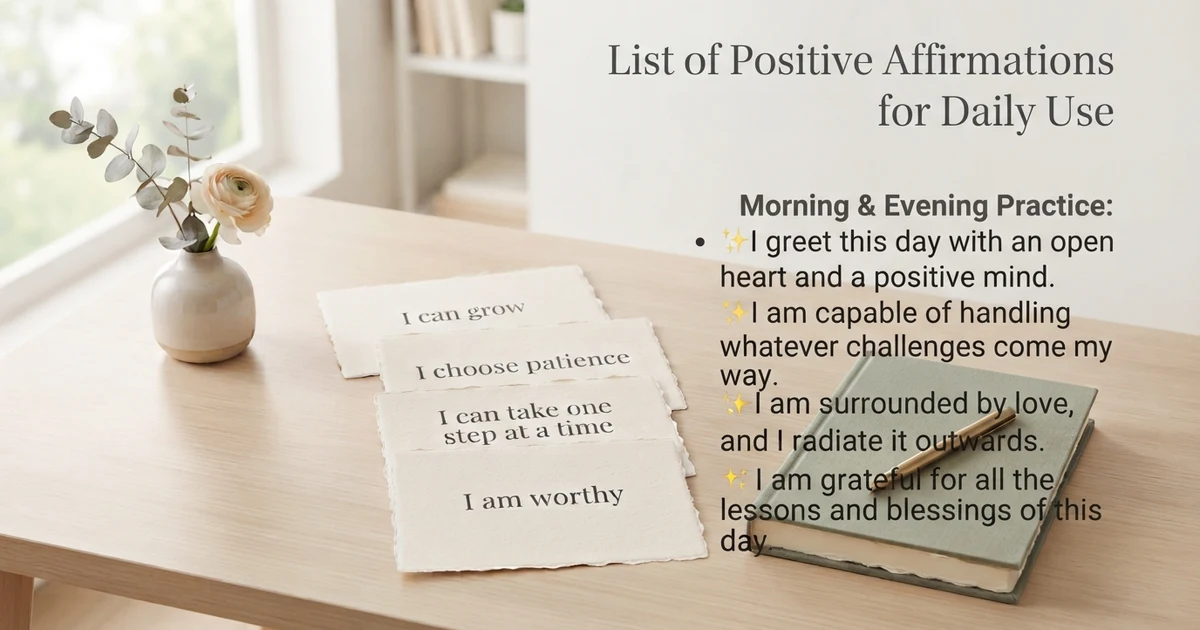
List of Positive Affirmations for Daily Use
Daily affirmations work best when they fit naturally into your routine. You might read a few in the morning, write one in a journal, or choose one before starting an important task.
Here are some everyday examples:
- I will focus on what I can control today.
- I can take my day at a manageable pace.
- I have permission to pause and reset.
- I can give my attention to what matters most.
- I am capable of taking the next step.
- I will be patient with myself today.
- I can learn something from today’s experience.
- I choose progress over perfection.
- I can make time for what matters.
- I am grateful for the good things I notice today.
- I can respond thoughtfully instead of reacting quickly.
- I deserve time to rest and recharge.
- I can adjust my plans when circumstances change.
- I am allowed to have an imperfect day.
- I can end today knowing I did what I could.
Positive Affirmations for Confidence
Confidence does not have to mean feeling certain all the time. These affirmations can help you practice supportive self-talk around confidence:
- I can trust myself to learn.
- I am capable of handling new situations.
- I can speak with honesty and confidence.
- My ideas are worth sharing.
- I do not need to be perfect to participate.
- I can learn from feedback.
- I am becoming more confident through practice.
- I can take up space without putting others down.
- I can make decisions thoughtfully.
- I am allowed to believe in myself.
Positive Affirmations for Self-Love
Self-love affirmations can focus on self-respect, patience, acceptance, and healthy boundaries.
Try these:
- I treat myself with compassion.
- I deserve respect from myself and others.
- I am learning to appreciate who I am.
- I can accept that I am still growing.
- I listen to my needs.
- I give myself permission to rest.
- I can set healthy boundaries.
- I do not need to compare my journey with someone else’s.
- I can forgive myself for past mistakes.
- I choose words for myself that I would offer to someone I care about.
Positive Affirmations for Motivation
When you need encouragement to begin or continue a task, choose an affirmation that focuses on action rather than an unrealistic promise.
- I can take one useful step now.
- I do not have to finish everything at once.
- Starting is progress.
- I can keep going at my own pace.
- My effort has value.
- I can focus on the next task.
- I can learn as I go.
- Small steps can move me forward.
- I can return to my goal after a setback.
- I have the patience to keep practicing.
Positive Affirmations for Calm and Patience
These statements can be useful when you want a calmer, more grounded mindset:
- I can slow down and take one moment at a time.
- I can pause before I respond.
- I do not have to solve everything immediately.
- I can focus on what is within my control.
- I give myself permission to take a break.
- I can be patient with the process.
- I can notice my thoughts without accepting every thought as fact.
- I can choose a calmer response.
- I can handle this moment before worrying about the next one.
- I can give myself time to think.
List of Positive Affirmations for Beginners
If you have never used affirmations before, start with statements that feel believable. You do not need to repeat extremely positive claims that feel disconnected from your current experience.
Try these beginner-friendly examples:
- I am willing to learn.
- I can take one step at a time.
- I am open to making progress.
- I can practice being kinder to myself.
- I can learn from difficult experiences.
- I am allowed to start small.
- I can try again.
- I can ask questions when I am unsure.
- I am learning more about myself.
- I can choose one helpful thought today.
List of Positive Affirmations: Related Terms Compared
Affirmations are sometimes confused with other types of positive or motivational statements. The terms overlap, but they are not always identical.
| Term | Simple meaning | Example |
|---|---|---|
| Positive affirmation | A supportive statement used as self-talk | “I can learn from challenges.” |
| Positive self-talk | The broader practice of speaking to yourself in a helpful way | “I made a mistake, but I can fix it.” |
| Motivational quote | A saying intended to encourage or inspire | A famous statement about persistence |
| Mantra | A word, phrase, or statement repeated for focus or reflection | “Stay present.” |
| Goal statement | A statement describing something you want to accomplish | “I will study for 30 minutes.” |
| Gratitude statement | A statement expressing appreciation | “I am grateful for my supportive family.” |
The key difference is purpose. An affirmation is generally used as an intentional self-statement, while a goal describes an outcome or action and a quote may come from another person.
How to Use a List of Positive Affirmations Naturally
You do not need a complicated routine. Choose one or two statements that match what you want to focus on and use them in a way that feels natural.
1. Choose a relevant affirmation
Pick a statement connected to something you are currently working on.
For example, if you tend to doubt your abilities, try:
I can learn through practice.
2. Make it believable
Avoid statements that feel completely impossible to accept. A small adjustment can make an affirmation easier to connect with.
Instead of:
I am completely confident in every situation.
Try:
I am learning to feel more confident in new situations.
3. Say or write it regularly
You can read an affirmation in the morning, write it in a journal, keep it on a note, or repeat it before a task.
Consistency matters more than using a large number of statements.
4. Connect it with an action
Affirmations can be more practical when paired with something you can actually do.
For example:
Affirmation: I can make progress one step at a time.
Action: Spend 15 minutes working on the task you have been avoiding.
5. Change the wording when needed
Your affirmation does not have to stay exactly the same. Adjust it as your needs change.
For example:
I can start small.
can become:
I can keep building on the progress I have made.
List of Positive Affirmations You Can Copy and Paste
Here is a simple copy-and-paste list for your notes or journal:
- I am learning and growing.
- I can take things one step at a time.
- I trust myself to keep learning.
- I deserve kindness and respect.
- I can handle today’s challenges.
- I am allowed to make mistakes.
- I can learn from every experience.
- I choose patience with myself.
- I can focus on what I can control.
- My effort matters.
- I can ask for support when I need it.
- I am capable of change.
- I can begin again.
- I am proud of myself for trying.
- I can make thoughtful choices.
- I give myself permission to rest.
- I can move forward at my own pace.
- I am worthy of healthy relationships.
- I can speak to myself with kindness.
- I can focus on progress instead of perfection.
Common Mistakes When Using Positive Affirmations
Affirmations are simple, but a few common mistakes can make them less useful.
Using statements that feel unrealistic
If a statement feels completely untrue to you, it may be difficult to connect with. Try softer language such as “I am learning,” “I can practice,” or “I am becoming.”
Repeating words without meaning
Simply saying an affirmation many times does not automatically make it useful. Take a moment to understand what the statement means to you.
Using too many affirmations
You do not need a list of hundreds of statements every day. Choosing one to three relevant affirmations can make the practice easier to maintain.
Treating affirmations as a replacement for action
An affirmation can support a mindset, but it does not replace practical steps. If your affirmation is about confidence, for example, pair it with an action that gives you an opportunity to practice confidence.
Expecting immediate results
Different people respond to self-talk practices differently. Give yourself time to find wording that feels useful rather than expecting one sentence to change everything immediately.
How to Create Your Own List of Positive Affirmations
Creating personal affirmations is easy when you start with an area you want to support.
Use this simple formula:
I + present-focused supportive statement + realistic quality or action.
Examples:
- I am learning to trust myself.
- I can practice patience.
- I am becoming more comfortable asking for help.
- I can focus on one task at a time.
- I choose to treat myself with respect.
You can also turn a negative thought into a more constructive statement.
Negative thought: I always get everything wrong.
Balanced affirmation: I can learn from mistakes and improve with practice.
This approach keeps the statement encouraging without requiring you to pretend that difficulties do not exist.
Final Thoughts on the List of Positive Affirmations
A list of positive affirmations can be a simple way to practice supportive self-talk and bring your attention back to qualities or intentions that matter to you. Start with a few short statements that feel realistic, personalize the wording, and connect your affirmations with everyday actions.
You do not need a perfect routine or a huge collection. One meaningful affirmation that you actually use can be more practical than a long list that stays unread. Save the list and return to it whenever you want a simple starting point for your daily self-talk.
Frequently Asked Questions
What is a list of positive affirmations?
A list of positive affirmations is a collection of supportive statements that can be read, repeated, written, or personalized as a form of intentional self-talk.
What is a good positive affirmation?
A good affirmation is usually short, clear, relevant, and believable. For example, “I can take one step at a time” is simple enough to apply to many everyday situations.
How many positive affirmations should I use each day?
There is no required number. Starting with one to three relevant affirmations can make the practice simple and manageable.
Can I copy and paste positive affirmations?
Yes. You can copy affirmations into your notes, journal, planner, or another place where you will see them. Personalizing the wording can make them more meaningful.
What are positive affirmations used for?
Positive affirmations are commonly used as intentional self-talk to focus attention on supportive thoughts, values, qualities, or actions.
Should affirmations always start with “I am”?
No. Although “I am” statements are common, affirmations can also begin with phrases such as “I can,” “I choose,” “I am learning,” or “Today I will.”
Are positive affirmations the same as positive self-talk?
They are closely related but not identical. Affirmations are specific intentional statements, while positive self-talk is a broader way of responding to yourself with constructive and supportive language.
Can beginners use positive affirmations?
Yes. Beginners can start with simple statements that feel realistic, such as “I can learn,” “I can start small,” or “I am willing to try.”
How can I make affirmations feel more natural?
Use everyday language and choose statements that match your current situation. If an affirmation feels too extreme, soften it by using phrases such as “I am learning,” “I can practice,” or “I am becoming.”
Can affirmations replace professional help?
No. Affirmations are a self-talk and mindset practice. They should not be treated as a replacement for professional care or other appropriate support when someone needs it.