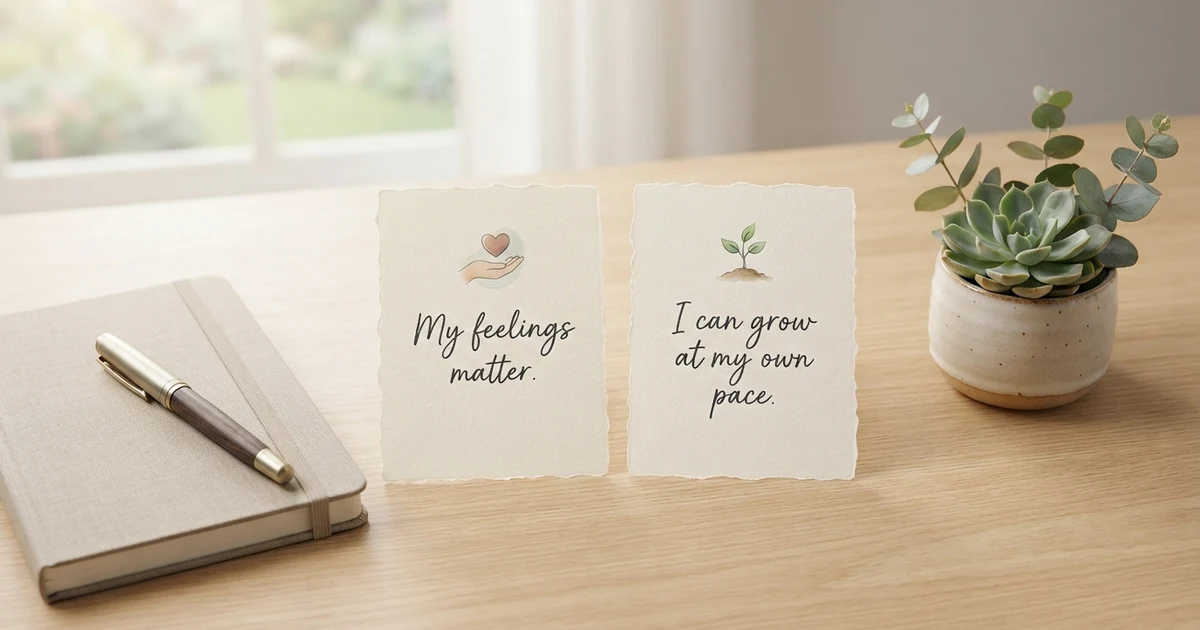
Validation and affirmation are two ways to support emotional well-being, build self-awareness, and develop a healthier relationship with yourself. Although they may sound similar, they serve different purposes. Validation helps you acknowledge your feelings and experiences without judgment, while affirmation uses supportive self-talk to encourage confidence, self-respect, and a positive mindset.
Understanding validation vs affirmation can help you choose the right words for different situations. Sometimes, you need to recognize that your feelings are understandable. Other times, you may benefit from reminding yourself of your strengths, values, or personal goals. Both approaches can be useful in everyday life, especially when practiced with honesty and kindness.
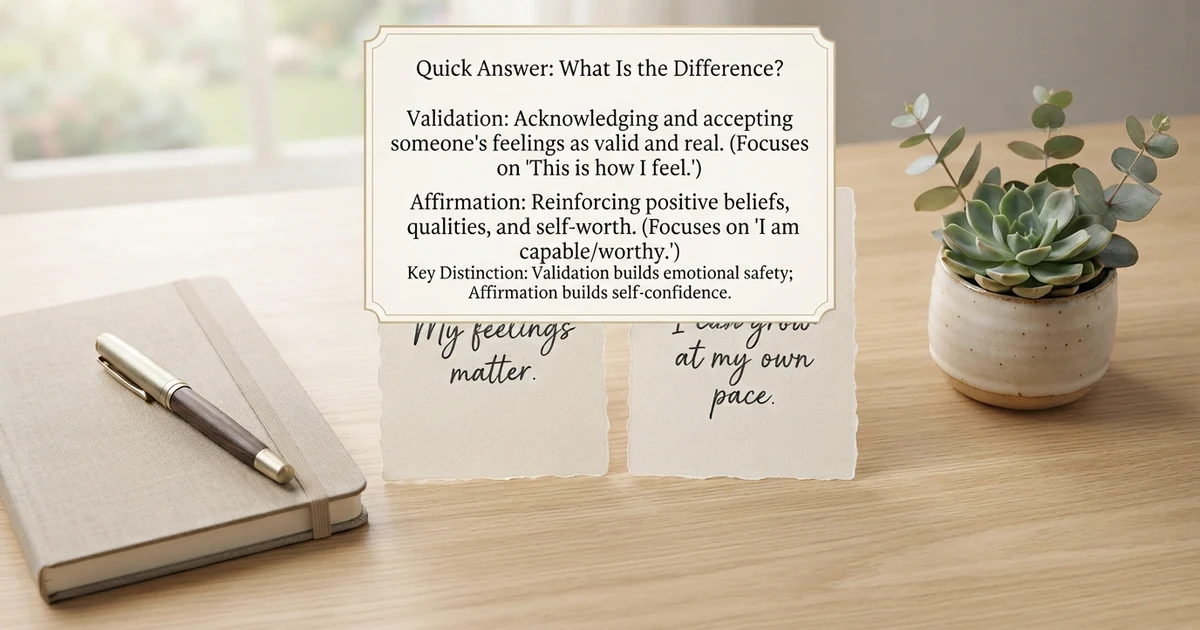
Quick Answer: What Is the Difference Between Validation vs Affirmation?
The main difference between validation and affirmation is what each practice focuses on.
- Validation means acknowledging and accepting your feelings, thoughts, or experiences as real and understandable.
- Affirmation means using positive, supportive statements to encourage a healthy mindset, confidence, or personal growth.
For example:
- Validation: “It makes sense that I feel disappointed after a difficult day.”
- Affirmation: “I can learn from difficult days and keep moving forward.”
Validation recognizes what you are experiencing right now. Affirmation encourages how you want to think, respond, or move forward.
Neither approach requires you to ignore difficult emotions or pretend everything is perfect. Both work best when your words feel genuine and reflect your actual experience.
What Does Validation Mean?
Validation is the practice of recognizing someone’s feelings, thoughts, or experiences without dismissing, criticizing, or immediately trying to change them.
When you validate yourself, you acknowledge what you are feeling and allow yourself to experience it without unnecessary judgment.
For example, instead of saying, “I should not feel upset about this,” you might say, “I feel upset, and I can take a moment to understand why.”
Validation does not mean agreeing with every thought or believing that every reaction is correct. It simply means recognizing that an emotion exists and deserves thoughtful attention.
Examples of Validation
Here are some simple validation statements you can use in everyday situations:
- My feelings are real, even when I struggle to explain them.
- It is understandable that I feel nervous about something unfamiliar.
- I can acknowledge my disappointment without judging myself.
- My experiences matter, even when others see things differently.
- I am allowed to need time to process what happened.
- Feeling overwhelmed does not mean I have failed.
- I can accept my emotions without letting them define me.
- My concerns deserve to be heard.
- I do not have to minimize my feelings to make others comfortable.
- I can be patient with myself while working through a difficult moment.
These statements focus on emotional acknowledgment rather than forcing a positive interpretation.
What Does Affirmation Mean?
An affirmation is a positive or supportive statement that you repeat to encourage a particular mindset, strengthen self-belief, or remind yourself of your values.
Affirmations can help you focus on personal strengths, develop constructive self-talk, and approach everyday challenges with greater intention.
A useful affirmation should feel believable and supportive rather than exaggerated or disconnected from your circumstances.
For example, “I am learning to trust myself” may feel more natural than “I never make mistakes.”
Affirmations are not promises that everything will go according to plan. They are reminders that can support the way you approach your choices and experiences.
Examples of Affirmations
Here are 10 simple affirmations for daily use:
- I am capable of learning new things.
- I deserve to treat myself with kindness.
- I can take small steps toward meaningful goals.
- My progress matters, even when it feels slow.
- I am allowed to grow at my own pace.
- I can learn from mistakes without defining myself by them.
- I have strengths that I can continue developing.
- I can approach challenges with patience.
- I am worthy of respect and understanding.
- I can make thoughtful choices that reflect my values.
These affirmations encourage a constructive outlook while leaving room for real-life challenges.
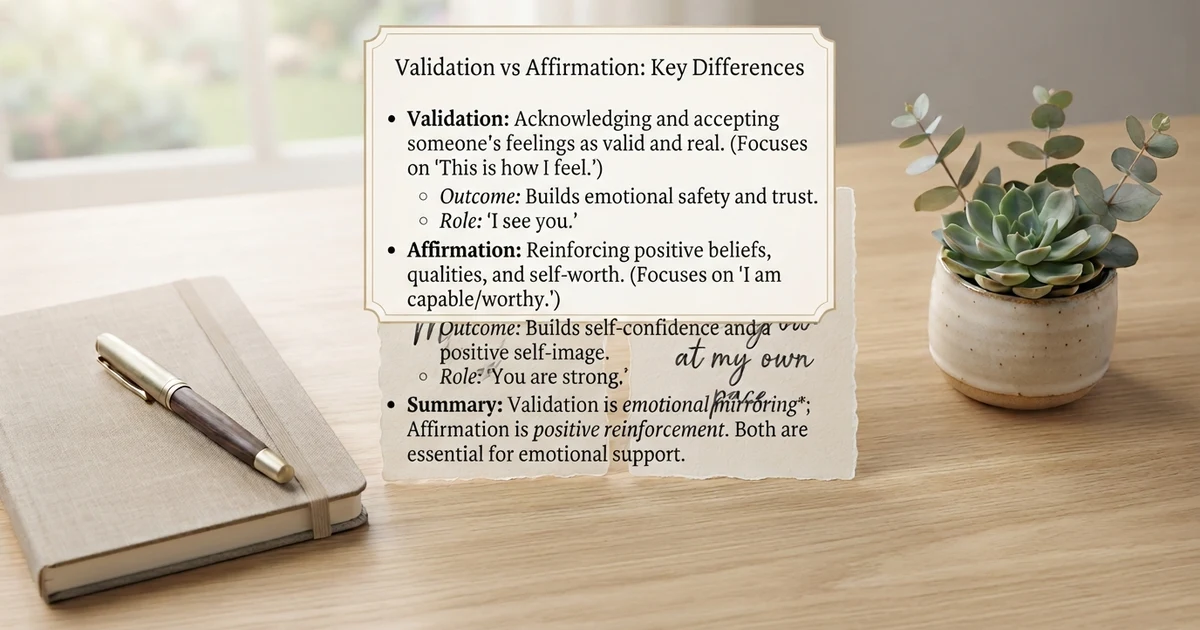
Validation vs Affirmation: Key Differences
Although validation and affirmation can both support self-awareness, their focus and purpose are different.
| Aspect | Validation | Affirmation |
|---|---|---|
| Main purpose | Acknowledge feelings and experiences | Encourage supportive beliefs and self-talk |
| Primary focus | What you are experiencing | What you want to reinforce or practice |
| Tone | Understanding and accepting | Encouraging and constructive |
| Typical wording | “It makes sense that I feel this way.” | “I can handle this one step at a time.” |
| Emotional approach | Makes room for difficult feelings | Supports confidence and personal growth |
| Best used when | You need acknowledgment or understanding | You want to reinforce a helpful mindset |
| Common mistake | Confusing acceptance with agreement | Forcing positivity or ignoring reality |
| Daily application | Naming emotions without judgment | Repeating meaningful, realistic statements |
The two practices are not competing approaches. They can complement each other when used thoughtfully.
Validation vs Affirmation Examples in Everyday Life
Understanding the difference becomes easier when you see how both practices apply to familiar situations.
1. After Making a Mistake
Validation
“I feel disappointed because I wanted to do better. It is understandable to feel this way.”
Affirmation
“I can learn from this experience and make a different choice next time.”
Validation acknowledges the disappointment, while affirmation encourages learning and future action.
2. When Feeling Nervous
Validation
“It makes sense that I feel nervous about something important to me.”
Affirmation
“I can prepare, take a deep breath, and approach this moment one step at a time.”
Both statements recognize the situation without demanding that nervousness disappear immediately.
3. When Feeling Unappreciated
Validation
“I feel hurt because being appreciated matters to me.”
Affirmation
“My worth does not depend entirely on whether others recognize my efforts.”
Validation identifies the emotional need, while affirmation reinforces self-respect.
4. During a Difficult Day
Validation
“Today has been challenging, and I am allowed to acknowledge that.”
Affirmation
“I can give myself permission to rest and begin again tomorrow.”
These statements allow you to recognize difficulty while maintaining a sense of possibility.
5. When Facing Change
Validation
“Change can feel uncomfortable, especially when I do not know what to expect.”
Affirmation
“I can adapt gradually and give myself time to adjust.”
The validation recognizes uncertainty, while the affirmation encourages patience and adaptability.
Short Validation vs Affirmation List for Daily Use
Sometimes, you need a simple sentence rather than a long explanation. The following list offers short validation and affirmation statements that you can save, copy, or revisit throughout the day.
15 Short Validation Statements
- My feelings matter.
- I can feel what I feel.
- My experience is valid.
- I deserve understanding.
- It is okay to need time.
- I can acknowledge my disappointment.
- My emotions deserve attention.
- I do not need to judge myself.
- My concerns are worth exploring.
- I can accept uncertainty.
- I am allowed to feel frustrated.
- My needs are important.
- I can be honest about my feelings.
- I do not have to minimize my experience.
- I can give myself compassion.
15 Short Affirmations
- I am capable.
- I am learning every day.
- I deserve kindness.
- I can take small steps.
- My growth matters.
- I trust myself to learn.
- I can begin again.
- I have meaningful strengths.
- I am worthy of respect.
- I can choose a thoughtful response.
- I welcome healthy progress.
- I can practice patience.
- I am allowed to grow.
- My efforts have value.
- I can move forward with intention.
Helpful reminder: Save the validation statements for moments when you need acknowledgment and the affirmations for moments when you want to reinforce supportive self-talk.
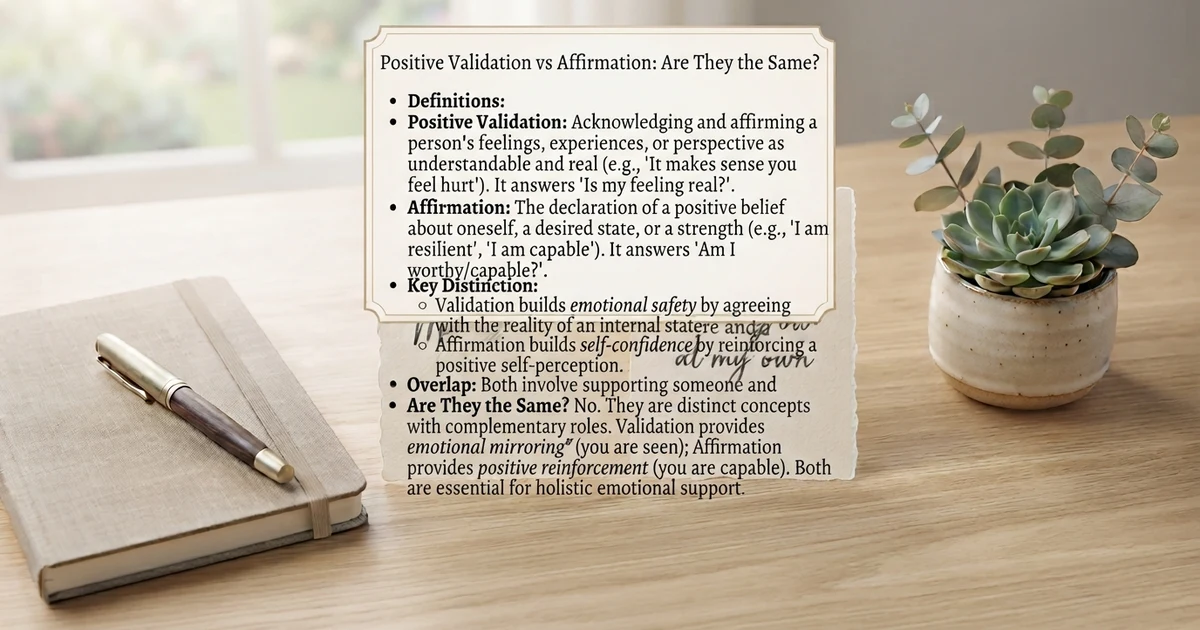
Positive Validation vs Affirmation: Are They the Same?
Positive validation and affirmation may sound alike because both can involve kind, encouraging language. However, the difference lies in their intention.
Positive validation acknowledges an experience in a supportive way. It does not require you to change your feelings or immediately find a solution.
An affirmation, on the other hand, reinforces a constructive belief or intention.
Consider these examples:
- Positive validation: “You have been trying hard, and it makes sense that you feel tired.”
- Affirmation: “I can recognize my efforts and give myself the rest I need.”
The first statement recognizes the person’s current experience. The second encourages a supportive response.
Positive validation can also be offered by another person. For example, a friend might say, “I understand why that situation was upsetting.” An affirmation is often a statement you choose to repeat to yourself, although people can also share affirmations with others.
Both can communicate care, but they are not interchangeable in every situation.
Validation vs Affirmation vs Reassurance
Validation, affirmation, and reassurance are related concepts, but each serves a slightly different purpose.
| Concept | Meaning | Example |
|---|---|---|
| Validation | Acknowledging an experience | “It makes sense that you feel uncertain.” |
| Affirmation | Reinforcing a supportive belief | “I can take things one step at a time.” |
| Reassurance | Offering comfort or confidence | “You do not have to figure everything out today.” |
Reassurance often comes from another person, although you can reassure yourself as well.
For example, if a student feels worried about an upcoming exam:
- Validation: “I feel nervous because this exam matters to me.”
- Affirmation: “I can prepare and do my best with what I know.”
- Reassurance: “One exam does not define my entire ability or future.”
Each statement addresses a different part of the experience.
How to Use Validation vs Affirmation Correctly
You do not need a complicated routine to practice validation and affirmation. A few intentional moments throughout the day can help you become more aware of your emotions and the way you speak to yourself.
Step 1: Identify What You Are Feeling
Before choosing a statement, pause and notice your emotional experience.
Ask yourself:
- What am I feeling right now?
- What happened before I started feeling this way?
- What do I need in this moment?
- Am I looking for understanding, encouragement, or both?
Naming your feelings can help you choose words that reflect your actual experience.
Step 2: Begin With Validation
If you are experiencing frustration, disappointment, nervousness, or uncertainty, start by acknowledging it.
For example:
“I feel overwhelmed because I have several responsibilities today.”
This statement recognizes the experience without criticizing you for having it.
Step 3: Choose a Believable Affirmation
Once you have acknowledged your feelings, consider whether a supportive affirmation would be useful.
For example:
“I can focus on one responsibility at a time.”
A realistic affirmation is often easier to connect with than a statement that feels completely disconnected from your current circumstances.
Step 4: Connect Your Words With an Action
Words can help you clarify your intentions, but meaningful change also involves choices and behavior.
After repeating an affirmation, ask yourself what small action would support it.
For example:
- Affirmation: “I can take care of my needs.”
- Action: Set aside a few minutes for a break.
- Affirmation: “I am capable of learning.”
- Action: Review one topic that you find challenging.
- Affirmation: “My boundaries matter.”
- Action: Communicate a reasonable limit respectfully.
This approach keeps affirmations connected to everyday life.
Step 5: Practice Without Pressure
You do not have to repeat statements perfectly or follow a strict schedule.
Some days, validation may be all you need. On other days, an affirmation may feel more helpful. You can also use both in the same conversation with yourself.
The purpose is to develop a more understanding and constructive inner voice, not to create another task you feel pressured to complete.
Common Mistakes to Avoid
Even supportive practices can become less helpful when they are misunderstood or used rigidly.
Here are some common mistakes to watch for.
1. Using Affirmations to Dismiss Feelings
Statements such as “I am happy all the time” may feel uncomfortable when you are experiencing sadness or frustration.
Instead, acknowledge your current feelings and choose an affirmation that allows room for them.
For example: “I can experience difficult emotions and still treat myself with care.”
2. Assuming Validation Means Agreement
Validating a feeling does not mean agreeing with every interpretation, assumption, or behavior connected to it.
You can acknowledge that someone feels hurt while still discussing what happened and considering different perspectives.
3. Choosing Unrealistic Affirmations
If an affirmation feels impossible to believe, it may be difficult to connect with.
Rather than forcing a statement, adjust it to reflect a realistic intention.
For example:
- Instead of: “I never feel nervous.”
- Try: “I am learning how to respond to nervousness with patience.”
4. Expecting Immediate Results
Validation and affirmation are practices, not instant solutions. They may support self-awareness and constructive self-talk, but they cannot guarantee a particular emotional outcome.
Allow yourself to explore what works without judging your progress.
5. Repeating Words Without Understanding Them
Simply repeating a phrase may not be meaningful if you do not understand what it represents.
Take a moment to connect your statement with your values, experiences, or personal goals.
For example, if you say, “I deserve respect,” consider how that belief might influence the way you communicate, make decisions, or establish boundaries.
Can You Use Validation and Affirmation Together?
Yes. Validation and affirmation can work together because they address different aspects of an experience.
Validation helps you recognize what is happening internally, while affirmation can help you choose a supportive perspective or next step.
A simple formula is:
Validation + Affirmation
First: Acknowledge
“I feel disappointed because things did not go as planned.”
Next: Encourage
“I can learn from this experience and decide what to do next.”
Finally: Take a small step
“I will review what happened and identify one thing I can improve.”
This approach creates space for emotional honesty, constructive thinking, and practical action.
You can use it in a journal, during a quiet moment, or whenever you want to respond to yourself with greater awareness.
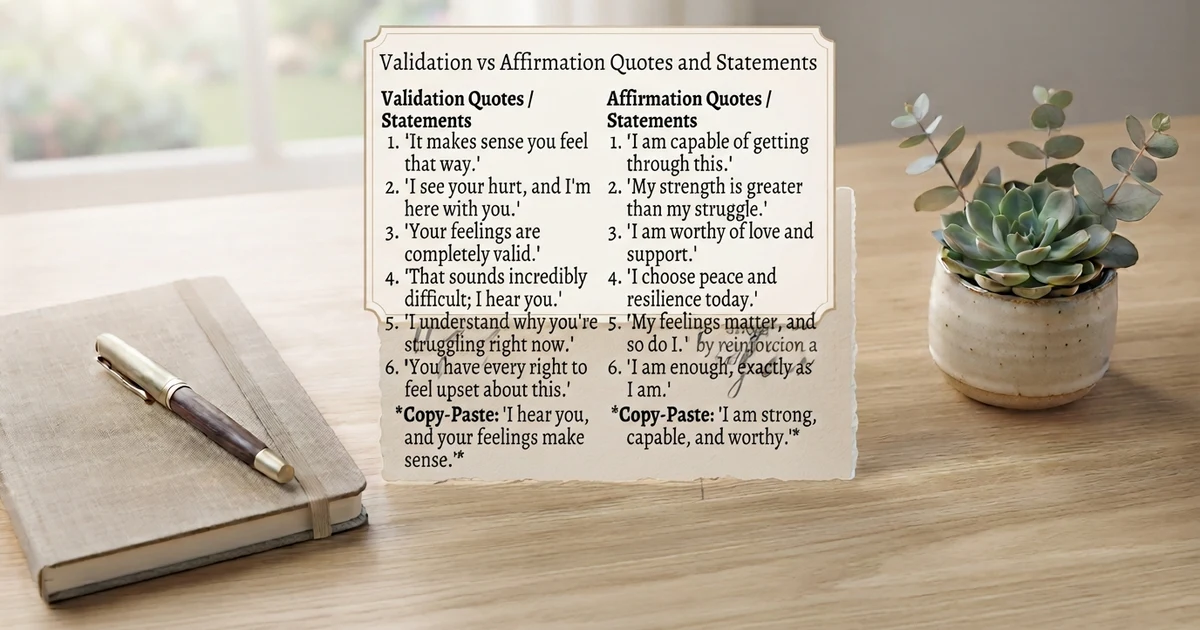
Validation vs Affirmation Quotes and Copy-and-Paste Statements
If you prefer short statements that are easy to remember, these examples combine the ideas of validation and affirmation in a natural way.
- “My feelings deserve understanding, and my future deserves hope.”
- “I can acknowledge what is difficult without losing sight of what is possible.”
- “I do not have to feel confident every moment to keep learning.”
- “My experiences matter, and I can choose how I respond to them.”
- “I can accept where I am while working toward where I want to be.”
- “I am allowed to feel uncertain and still take thoughtful steps.”
- “I can honor my emotions without letting one difficult moment define me.”
- “My progress does not have to look like anyone else’s.”
- “I deserve patience while I learn to understand myself.”
- “I can be honest about today and hopeful about tomorrow.”
These are original supportive statements rather than quotations attributed to outside authors.
Save This List
Daily reminder
Keep these three statements together for a simple daily practice:
- I can acknowledge my feelings without judging myself.
- I deserve kindness, even when things are difficult.
- I can take one meaningful step at a time.
Copy all three statements
Conclusion
Understanding validation vs affirmation can help you develop a more balanced and supportive relationship with yourself. Validation reminds you that your feelings and experiences deserve acknowledgment, while affirmation encourages constructive self-talk and personal growth. Neither requires you to ignore difficulties, force happiness, or pretend to have everything figured out. Instead, you can use both practices to recognize where you are and consider where you want to go. Start with one honest validating statement, add a believable affirmation when appropriate, and allow your actions to reflect the care and understanding you are learning to give yourself.
Frequently Asked Questions About Validation vs Affirmation
1. What is the main difference between validation and affirmation?
Validation acknowledges feelings, thoughts, or experiences as real and understandable. Affirmation uses supportive statements to reinforce a constructive mindset, self-belief, or personal intention. Validation focuses more on recognizing what you are experiencing, while affirmation focuses on what you want to encourage or practice.
2. Is validation better than affirmation?
Neither is universally better because they serve different purposes. Validation may be more appropriate when you need to acknowledge a difficult emotion, while affirmation may be useful when you want to reinforce confidence or a supportive belief. Your needs and circumstances can help determine which approach feels suitable.
3. Can affirmations be a form of validation?
Affirmations can include validating language, but not every affirmation is validation. For example, “My feelings matter” can function as a validating statement, while “I can work toward my goals” is primarily an affirmation. The purpose and context of the statement determine how it is being used.
4. What is an example of validation vs affirmation in a relationship?
Validation: “I understand why you felt hurt when that happened.” Affirmation: “I deserve respectful communication, and I can express my needs clearly.” The first acknowledges an emotional experience, while the second reinforces a personal belief and encourages constructive communication.
5. What is positive validation?
Positive validation is the act of acknowledging someone’s feelings or experiences with understanding and respect. It can involve recognizing their effort, listening without judgment, or confirming that their emotional response is understandable. It does not require agreeing with every conclusion or behavior.
6. What are short validation statements?
Short validation statements include “My feelings matter,” “I am allowed to need time,” “My experience is valid,” and “I can acknowledge my emotions.” These phrases can help you recognize your internal experience without immediately criticizing or dismissing it.
7. What are the best affirmations for daily use?
Useful daily affirmations are realistic, personally meaningful, and connected to your values. Examples include “I can learn from challenges,” “I deserve kindness,” “My progress matters,” and “I can take small steps toward my goals.” Choose statements that feel supportive rather than forced.
8. Can validation and affirmation be used together?
Yes. You can begin by validating your feelings and then use an affirmation to encourage a constructive response. For example, “I feel nervous about this change” acknowledges your experience, while “I can give myself time to adjust” reinforces patience and adaptability.
9. What is the difference between validation and reassurance?
Validation acknowledges that a feeling or experience is understandable. Reassurance offers comfort or confidence about a situation. For example, “It makes sense that you feel worried” is validation, while “You do not have to solve everything right now” is reassurance. Both can be supportive in different ways.
10. How can beginners practice validation and affirmation?
Start by identifying one feeling each day and acknowledging it without judgment. Then, if it feels helpful, choose one realistic affirmation that supports your values or next step. You can write both statements in a journal, save them on your phone, or repeat them during a quiet moment.