

Understanding the difference between confirmation and affirmation can make everyday communication clearer and help you choose the right words for your thoughts, writing, and personal growth.
Although these terms sound similar, they serve different purposes. Confirmation is generally about verifying information, acknowledging something, or establishing that a statement or event is true. Affirmation, on the other hand, involves expressing support, reinforcing a belief, or using positive self-talk to encourage a constructive mindset.
Both words have meaningful uses in daily life, but knowing when to use each one can prevent confusion. Whether you are learning their definitions, comparing examples, or looking for positive phrases to use every day, this guide explains confirmation vs affirmation in simple language.
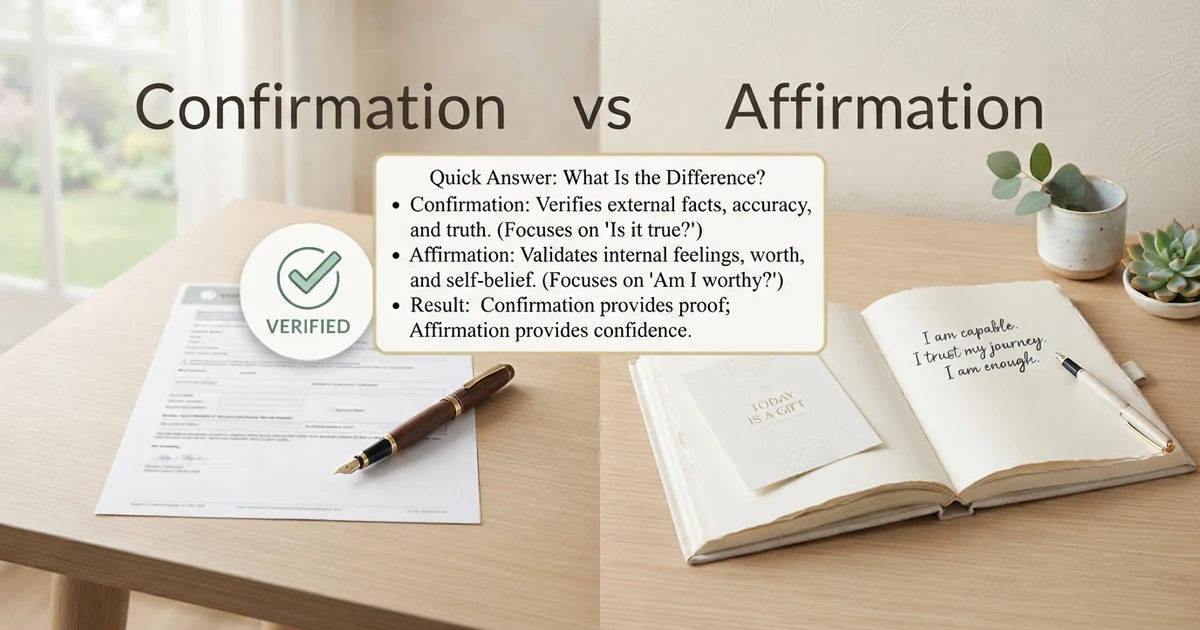
Quick Answer: What Is the Difference Between Confirmation and Affirmation?
Confirmation means verifying, approving, or acknowledging that something is correct, true, or has happened.
Affirmation means expressing support, reinforcing a belief, or stating something positively, often to encourage confidence and a helpful mindset.
For example:
- Confirmation: “Your appointment is confirmed for Monday.”
- Affirmation: “I am capable of handling new challenges.”
The simplest distinction is that confirmation establishes or acknowledges information, while affirmation reinforces a statement, belief, or positive perspective.
Confirmation vs Affirmation: Simple Definitions
Before exploring their differences, it helps to understand what each word means on its own.
What Is Confirmation?
Confirmation is the act of checking, verifying, or acknowledging that something is accurate, accepted, or established.
It is commonly used in communication, professional settings, appointments, and everyday situations where people need assurance about information.
Examples of confirmation include:
- Receiving confirmation of a reservation.
- Confirming that a meeting will take place.
- Getting confirmation that a payment was received.
- Acknowledging that a piece of information is correct.
- Confirming that someone has understood an instruction.
Confirmation focuses primarily on certainty, acknowledgment, and verification.
What Is Affirmation?
Affirmation is a positive statement or expression of support that reinforces a belief, value, or feeling.
In personal development, affirmations are often short statements people repeat or reflect on to encourage constructive thinking, self-awareness, and confidence.
Examples include:
- I believe in my ability to learn.
- I deserve kindness and respect.
- I can take things one step at a time.
- My efforts have value.
- I am allowed to grow at my own pace.
Affirmation focuses on positive reinforcement rather than simply verifying information.
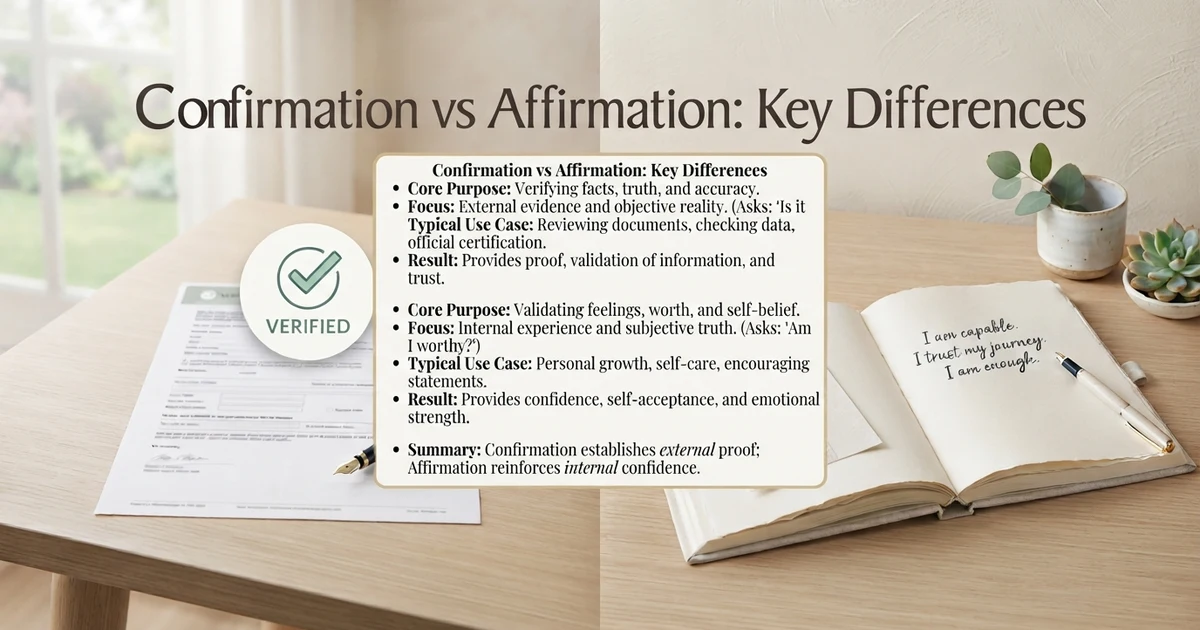
Confirmation vs Affirmation: Key Differences
Although confirmation and affirmation can both communicate agreement or support, their meanings and purposes are different.
| Feature | Confirmation | Affirmation |
|---|---|---|
| Main meaning | Verification or acknowledgment | Positive reinforcement or expression of belief |
| Primary purpose | Establish certainty | Strengthen a belief or supportive perspective |
| Common use | Appointments, information, decisions, communication | Personal growth, encouragement, self-talk |
| Focus | Accuracy, acceptance, or acknowledgment | Confidence, values, and positive thinking |
| Example | Your booking is confirmed. | I am making progress every day. |
| Typical context | Professional and everyday communication | Personal development and supportive communication |
| Main question | Is this correct or established? | What positive belief or value am I reinforcing? |
The most important difference is their function. Confirmation helps establish what is known or agreed upon, while affirmation communicates or reinforces a positive statement.
Confirmation vs Affirmation Examples in Everyday Life
Examples make the distinction easier to understand because the same general situation can involve both terms.
1. In Daily Communication
Confirmation:
“Please confirm that you received my message.”
This asks someone to acknowledge that a message arrived.
Affirmation:
“I appreciate the effort you put into communicating clearly.”
This expresses positive recognition and support.
2. In Education
Confirmation:
“The teacher confirmed the examination date.”
This communicates verified information.
Affirmation:
“I am capable of improving my understanding through practice.”
This reinforces a constructive belief about learning.
3. In the Workplace
Confirmation:
“Your attendance at the meeting has been confirmed.”
This establishes that participation is arranged.
Affirmation:
“My ideas and contributions have value.”
This expresses a positive perspective about one’s role.
4. In Personal Growth
Confirmation:
“I have confirmed that my application was submitted successfully.”
This verifies that an action has been completed.
Affirmation:
“I can learn from my experiences and continue moving forward.”
This encourages a growth-oriented mindset.
5. In Relationships
Confirmation:
“She confirmed that she would attend the family gathering.”
This acknowledges a decision or arrangement.
Affirmation:
“I value honest communication and mutual respect.”
This expresses a positive personal belief.
These examples show that confirmation generally relates to information or acknowledgment, whereas affirmation communicates encouragement, support, or a meaningful belief.
Short Confirmation vs Affirmation List
Here is a quick reference list you can save and revisit whenever you need to distinguish the two terms.
| Confirmation Examples | Affirmation Examples |
|---|---|
| Your order is confirmed. | I am worthy of respect. |
| The details have been verified. | I trust myself to keep learning. |
| Your appointment is scheduled. | I welcome new opportunities. |
| The payment has been received. | My efforts matter. |
| The information is correct. | I can approach challenges with patience. |
| Your registration is complete. | I am proud of my progress. |
| The meeting time is approved. | I can learn at my own pace. |
| Your request has been acknowledged. | I choose to speak kindly to myself. |
| The reservation is secured. | I deserve supportive relationships. |
| The results have been checked. | I can take meaningful steps toward my goals. |
Remember: Confirmation is about establishing or acknowledging something. Affirmation is about expressing or reinforcing a positive statement.
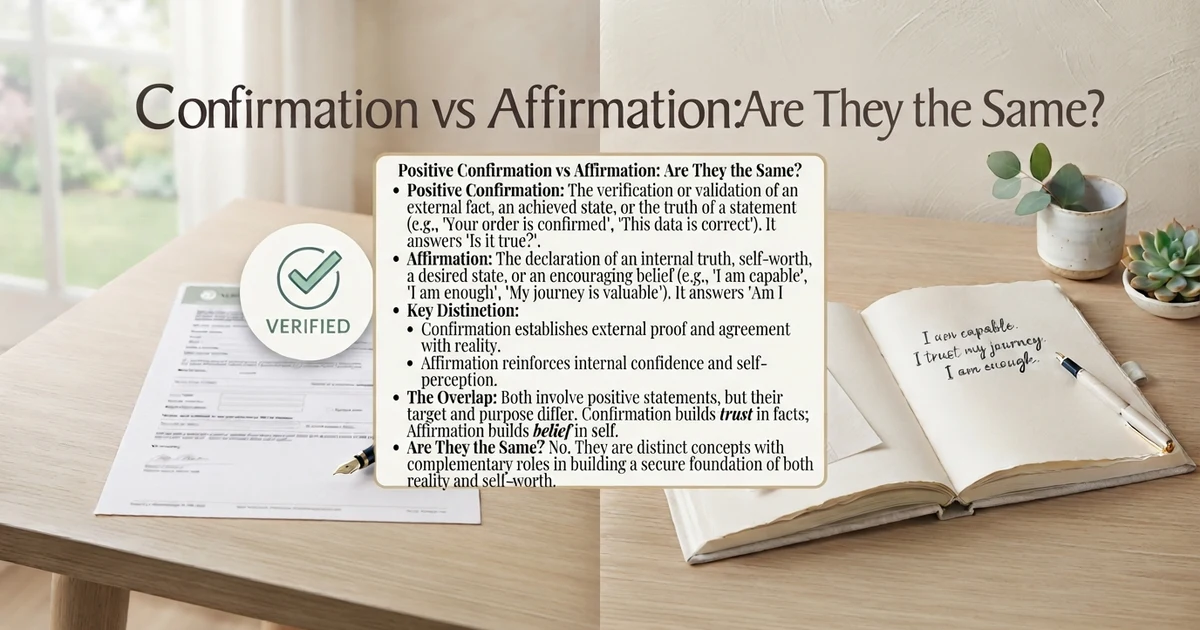
Positive Confirmation vs Affirmation: Are They the Same?
Positive confirmation and affirmation may sound alike because both can communicate reassurance or encouragement. However, they are not interchangeable in every situation.
Positive confirmation usually involves reassuring someone by acknowledging a fact, decision, action, or experience.
For example:
- “Yes, your work meets the requirements.”
- “You have successfully completed the assignment.”
- “Your concerns have been heard and acknowledged.”
These statements confirm or recognize something specific.
Affirmations are generally broader positive statements that reinforce beliefs, values, or self-perception.
For example:
- “I am capable of learning new skills.”
- “I deserve to be treated with kindness.”
- “I can recognize my progress, even when it feels small.”
The distinction depends on the purpose of the statement. If you are verifying something, confirmation is appropriate. If you are expressing a supportive belief, affirmation is generally the better choice.
Confirmation vs Affirmation Quotes and Statements
People sometimes use quotes and short statements to communicate reassurance, recognition, or encouragement. Understanding their purpose helps you identify whether they function as confirmation or affirmation.
Confirmation Statements
- “Your efforts have been acknowledged.”
- “The information has been verified.”
- “Your participation is confirmed.”
- “Your concerns have been heard.”
- “The decision has been approved.”
These statements provide acknowledgment or establish a specific fact.
Affirmation Statements
- “I am learning to trust my abilities.”
- “I can grow through consistent effort.”
- “My voice deserves to be heard.”
- “I welcome progress, even when it happens slowly.”
- “I can treat myself with patience and understanding.”
These statements reinforce positive beliefs and encourage constructive self-talk.
Statements That Can Serve Both Purposes
Some statements can function differently depending on their context.
For example, “You are making progress” can be confirmation when it describes an observed improvement. It can also be affirming when used to encourage someone who is learning a new skill.
Similarly, “Your feelings matter” may affirm someone’s emotional experience while also acknowledging their importance in a conversation.
The words themselves matter, but the speaker’s purpose and the surrounding context help determine their function.
Related Terms: Confirmation, Affirmation, Validation, and Verification
Confirmation and affirmation are sometimes confused with other words that communicate support, certainty, or recognition. Understanding these related terms makes their meanings easier to separate.
| Term | Meaning | Example |
|---|---|---|
| Confirmation | Establishing or acknowledging that something is correct or arranged | “Your appointment is confirmed.” |
| Affirmation | A positive statement or expression of support | “I am capable of learning.” |
| Validation | Recognizing that someone’s feelings, experiences, or concerns are understandable or meaningful | “It makes sense that you feel disappointed.” |
| Verification | Checking information or evidence to establish accuracy | “We verified the account details.” |
| Acknowledgment | Showing that something has been noticed or recognized | “Thank you for acknowledging my contribution.” |
| Reassurance | Offering words or information intended to reduce uncertainty or worry | “The team is working on your request.” |
These terms overlap in certain situations, but each has a distinct emphasis.
Confirmation and verification are especially closely related. Verification usually highlights the process of checking accuracy, while confirmation can refer to the resulting acknowledgment or established information.
Affirmation and validation can also overlap. However, affirmation often reinforces a positive belief or value, while validation focuses on recognizing someone’s experience or perspective.
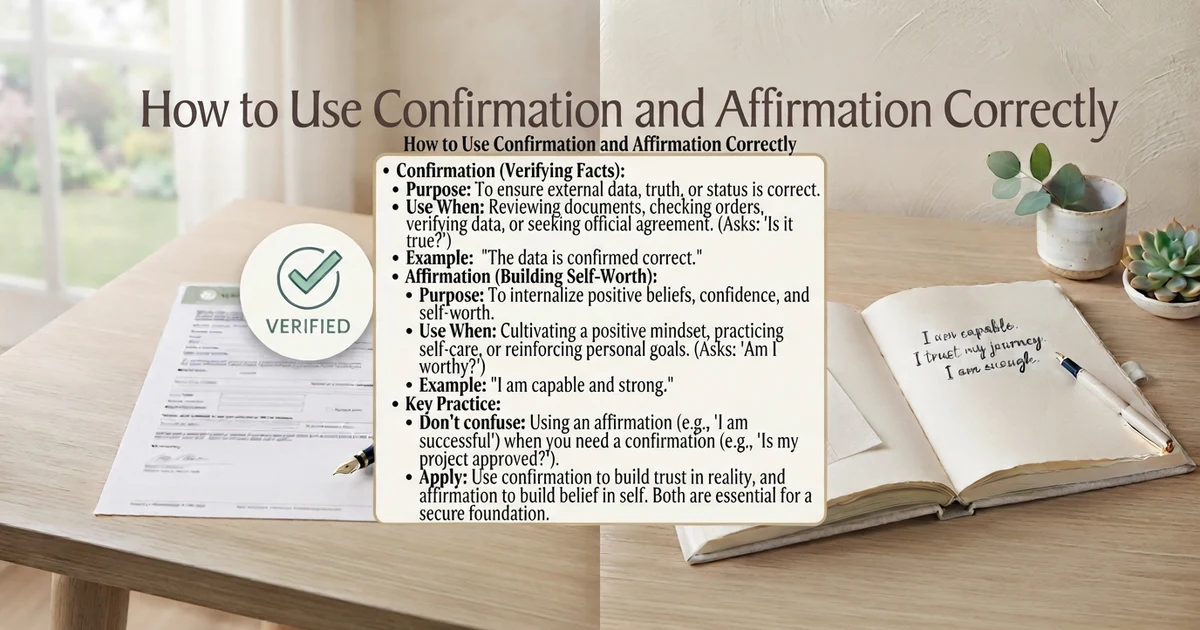
How to Use Confirmation and Affirmation Correctly
Choosing the right word becomes easier when you consider what you want your statement to accomplish.
Use Confirmation When You Need to Establish Information
Choose confirmation when you are:
- Checking whether something is correct.
- Acknowledging that a request has been received.
- Verifying an appointment or arrangement.
- Communicating an approved decision.
- Establishing that a task has been completed.
Example: “I am writing to request confirmation of my registration.”
Use Affirmation When You Want to Reinforce a Positive Belief
Choose affirmation when you are:
- Expressing encouragement.
- Practicing positive self-talk.
- Reinforcing personal values.
- Recognizing someone’s strengths.
- Supporting a constructive mindset.
Example: “I am learning to recognize my strengths and use them with confidence.”
Ask Yourself One Simple Question
Before choosing between the terms, consider your intention:
- Do I need to verify or acknowledge information? Use confirmation.
- Do I want to express support or reinforce a belief? Use affirmation.
This simple distinction works in most everyday situations.
How to Use Affirmations Naturally in Daily Life
If your interest in confirmation vs affirmation comes from personal development, it is helpful to understand how affirmations can fit into an ordinary routine.
Affirmations do not need to sound dramatic or overly positive. The most useful statements are often simple, believable, and connected to real experiences.
1. Choose Words That Feel Realistic
Instead of forcing yourself to believe something that feels completely disconnected from your experience, choose a statement that reflects a direction you want to move toward.
For example:
- “I am learning to become more confident.”
- “I can improve through practice.”
- “I am allowed to make mistakes while learning.”
These statements acknowledge growth without demanding perfection.
2. Connect Affirmations to Your Values
Choose affirmations that reflect what matters to you, such as kindness, patience, learning, honesty, or personal responsibility.
Examples:
- I value honesty in my words and actions.
- I can practice patience with myself and others.
- I want my decisions to reflect my values.
- I can make time for meaningful priorities.
3. Pair Positive Self-Talk With Action
Affirmations can support a constructive mindset, but they are not substitutes for practical steps.
For example, saying “I am becoming more organized” can be paired with making a simple daily plan.
Similarly, “I can improve my communication” can be paired with listening carefully and practicing clear expression.
4. Keep Your Statements Short
Short affirmations are easier to remember and revisit throughout the day.
Try statements such as:
- I can keep learning.
- My efforts matter.
- I choose patience.
- I can ask for help.
- I welcome steady progress.
5. Adjust Your Words as You Grow
Your needs and priorities may change over time. An affirmation that feels meaningful today may need to be updated later.
Review your statements occasionally and choose words that reflect your current goals, experiences, and values.
Common Mistakes When Comparing Confirmation vs Affirmation
Even though the difference is straightforward, several common misunderstandings can make these words confusing.
Mistake 1: Assuming Both Words Mean Agreement
Confirmation can communicate agreement or acknowledgment, but affirmation is not simply another word for agreement.
Affirmation can express support, encouragement, or a positive belief without verifying a specific fact.
Mistake 2: Treating Affirmations as Proof
An affirmation is a positive statement, not automatic evidence that something is true.
For example, saying “I am prepared for this task” can encourage confidence, but actual preparation still depends on learning, practice, and relevant work.
Mistake 3: Using Confirmation When You Mean Encouragement
If you want to support someone emotionally, a statement of affirmation may communicate your intention more clearly than a formal confirmation.
For example, “I believe in your ability to learn” expresses encouragement more directly than “Your ability is confirmed.”
Mistake 4: Making Affirmations Unrealistic
Statements that feel impossible to accept may be difficult to use meaningfully.
Instead of focusing on absolute claims, choose language that allows room for learning and progress.
Mistake 5: Ignoring Context
A word can have different nuances depending on the situation.
In professional communication, confirmation often refers to arrangements or verified information. In personal development, affirmation commonly refers to supportive self-talk.
Always consider the context before deciding which word fits.
Confirmation vs Affirmation for Beginners: A Simple Memory Guide
If you are still unsure which term to use, remember these two definitions:
Confirmation
“This is established or acknowledged.”
Confirmation helps communicate certainty, verification, or recognition.
Example: Your appointment is confirmed.
Affirmation
“This is a positive belief or statement.”
Affirmation expresses support, encouragement, or a meaningful belief.
Example: I am capable of learning and growing.
You can also remember the difference through their most common uses:
- Confirmation: information, arrangements, acknowledgment, and certainty.
- Affirmation: beliefs, encouragement, positive self-talk, and personal values.
Once you understand their purpose, choosing between the words becomes much more natural.
Conclusion: Confirmation vs Affirmation
The difference between confirmation vs affirmation comes down to purpose. Confirmation is used to verify, establish, or acknowledge information, while affirmation expresses support or reinforces a positive belief. Both are valuable forms of communication, but they serve different needs.
Understanding these distinctions can help you write more clearly, communicate with confidence, and use positive statements more intentionally. When you need to establish that something is correct or arranged, choose confirmation. When you want to encourage yourself or reinforce a meaningful belief, choose affirmation.
Save this list as a quick reference, and revisit the examples whenever you need help choosing the right word.
Frequently Asked Questions
1. What is the main difference between confirmation and affirmation?
Confirmation involves verifying or acknowledging information, while affirmation involves expressing support or reinforcing a positive belief. Confirmation establishes certainty about something, whereas affirmation communicates encouragement, recognition, or a meaningful statement.
2. Is confirmation the same as affirmation?
No. Although both terms can involve acknowledgment or support, they have different meanings. Confirmation generally relates to accuracy, acceptance, or verification. Affirmation generally relates to positive statements, beliefs, and encouragement.
3. What is an example of confirmation vs affirmation?
An example of confirmation is “Your application has been received and approved.” An example of affirmation is “I am capable of learning new skills.” The first acknowledges an established outcome, while the second reinforces a positive belief.
4. Can an affirmation also be a confirmation?
Yes, depending on the context. A statement such as “You have made meaningful progress” can confirm an observed improvement and also serve as encouragement. However, the two terms do not mean the same thing in every situation.
5. What is the difference between affirmation and validation?
Affirmation usually involves expressing a positive belief or reinforcing a statement. Validation involves recognizing that someone’s feelings, experiences, or concerns are understandable or meaningful. Both can communicate support, but their emphasis is different.
6. Are positive affirmations always true?
Affirmations are positive statements, but repeating one does not automatically make it a verified fact. For personal development, it can be helpful to choose realistic statements that reflect your values, acknowledge your current experience, and encourage constructive action.
7. What are some short affirmations for daily use?
Here are a few simple examples:
- I can keep learning.
- My efforts matter.
- I deserve kindness.
- I can take things slowly.
- I am open to growth.
- I can make thoughtful choices.
- I value my progress.
These statements can be adapted to reflect your personal goals and circumstances.
8. When should I use confirmation instead of affirmation?
Use confirmation when you need to verify information, acknowledge a request, establish an arrangement, or communicate that something has been completed. For example, “Please confirm your attendance” is appropriate when asking someone to verify their participation.
9. Can affirmations help build confidence?
Affirmations may support confidence by encouraging constructive self-talk and helping people focus on their strengths, values, and efforts. Their usefulness can depend on whether the statements feel believable and are supported by practical actions and experiences.
10. How can I remember confirmation vs affirmation easily?
Remember that confirmation is about establishing or acknowledging something, while affirmation is about expressing or reinforcing a positive belief. If you are checking information, think confirmation. If you are offering encouragement or practicing positive self-talk, think affirmation.