

Negative affirmation is a statement that expresses a discouraging, self-critical, or limiting belief about yourself, your abilities, or your situation. Unlike positive affirmations, which are designed to support constructive self-talk, negative affirmations often repeat thoughts such as “I am not good enough” or “I always fail.”
Understanding a negative affirmation can help you notice unhelpful thought patterns and replace them with more balanced and supportive language. This guide explains the negative affirmation meaning, provides simple examples, compares negative and positive affirmations, and shows how to use affirmation language more naturally.
Quick Answer: What Is a Negative Affirmation?
A negative affirmation is a repeated statement that reinforces an unwanted, discouraging, or limiting belief.
For example:
- “I am not capable.”
- “I always make mistakes.”
- “Nobody likes me.”
- “I will never improve.”
- “I am not good enough.”
These statements can sound like ordinary thoughts, but repeating them regularly can make negative self-talk feel more familiar. The goal is not to criticize yourself for having these thoughts. Instead, noticing them can help you choose more realistic and supportive alternatives.
Negative Affirmation Meaning and Definition
The negative affirmation meaning is simple: it refers to a statement that repeatedly reinforces a negative idea about yourself, another person, or a situation.
An affirmation is generally a short statement that is repeated to reinforce a particular thought or belief. The word “affirmation” itself does not automatically mean that the statement is positive.
For example, both of these are affirmations in the broad sense:
- “I am capable of learning.”
- “I am incapable of learning.”
The first supports a constructive belief, while the second reinforces a limiting one.
Negative affirmations are often connected to negative self-talk. They may develop from repeated criticism, disappointment, fear, comparison, or past experiences.
Recognizing this difference is useful because a person may repeat a negative statement without realizing that it has become part of their everyday inner dialogue.
Negative Affirmation Examples
Negative affirmations can appear in many areas of everyday life. Some focus on confidence, while others relate to work, relationships, appearance, learning, or personal goals.
Here are some simple negative affirmation examples:
Confidence
- “I am not confident.”
- “I cannot do difficult things.”
- “Other people are better than me.”
- “I always doubt myself.”
- “I am not capable enough.”
Work and Goals
- “I will never succeed.”
- “I always get things wrong.”
- “I cannot reach my goals.”
- “I am not talented enough.”
- “My work is never good enough.”
Learning
- “I am bad at learning.”
- “I cannot understand this.”
- “I always fail tests.”
- “I am not smart enough.”
- “I will never get better at this.”
Social Situations
- “Nobody wants to talk to me.”
- “People do not like me.”
- “I always say the wrong thing.”
- “I do not fit in.”
- “Everyone is judging me.”
These examples are not facts. They are examples of the kind of absolute or discouraging statements that can become negative self-talk.

Short Negative Affirmation List
Short statements can be especially easy to recognize because they may appear repeatedly in everyday thinking.
Here is a simple negative affirmation list:
- I am not good enough.
- I always fail.
- I cannot do this.
- I am not capable.
- I never improve.
- I make everything worse.
- I am not confident.
- I cannot succeed.
- I always get things wrong.
- Nobody understands me.
- I am not talented.
- I cannot change.
- I am too afraid to try.
- I will never improve.
- I am not worthy of success.
- I cannot handle challenges.
- I am always behind.
- I never make the right choice.
- I am not strong enough.
- Nothing I do is good enough.
If you recognize one of these statements in your own thoughts, that does not mean the statement is true. It simply gives you an opportunity to examine the thought more carefully.
Negative Affirmation Quotes and Common Phrases
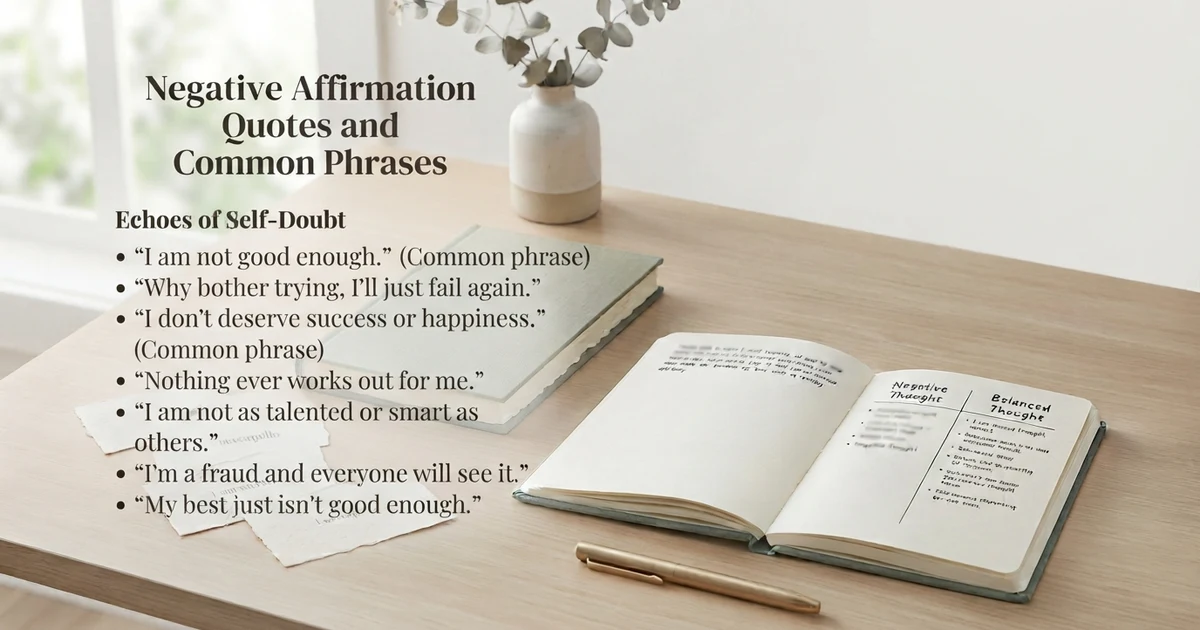
Negative affirmation quotes often use absolute words such as always, never, nobody, nothing, or impossible.
For example:
- “I always fail.”
- “I never get anything right.”
- “Nobody likes me.”
- “Nothing will ever change.”
- “I can never improve.”
- “I am destined to fail.”
- “I am not capable of anything.”
- “I will always struggle.”
These phrases can sound convincing when someone is frustrated or disappointed. However, words such as “always” and “never” can turn one difficult experience into a much broader conclusion.
A more balanced approach is to describe the specific situation instead of making a permanent statement about yourself.
For example:
Negative: “I always fail at this.”
More balanced: “This attempt did not go the way I wanted, but I can learn from it.”
The second statement does not pretend that everything is perfect. It simply leaves room for learning and change.
Positive vs. Negative Affirmation
Positive and negative affirmations differ mainly in the type of belief they reinforce.
| Negative affirmation | Positive or balanced alternative |
|---|---|
| I cannot do this. | I can take this one step at a time. |
| I always fail. | I can learn from mistakes. |
| I am not good enough. | I am learning and improving. |
| Nobody likes me. | I can build supportive connections. |
| I am not capable. | I can develop my skills with practice. |
| I will never improve. | I can improve gradually. |
| I always get things wrong. | I can correct mistakes and try again. |
| I cannot handle challenges. | I can work through challenges step by step. |
The goal is not to replace every difficult thought with an unrealistic statement. Helpful affirmations are generally more believable when they acknowledge the present situation while leaving room for growth.
Positive Negative Affirmation: What Does It Mean?
The phrase positive negative affirmation can be confusing because “positive” and “negative” describe opposite directions in this context.
Sometimes people use the phrase to describe an affirmation that takes a negative thought and reframes it into something more constructive.
For example:
Negative thought:
“I am terrible at speaking in front of people.”
Constructive reframe:
“I can become more comfortable with speaking through practice.”
This does not mean pretending that nervousness does not exist. Instead, it changes an absolute negative statement into a more realistic statement focused on possibility and action.
A useful affirmation should feel believable enough to repeat. If a statement feels completely disconnected from reality, a smaller and more practical version may be easier to use.
Negative Affirmation Copy and Paste Examples
If you are collecting examples for a worksheet, educational activity, or personal reflection, these negative affirmation copy and paste examples can help identify common patterns:
- I am not capable.
- I cannot succeed.
- I always make mistakes.
- I am not confident.
- I will never improve.
- I cannot learn this.
- I am not talented enough.
- Nobody appreciates me.
- I always get things wrong.
- I cannot handle this challenge.
- I am not good enough.
- I will never reach my goals.
- I am afraid to try.
- I cannot change.
- Nothing I do matters.
For personal use, these statements are best treated as examples to recognize and examine, rather than statements to reinforce.

How to Use Negative Affirmations Correctly
Negative affirmations are generally more useful as something to identify and reframe rather than deliberately repeat as self-talk.
Here is a simple process:
1. Notice the Statement
Pay attention to the words that appear in your self-talk.
For example:
“I can never get this right.”
Instead of immediately accepting the statement, pause and notice it.
2. Look for Absolute Language
Watch for words such as:
- Always
- Never
- Nobody
- Nothing
- Impossible
- Everyone
- Completely
These words can make a temporary situation sound permanent.
3. Ask What Actually Happened
Separate the specific event from the conclusion.
Instead of:
“I always fail.”
Consider:
“This particular attempt did not work.”
That creates a more accurate starting point.
4. Create a Balanced Alternative
Turn the original statement into something realistic.
For example:
Original: “I cannot learn this.”
Balanced: “I do not understand this yet, but I can practice.”
The new statement does not require pretending that learning is easy. It simply leaves room for progress.
5. Add a Small Action
Affirmations can be more useful when connected to behavior.
For example:
“I can improve my writing by practicing one paragraph today.”
This combines supportive self-talk with a specific action.
Best Negative Affirmation Examples to Recognize
There is no single “best” negative affirmation to repeat because negative statements are generally not intended as a positive self-talk practice. However, some examples are particularly useful for recognizing common negative thinking patterns.
All-or-Nothing Statements
“I either do this perfectly or I am a failure.”
Permanent Statements
“I will never get better.”
Self-Labeling Statements
“I am a failure.”
Comparison Statements
“Everyone is better than me.”
Mind-Reading Statements
“Everyone thinks I am not good enough.”
Future-Based Statements
“I know I will fail.”
Recognizing these patterns can make it easier to replace them with statements that are specific, flexible, and realistic.

Negative Affirmation for Daily Use: What to Watch For
Negative self-talk can show up during ordinary activities, so you may notice it in situations such as studying, working, socializing, or trying something new.
For example:
Morning:
“I am going to have a terrible day.”
Before studying:
“I will never understand this.”
After a mistake:
“I always ruin everything.”
Before speaking to someone:
“They will not like me.”
After receiving criticism:
“I am bad at everything.”
Instead of treating these statements as predictions or facts, identify what happened and consider a more balanced interpretation.
A simple daily reminder could be:
“A difficult moment does not define my entire ability or future.”
Negative Affirmation vs. Negative Self-Talk
The terms negative affirmation and negative self-talk are closely related, but they are not always identical.
Negative self-talk refers broadly to discouraging or critical thoughts and internal dialogue.
Negative affirmation can refer to a negative statement that is repeated or reinforced, particularly when it becomes a familiar belief or phrase.
For example, thinking “I made a mistake” after an error is not necessarily a negative affirmation. Repeatedly telling yourself “I always make mistakes and cannot do anything right” is much more strongly aligned with negative self-talk and a negative affirmation pattern.
The difference is often the repetition, wording, and belief attached to the statement.
Common Mistakes When Using Affirmations
Understanding negative affirmation can also help prevent common mistakes with positive self-talk.
Using Statements You Do Not Believe
If you strongly believe “I cannot do this” and suddenly repeat “I am perfect at everything,” the statement may feel unrealistic.
Try something more believable:
“I can learn this with practice.”
Ignoring Real Problems
Affirmations should not be used to pretend that genuine problems do not exist.
If something needs a practical solution, pair supportive self-talk with action.
Using Absolute Language
Statements containing “always” or “never” can make situations feel permanent.
More specific language is often easier to believe.
Repeating Criticism Without Questioning It
A thought can feel familiar without being accurate.
Instead of automatically believing a repeated thought, ask whether it describes the entire situation.
Treating Affirmations as a Substitute for Help
Affirmations can be a simple self-talk practice, but they are not a replacement for professional support when someone is dealing with serious emotional or mental health concerns.
How to Turn a Negative Affirmation Into a Helpful Statement
A simple three-part formula can make reframing easier:
Notice → Question → Reframe
For example:
Negative affirmation:
“I am terrible at everything.”
Question:
“Is that literally true, or am I focusing on one difficult situation?”
Reframe:
“I am struggling with this particular task, but I can improve with practice.”
Another example:
Negative affirmation:
“I will never succeed.”
Reframe:
“I do not know exactly how things will turn out, but I can keep working toward my goal.”
The strongest replacement is not necessarily the most dramatic one. It is often the statement that feels both supportive and believable.

Negative Affirmation Examples for Beginners
If you are new to the topic, start by simply learning to identify the pattern.
Look for statements that:
- Put yourself down.
- Predict failure as a certainty.
- Turn one mistake into a general rule.
- Compare you unfairly with other people.
- Treat a temporary problem as permanent.
- Use words such as “always” and “never.”
- Ignore evidence that contradicts the negative belief.
You do not need to challenge every thought immediately. Even noticing the difference between a fact and a self-critical interpretation can be a useful first step.
Conclusion
A negative affirmation is a repeated statement that reinforces a discouraging, limiting, or self-critical belief. Examples include “I always fail,” “I am not capable,” and “I will never improve.” Learning to recognize these statements can help you separate temporary difficulties from broad conclusions about yourself.
Rather than repeating negative affirmations as facts, use them as examples to identify unhelpful self-talk. Then try creating alternatives that are realistic, supportive, and connected to practical action. Save this list if you want a simple reference for recognizing and reframing negative affirmation patterns.
Frequently Asked Questions About Negative Affirmation
What is a negative affirmation?
A negative affirmation is a repeated statement that reinforces a discouraging, limiting, or self-critical belief. Examples include “I am not capable” and “I will never improve.”
Are negative affirmations the same as negative thoughts?
They can overlap, but they are not exactly the same. A negative thought may occur once, while a negative affirmation usually refers to a statement that is repeated or reinforced.
Can negative affirmations affect self-talk?
Repeated negative statements can become familiar patterns of self-talk. Recognizing them can help you examine whether the statements are accurate and develop more balanced alternatives.
What is an example of a negative affirmation?
“I always fail” is a simple example. It takes a negative conclusion and presents it as a permanent pattern.
How can I change a negative affirmation?
First notice the statement, then question whether it is completely accurate. Replace it with a specific and realistic statement that leaves room for learning or change.
What is the opposite of a negative affirmation?
A positive or constructive affirmation generally expresses a supportive belief, such as “I can learn from mistakes and keep improving.”
Can a negative affirmation be turned into a positive affirmation?
Yes. For example, “I cannot do this” can become “I can learn this step by step.” The goal is to create a statement that is encouraging without being unrealistic.
Are negative affirmations useful?
They can be useful as examples for recognizing negative self-talk and limiting beliefs. They are generally not used as a practice for reinforcing discouraging beliefs.
Why do people repeat negative statements about themselves?
Negative statements can develop from habits of self-criticism, difficult experiences, fear, comparison, or repeated messages from other people. A repeated thought can feel familiar without necessarily being true.
Can I make a printable negative affirmation list?
Yes. A list can be useful for educational purposes, journaling, or identifying negative self-talk patterns. You can create two columns: the negative statement and a more balanced alternative.