

Understanding the difference between affirmation vs confirmation can help you communicate more clearly, use positive self-talk naturally, and recognize how these two words work in everyday life. Although affirmation and confirmation may sound similar, they serve different purposes. An affirmation is a statement that expresses support, encouragement, or a belief, while a confirmation verifies that something is true, correct, or has happened. Both have a place in daily communication, but knowing when to use each one makes a difference. This guide explains their meanings, provides simple examples, compares their uses, and shares practical ways to understand the distinction.
Quick Answer: What Is the Difference Between Affirmation vs Confirmation?
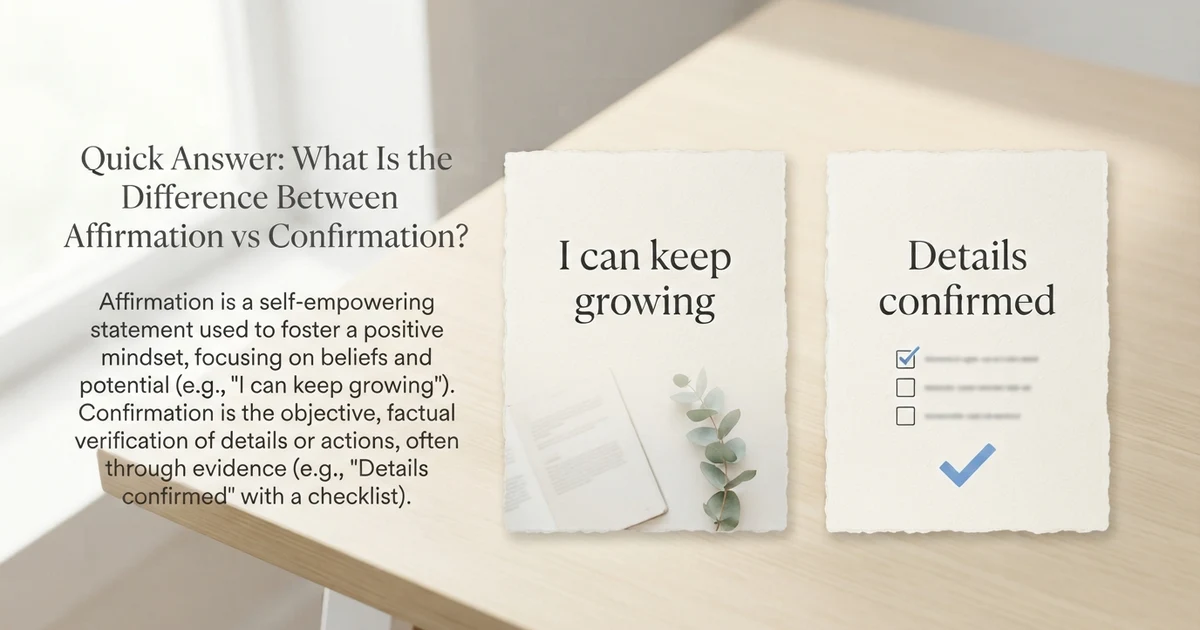
The main difference between affirmation and confirmation is their purpose.
- Affirmation is a positive or supportive statement that reinforces a belief, value, feeling, or sense of self.
- Confirmation is an acknowledgment or verification that something is accurate, agreed upon, or completed.
For example:
- Affirmation: “I am capable of learning new things.”
- Confirmation: “Your appointment is confirmed for Monday.”
An affirmation can encourage a person or reinforce a personal belief. A confirmation provides information or establishes that something is correct.
In simple terms, affirmation supports or expresses a belief, while confirmation verifies or acknowledges something.
Affirmation vs Confirmation Meaning and Definitions
To understand affirmation vs confirmation, it helps to examine each word separately. Both are related to expressing or establishing something, but their meanings differ depending on the situation.
What Is an Affirmation?
An affirmation is a statement that expresses agreement, support, encouragement, or a belief. In personal development, affirmations are commonly used as positive self-talk to reinforce helpful thoughts and attitudes.
For example:
- I am worthy of kindness and respect.
- I can learn from my mistakes.
- I deserve to give myself time to grow.
- I can approach challenges with patience.
- My voice and opinions matter.
These statements are affirmations because they express supportive beliefs about oneself.
Affirmations can also be used outside personal development. A person might affirm someone’s decision, acknowledge a value, or express agreement with a statement.
What Is a Confirmation?
A confirmation is an act or statement that verifies something, establishes its accuracy, or acknowledges that an arrangement has been made.
For example:
- Your payment has been confirmed.
- The meeting is confirmed for Thursday.
- Please send confirmation of your attendance.
- The results confirmed the earlier information.
- I received confirmation of the booking.
These statements provide acknowledgment or verification rather than encouragement.
Simple Difference Between the Two
| Affirmation | Confirmation |
|---|---|
| Expresses support or a belief | Verifies or acknowledges something |
| Often used for encouragement | Often used for accuracy or agreement |
| Can reinforce positive self-talk | Can establish that something is correct |
| Example: I am learning every day. | Example: Your registration is complete. |
| Focuses on belief or support | Focuses on verification or acknowledgment |
The distinction becomes clearer when you consider the purpose behind a statement rather than just its wording.
Affirmation vs Confirmation Examples in Everyday Life
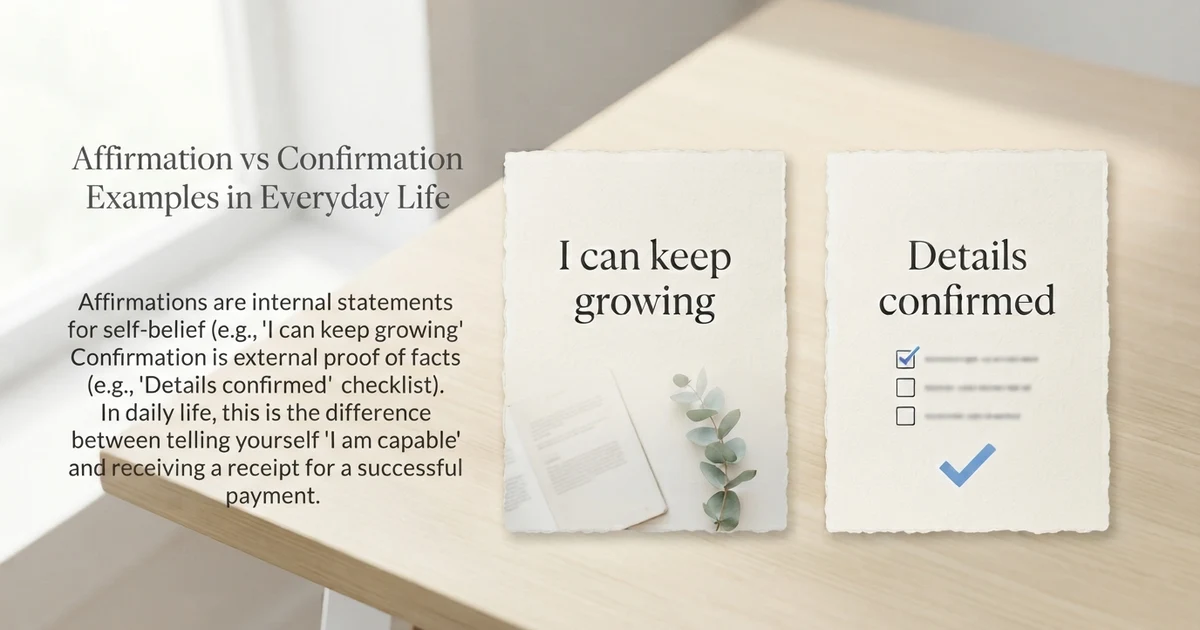
Everyday examples make the difference easier to recognize. Affirmations often appear in personal reflection, supportive conversations, and motivational writing. Confirmations are more common in scheduling, communication, transactions, and situations where information needs to be verified.
Here are examples from different settings.
Personal Development Examples
Affirmations:
- I trust myself to make thoughtful decisions.
- I can handle new experiences one step at a time.
- I am allowed to learn at my own pace.
- I recognize the progress I have made.
- I can choose a more helpful perspective.
Confirmations:
- I confirmed my participation in the workshop.
- The details of the application are correct.
- My registration has been accepted.
- The information matches the original document.
- I received confirmation of the scheduled session.
Workplace Examples
Affirmations:
- I bring useful ideas to my team.
- I can improve through practice.
- My contributions have value.
- I can communicate my thoughts clearly.
Confirmations:
- The manager confirmed the deadline.
- The team received confirmation of the updated schedule.
- The client confirmed the project requirements.
- The report confirms the previously discussed figures.
Relationship Examples
Affirmations:
- I deserve honest and respectful communication.
- I can express my feelings thoughtfully.
- My boundaries are important.
- I value kindness in my relationships.
Confirmations:
- She confirmed that she would attend the event.
- He acknowledged and confirmed the agreed plans.
- They confirmed their availability for the weekend.
- We received confirmation of the reservation.
These examples show that affirmations and confirmations can both appear in personal and professional settings, but they communicate different things.
Positive Affirmation vs Confirmation: Are They the Same?
A positive affirmation and a confirmation are not the same, even when both sound reassuring.
A positive affirmation is designed to express a constructive belief or supportive perspective. A confirmation establishes that information, an arrangement, or a claim has been acknowledged or verified.
Consider these statements:
- “I am capable of making progress.” This is a positive affirmation.
- “I have completed the first part of my project.” This is a confirmation of an action.
- “I can approach tomorrow with confidence.” This is an affirmation.
- “Tomorrow’s appointment is confirmed.” This is a confirmation.
The first and third statements express personal beliefs or intentions. The second and fourth establish information about something that has happened or been arranged.
Can a Confirmation Be Positive?
Yes. A confirmation can communicate positive news, but that does not automatically make it an affirmation.
For example, “Your application has been approved” is positive information. However, it is a confirmation because it verifies a decision.
Similarly, “You have made meaningful progress” can be an affirmation when used to encourage someone, or a factual acknowledgment when it refers to verified progress.
The context and intention determine how a statement functions.
Short Affirmation vs Confirmation List for Daily Use
The following list offers simple examples you can save, copy, or use to understand the difference in everyday communication.
15 Short Affirmations
- I am capable.
- I can keep learning.
- My efforts matter.
- I deserve respect.
- I trust my growth.
- I can begin again.
- I welcome new opportunities.
- I am allowed to rest.
- I can make thoughtful choices.
- I value my progress.
- I can learn from today.
- My voice matters.
- I choose patience.
- I can take small steps.
- I believe in my ability to grow.
15 Short Confirmations
- Your appointment is confirmed.
- The payment was received.
- Your registration is complete.
- The meeting is scheduled.
- Your attendance is confirmed.
- The details are correct.
- The booking is verified.
- Your request was approved.
- The document was received.
- The deadline has been confirmed.
- The information is accurate.
- Your order has been processed.
- The changes are approved.
- The results match the records.
- Your participation is acknowledged.
Copy-and-Paste Comparison
| Affirmation | Confirmation |
|---|---|
| I am ready to learn. | The lesson is scheduled. |
| I can handle this challenge. | The task has been assigned. |
| I deserve positive relationships. | The meeting has been confirmed. |
| I trust my ability to improve. | The results have been verified. |
| I can make meaningful progress. | The project is officially complete. |
Save this list as a quick reference whenever you need to distinguish supportive self-talk from factual acknowledgment.
Affirmation vs Confirmation vs Validation
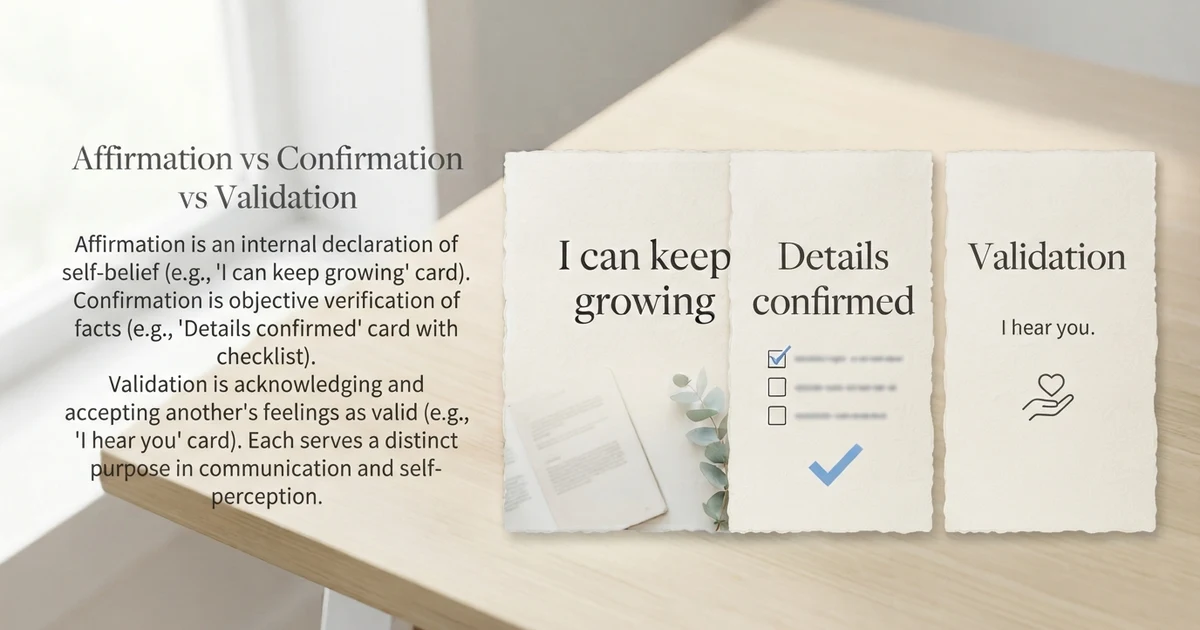
Affirmation, confirmation, and validation are related terms, but they are not interchangeable. Understanding their differences can improve both communication and self-awareness.
Affirmation
Affirmation expresses support, agreement, or a belief.
Example: “I am proud of the effort I put into this.”
The statement reinforces a positive perspective.
Confirmation
Confirmation verifies information or acknowledges that something is correct.
Example: “The teacher confirmed that the assignment was submitted.”
The statement establishes a fact.
Validation
Validation means recognizing or acknowledging that someone’s feelings, experiences, or perspective are understandable or meaningful.
Example: “It makes sense that you feel disappointed after that experience.”
The statement acknowledges an emotional experience without necessarily agreeing with every interpretation or conclusion.
Comparison Table
| Term | Main purpose | Example |
|---|---|---|
| Affirmation | Express support or reinforce a belief | I am worthy of respect. |
| Confirmation | Verify information or an arrangement | Your appointment is confirmed. |
| Validation | Acknowledge feelings or experiences | Your feelings are understandable. |
These three concepts can work together in a supportive conversation.
For example, someone might validate a friend’s disappointment, affirm their ability to move forward, and confirm the details of a plan to help them take the next step.
How to Use Affirmation vs Confirmation Correctly
Choosing between affirmation and confirmation becomes easier when you identify what you want your statement to accomplish.
Use Affirmations When You Want to Express Support
Affirmations are useful when you want to:
- Encourage yourself or someone else.
- Reinforce a personal value.
- Practice constructive self-talk.
- Express confidence in your ability to learn.
- Recognize effort and personal growth.
For example, instead of saying, “I have no idea what I am doing,” you might use the affirmation, “I can learn what I need, one step at a time.”
The second statement offers a more supportive perspective without pretending that every challenge is easy.
Use Confirmations When You Need to Verify Something
Confirmations are appropriate when you want to:
- Verify an appointment or schedule.
- Acknowledge receipt of information.
- Establish that a task is complete.
- Confirm an agreement.
- Check the accuracy of details.
For example:
“Please confirm whether the meeting is scheduled for 10 a.m.”
This is a request for verification, not an affirmation.
Ask Yourself One Simple Question
Before using either term, ask:
Am I expressing a supportive belief, or am I verifying information?
If your goal is encouragement or self-expression, an affirmation may be appropriate.
If your goal is acknowledgment or verification, confirmation is generally the correct word.
Common Mistakes When Comparing Affirmation vs Confirmation
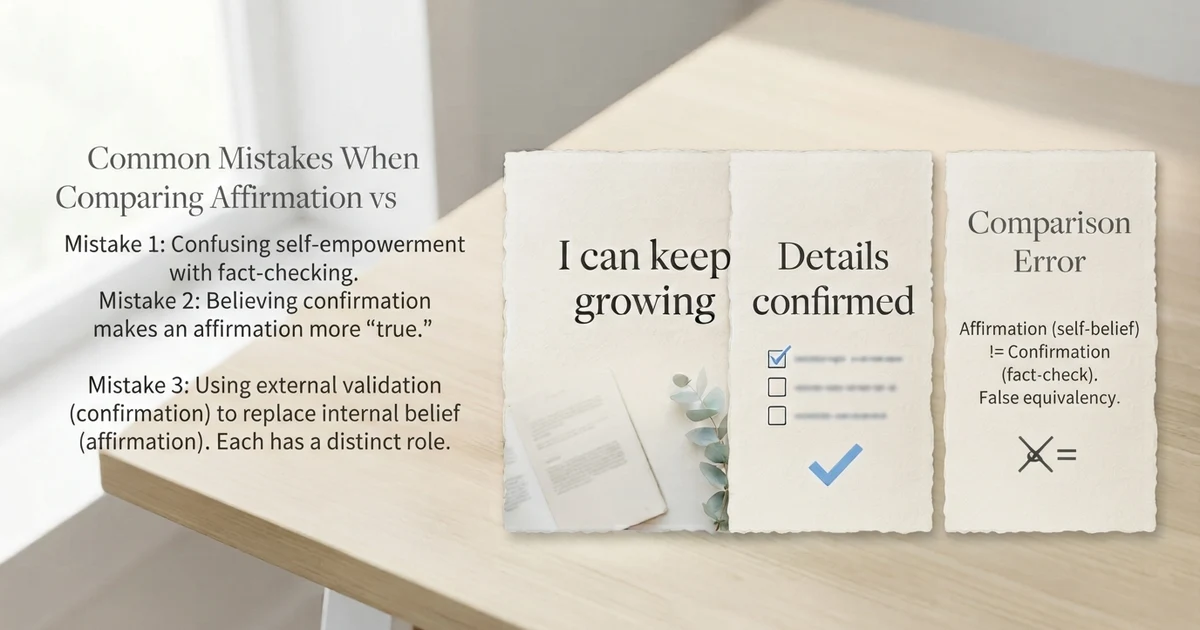
Because the words are similar, people sometimes use them interchangeably. However, a few simple distinctions can prevent confusion.
Mistake 1: Assuming Every Positive Statement Is an Affirmation
A statement can communicate good news without being an affirmation.
For example, “Your exam results have been released” is a factual update. It is not necessarily an affirmation.
A more clearly affirmational statement would be, “I can recognize my effort regardless of the outcome.”
Mistake 2: Treating Affirmations as Proof
An affirmation expresses a belief or supportive perspective, but it does not independently establish that a factual claim is true.
For example, saying “I am fully prepared” may help someone express confidence, but actual preparation depends on their knowledge, practice, and readiness.
Affirmations work best when they complement realistic thinking and meaningful action.
Mistake 3: Using Confirmation When You Mean Encouragement
Consider the statement, “I confirm that I am a valuable person.”
Although the sentence is understandable, it may sound unnatural in ordinary self-talk.
A more natural affirmation would be:
“I recognize my value and treat myself with respect.”
Mistake 4: Confusing Agreement With Verification
Agreeing with someone and confirming a fact are not always the same.
You can agree with someone’s opinion without having verified the information behind it.
For example:
- Agreement: “I understand and share your perspective.”
- Confirmation: “I checked the details, and the information is accurate.”
Recognizing this distinction is especially useful in workplace discussions and important decisions.
Mistake 5: Expecting Affirmations to Replace Action
Positive self-talk can support motivation and reflection, but it does not replace planning, practice, communication, or other practical steps.
A balanced approach connects a supportive statement with an achievable action.
For example:
Affirmation: “I can become more organized.”
Action: “I will write down my three main priorities for tomorrow.”
This approach keeps affirmations grounded in everyday life.
Conclusion:
The difference between affirmation vs confirmation comes down to purpose. An affirmation expresses support, encouragement, or a belief, while a confirmation verifies information or acknowledges that something is accurate. Both are useful in everyday communication, but they serve different roles. Understanding this distinction can help you choose clearer words, practice more thoughtful self-talk, and communicate with greater confidence. Whether you are writing daily affirmations, confirming an appointment, or explaining an idea, focus on what you want your statement to express. Save this list as a quick reference and return to it whenever you need a simple example.
Frequently Asked Questions About Affirmation vs Confirmation
1. What is the simplest difference between affirmation and confirmation?
An affirmation expresses support, encouragement, or a belief, while a confirmation verifies information or acknowledges that something is correct. An affirmation might say, “I can learn from this experience,” whereas a confirmation might say, “The meeting time has been verified.”
2. Is an affirmation the same as a confirmation?
No. Although both words relate to expressing or establishing something, their purposes differ. Affirmations are often used for positive self-talk and encouragement, while confirmations are used to acknowledge or verify facts, arrangements, or information.
3. What is an example of an affirmation?
“I am capable of learning new skills” is an example of an affirmation. It expresses a supportive belief about personal ability and growth. Other examples include “I deserve respect,” “My efforts matter,” and “I can approach challenges with patience.”
4. What is an example of a confirmation?
“Your appointment has been confirmed for Friday” is an example of a confirmation. It verifies an arrangement. Other examples include confirming a payment, acknowledging receipt of a document, or verifying that a scheduled meeting will take place.
5. Can affirmations be used for daily self-talk?
Yes. Affirmations can be incorporated into daily self-talk as reminders of personal values, intentions, and constructive perspectives. Simple statements such as “I can take one step at a time” may help create a more supportive approach to everyday challenges.
6. Is positive affirmation the same as positive thinking?
Not exactly. Positive affirmations are specific statements that express supportive beliefs or intentions. Positive thinking is a broader approach to interpreting situations and considering constructive possibilities. Affirmations can be one tool within a positive-thinking practice, but they are not the same concept.
7. What is the difference between affirmation and validation?
Affirmation expresses support or reinforces a belief, while validation acknowledges someone’s feelings or experiences as understandable or meaningful. For example, “I can handle this challenge” is an affirmation, whereas “It makes sense that this situation feels difficult” is validation.
8. Can a confirmation also be encouraging?
Yes. A confirmation can provide reassuring or positive information, such as confirmation that an application has been approved. However, its primary function remains verification or acknowledgment rather than reinforcing a personal belief.
9. How do I choose between affirmation and confirmation?
Consider your purpose. Use affirmation when expressing encouragement, support, or a personal belief. Use confirmation when checking accuracy, acknowledging an arrangement, or establishing that something has been received or completed. The intended meaning will usually make the correct choice clear.
10. Where can I find short affirmation and confirmation examples to copy?
You can use the short lists and comparison table in this guide as a reference. Save the affirmations for personal reflection and supportive self-talk, and use the confirmation examples when communicating about schedules, agreements, completed tasks, or verified information.