

Affirmations are simple, positive statements that can help you build a more supportive inner dialogue. However, knowing what affirmations are is different from knowing how to use them effectively. The way you choose, repeat, and apply these statements can make a difference in how meaningful they feel in everyday life.
Learning how to use affirmations does not require a complicated routine, special equipment, or hours of practice. You can begin with a few honest sentences that reflect the mindset you want to develop. Whether you are new to positive self-talk or looking for a more consistent daily practice, understanding the basics can help you use affirmations naturally and purposefully.
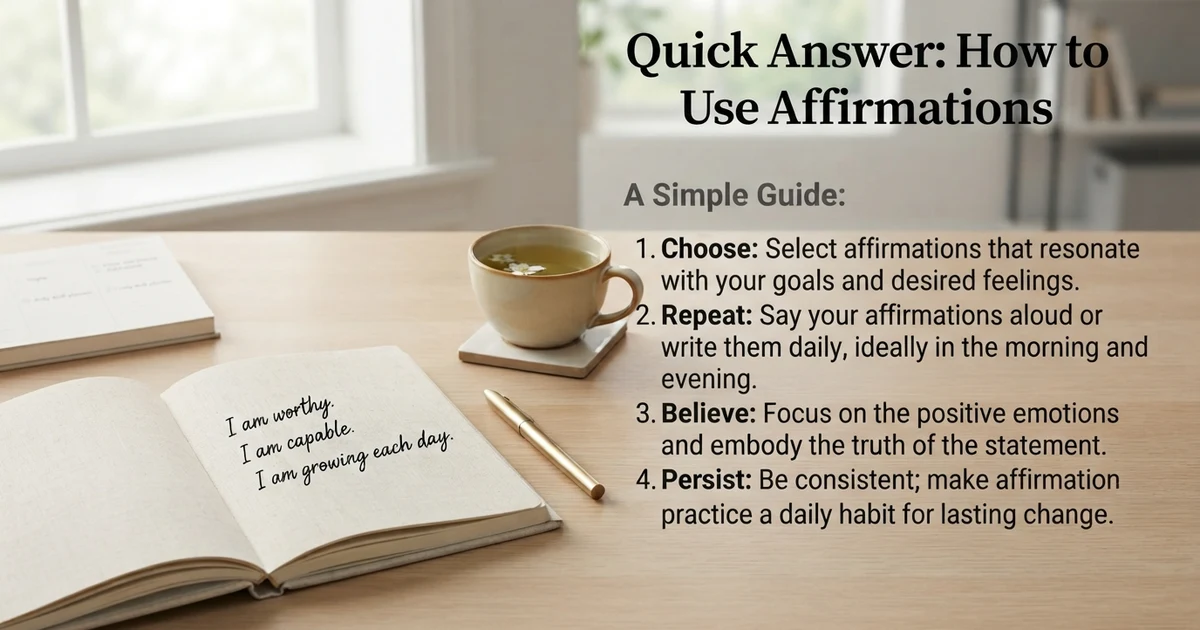
Quick Answer: How to Use Affirmations
To use affirmations, choose a short, positive statement that reflects a helpful belief or mindset you want to strengthen. Repeat it slowly, preferably at a consistent time each day, such as in the morning or before bed. Connect the words to your real experiences, adjust them until they feel believable, and support them with small actions.
For example, instead of saying, “Everything in my life is perfect,” you might say, “I can take one meaningful step toward a better day.”
The goal is not to force yourself to feel positive all the time. It is to practice more encouraging self-talk while remaining honest about your circumstances.
What Does It Mean to Use Affirmations?
Using affirmations means intentionally repeating positive or constructive statements to encourage a particular way of thinking. These statements are often written in the first person and focus on qualities, values, intentions, or behaviors you want to support.
For example:
- I can learn from my mistakes.
- I deserve to treat myself with kindness.
- I am capable of taking small steps forward.
- I can approach challenges with patience.
- My progress does not have to be perfect.
Affirmations are a form of intentional self-talk. They can help you pause, notice your usual thought patterns, and practice a more balanced response.
They are not magic words or guarantees that something will happen. Instead, they can serve as reminders of the attitudes and actions you want to bring into your daily life.
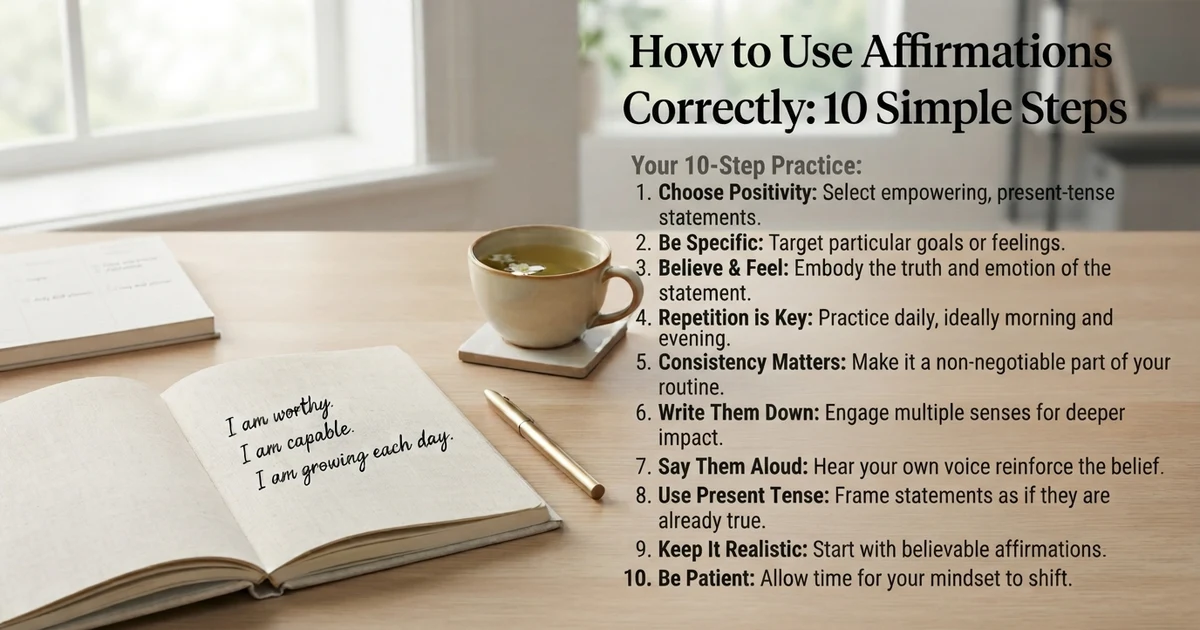
How to Use Affirmations Correctly: 10 Simple Steps
The most useful affirmation practice is one that feels natural, manageable, and relevant to your life. You do not need to follow every step perfectly. Start with the basics and build a routine that works for you.
1. Choose One Clear Intention
Begin by identifying what you want your affirmation to support. Your intention might relate to confidence, patience, learning, self-respect, or a more positive outlook.
A clear intention makes it easier to choose words that have personal meaning.
For example:
- Intention: Practicing patience.
- Affirmation: I can slow down and respond thoughtfully.
Avoid trying to address every area of your life with one statement. A focused affirmation is often easier to remember and apply.
2. Use Simple and Natural Language
Affirmations should sound like something you would actually say. Complicated wording can make a statement harder to remember and less comfortable to repeat.
Instead of:
“I consistently demonstrate exceptional personal resilience in every circumstance.”
Try:
“I can keep going, one step at a time.”
Simple language is not less meaningful. It can make your practice easier to maintain throughout the day.
3. Make Your Affirmations Believable
An affirmation does not need to describe your current reality perfectly, but it should feel possible to consider.
If you are struggling with confidence, saying “I am completely confident in everything I do” may feel disconnected from your experience.
A more approachable statement could be:
“I am learning to trust myself.”
This wording acknowledges that confidence can develop gradually. It gives you room to grow without requiring you to deny your current feelings.
4. Repeat Them Consistently
Choose a time when you can practice without rushing. Consistency is generally more practical than trying to repeat dozens of statements in one sitting.
You might repeat three affirmations after waking up, during a quiet break, or before going to sleep.
There is no universal number of repetitions that everyone must follow. Begin with a small routine that feels comfortable and adjust it as needed.
5. Pay Attention to the Meaning
Rather than repeating words automatically, take a moment to consider what each statement means to you.
For example, when you say, “I can learn from challenges,” think about one situation where you could apply that idea.
This simple reflection can help connect your words with your everyday experiences.
6. Write Your Affirmations Down
Writing can make your statements easier to remember and revisit.
You can use:
- A notebook or journal.
- Sticky notes near your desk.
- A digital notes app.
- Printable affirmation cards.
- A daily planner.
Choose a format that fits your routine. You do not need an elaborate journal or decorative materials to begin.
7. Connect Affirmations With Small Actions
Affirmations are most useful as reminders that support your choices, not substitutes for action.
For example:
| Affirmation | Supporting action |
|---|---|
| I am committed to learning. | Spend 15 minutes reviewing a topic. |
| I can care for my well-being. | Take a short, refreshing break. |
| I communicate with respect. | Listen carefully during a conversation. |
| I can make progress gradually. | Complete one manageable task. |
| I deserve a peaceful environment. | Organize one small area of your space. |
The action does not need to be impressive. Small, realistic steps can help you practice the values expressed in your affirmations.
8. Adjust Statements That Feel Unnatural
Your affirmations are not permanent rules. If a statement feels uncomfortable, exaggerated, or unrelated to your life, rewrite it.
For instance:
- Original: I never make mistakes.
- Revised: I can learn when things do not go as planned.
The revised statement is more realistic and leaves room for ordinary human experiences.
9. Practice Without Judging Yourself
Some days, affirmations may feel encouraging. On other days, they may seem less relevant or meaningful.
That is normal.
You do not have to force yourself to feel happy, confident, or motivated every time you repeat a statement. You can acknowledge difficult emotions while still choosing supportive language.
10. Review Your Practice Regularly
Every week or two, consider whether your affirmations still match your needs.
Ask yourself:
- Do these statements feel relevant?
- Am I using words that sound natural?
- Have my goals or priorities changed?
- Is this routine easy to maintain?
- Would a different affirmation be more helpful?
Reviewing your list helps keep your practice personal rather than turning it into another task you feel pressured to complete.
30 Positive Affirmations You Can Use Every Day
If you are unsure where to begin, the following affirmations offer simple examples for different situations. You can use them as written, personalize them, or choose only the statements that feel meaningful to you.
Short Affirmations for Beginners
- I can begin again.
- I am learning every day.
- My efforts matter.
- I can take my time.
- I choose kindness.
- I am open to growth.
- I can handle one step at a time.
- I deserve respect.
- I can learn from experience.
- I am allowed to grow.
Positive Affirmations for Daily Use
- I can make today meaningful in small ways.
- I welcome opportunities to learn.
- I can approach my responsibilities with patience.
- I appreciate the progress I have made.
- I can focus on what is within my control.
- I give myself permission to rest.
- I can respond thoughtfully instead of rushing.
- I choose words that encourage me.
- I can find value in ordinary moments.
- I am building habits that support my goals.
Affirmations for Confidence and Self-Belief
- I can trust myself to keep learning.
- My voice and ideas deserve consideration.
- I can face unfamiliar situations with curiosity.
- I do not need to be perfect to make progress.
- I can recognize my strengths.
- I am capable of making thoughtful decisions.
- I can grow through practice.
- I deserve to acknowledge my achievements.
- I can learn to feel more comfortable being myself.
- My worth is not defined by a single outcome.
Tip: Save this list and select three to five affirmations that reflect your current priorities. You can change them whenever your needs shift.
How to Use Affirmations in the Morning

Morning affirmations can provide a moment of reflection before your daily responsibilities begin. They offer an opportunity to set an intention rather than immediately reacting to messages, tasks, or distractions.
Try this simple routine:
- Sit somewhere comfortable for a few minutes.
- Choose three affirmations that match your intentions.
- Read each statement slowly.
- Consider one small action that supports your chosen mindset.
- Carry that intention into your day.
Morning affirmation examples:
- I can approach today with patience.
- I am ready to learn something new.
- I can focus on one task at a time.
- I will treat myself with understanding.
- I can make thoughtful choices throughout the day.
Your morning practice can take two minutes or less. The purpose is to create a useful starting point, not to add pressure to your schedule.
How to Use Affirmations at Night

Evening affirmations can help you reflect on the day and practice a gentler inner dialogue before resting.
Rather than evaluating everything you did or did not accomplish, use this time to recognize your efforts and consider what you learned.
Nighttime affirmation examples:
- I can let today be complete.
- I appreciate the effort I made.
- I do not need to solve everything tonight.
- I can learn from today without judging myself.
- I deserve time to rest.
- Tomorrow offers another opportunity to begin.
You can write one affirmation in your journal or repeat it quietly as part of your bedtime routine.
If a statement feels too positive for how you are feeling, make it more neutral. For example, “I am doing my best to move through this moment” may feel more comfortable than “I feel wonderful.”
How to Use Affirmations for Different Areas of Life
Affirmations can be adapted to different situations. The key is to choose language that supports a specific intention rather than relying on generic statements.
| Area of life | Example affirmation |
|---|---|
| Self-love | I deserve patience and respect from myself. |
| Confidence | I can express my thoughts with clarity. |
| Work | I can approach my tasks with focus. |
| Studying | I can improve through consistent practice. |
| Relationships | I can communicate honestly and kindly. |
| Personal growth | I am open to learning from experience. |
| Motivation | I can begin with one manageable step. |
| Gratitude | I can notice the good in ordinary moments. |
| Boundaries | I can respect my needs and communicate them. |
| Change | I can give myself time to adjust. |
These examples are starting points, not rules. Personalizing the language can make an affirmation more relevant to your circumstances.
Affirmations vs. Positive Thinking vs. Positive Self-Talk
These terms are related, but they do not mean exactly the same thing. Understanding their differences can help you decide which approach fits a particular situation.
| Term | Meaning | Example |
|---|---|---|
| Affirmations | Intentional statements used to reinforce a belief, value, or mindset. | I can learn from my experiences. |
| Positive thinking | Choosing to consider constructive possibilities while recognizing reality. | This situation is difficult, but there may be steps I can take. |
| Positive self-talk | The internal language you use when responding to yourself. | I made a mistake, but I can work out what to do next. |
| Gratitude | Noticing and appreciating things you value. | I appreciate the support I received today. |
| Visualization | Mentally imagining a situation, process, or desired action. | I picture myself preparing calmly for a presentation. |
You can combine these approaches, but they serve slightly different purposes.
For example, an affirmation might remind you that you can prepare for a challenge, while positive self-talk helps you respond constructively if something does not go as planned.
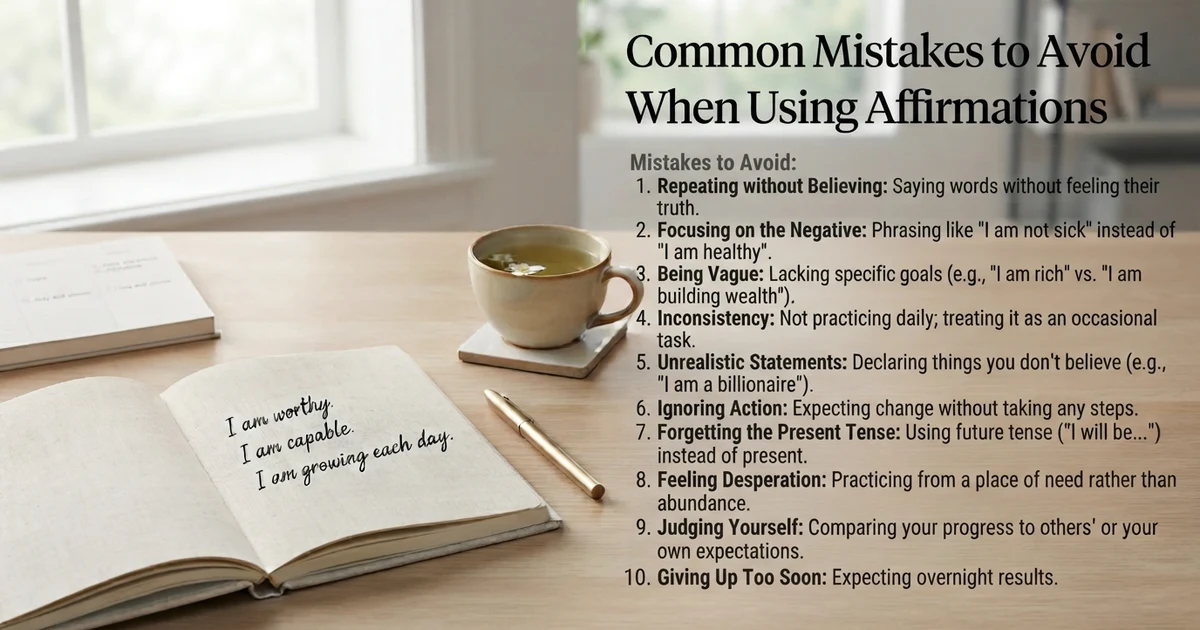
Common Mistakes to Avoid When Using Affirmations
Affirmations are simple, but certain habits can make the practice feel less useful or more demanding than it needs to be.
Choosing Statements That Feel Completely Unrealistic
If your affirmation feels impossible to relate to, consider using gentler language.
Instead of making a statement that conflicts sharply with your current experience, focus on what you are learning, practicing, or becoming open to.
Repeating Too Many Affirmations
A long list can become difficult to remember and maintain. You do not need to repeat every affirmation you find.
Choose a small number that reflects your present priorities.
Expecting Immediate Results
Affirmations are not guaranteed to change your thoughts, feelings, or circumstances instantly. Give yourself permission to explore the practice without measuring every session.
Ignoring Real Challenges
Positive self-talk should not require you to pretend that problems do not exist.
A balanced affirmation can acknowledge difficulty while supporting a constructive response.
For example, “This is challenging, and I can consider my next step” is more grounded than insisting that everything is easy.
Using Affirmations Instead of Taking Action
Statements about learning, confidence, or personal growth can remind you of your intentions, but they do not replace practice, planning, communication, or other meaningful steps.
Pair your affirmations with realistic actions whenever possible.
Treating the Practice Like a Strict Rule
Missing a day does not mean you have failed. You can return to your routine whenever it suits you.
The practice should support your day, not become another source of guilt.
How to Create Your Own Affirmations
Writing personal affirmations is often easier than it seems. You can build a useful statement by combining a value, a supportive belief, and a realistic intention.
Try this simple formula:
I am learning to + supportive quality or action.
Examples:
- I am learning to trust my decisions.
- I am learning to communicate with patience.
- I am learning to recognize my progress.
- I am learning to manage my time thoughtfully.
You can also use these sentence starters:
- I can…
- I choose to…
- I am open to…
- I deserve…
- I am practicing…
- I give myself permission to…
- I can take one step toward…
When creating your own affirmations, keep these three principles in mind:
- Make them personal: Choose words that reflect your actual needs.
- Keep them realistic: Focus on intentions and possibilities rather than guaranteed outcomes.
- Make them actionable: Whenever appropriate, connect the statement to a behavior you can practice.
For example, if your goal is to become more organized, “My entire life is perfectly organized” may not be particularly useful. “I can create more order by completing one task at a time” gives you a clear direction.
Conclusion:
Learning how to use affirmations is about more than repeating positive sentences. It involves choosing meaningful words, practicing supportive self-talk, and connecting your intentions with realistic actions. Start with a few statements that feel natural, use them at a convenient time, and adjust your routine as your needs change.
You do not have to feel positive every moment or follow a perfect schedule. A simple, flexible practice can be enough to help you pause and consider a more encouraging way to respond to everyday situations. Save the list of affirmations that resonates with you, revisit it when needed, and allow your practice to develop at your own pace.
Frequently Asked Questions About How to Use Affirmations
1. How do beginners start using affirmations?
Beginners can start by choosing one to three simple statements that reflect a helpful belief or intention. Repeat them during a convenient part of the day, such as the morning or evening. Keep the wording natural and adjust any statement that feels unrealistic or uncomfortable.
2. How many times should I repeat an affirmation?
There is no universally required number of repetitions. You can say an affirmation once thoughtfully or repeat it a few times as part of a daily routine. Consistency and personal relevance are more practical goals than reaching an arbitrary number.
3. Is it better to say affirmations out loud or silently?
Both approaches are acceptable. Speaking affirmations aloud may help some people focus on the words, while silent repetition can be more convenient in public or shared spaces. Choose whichever method feels natural to you.
4. Should affirmations be written in the present tense?
Many affirmations use the present tense because it creates a direct statement, such as “I am learning to trust myself.” However, you can also use phrases such as “I am working toward,” “I am practicing,” or “I am open to” when they better reflect your experience.
5. Can I use affirmations if I do not believe them yet?
Yes. You can begin with statements that feel possible rather than insisting on beliefs that seem completely out of reach. For example, “I am learning to recognize my strengths” may be easier to relate to than “I have unlimited confidence.”
6. What is the best time to use affirmations?
The best time is one that fits comfortably into your schedule. Morning practice can help you set an intention for the day, while evening practice can provide an opportunity for reflection. You can also use affirmations during a quiet break or before a specific activity.
7. Do affirmations work better when written down?
Writing affirmations can make them easier to revisit, personalize, and remember. However, writing is not essential. You can speak, read, or silently reflect on your statements instead. The most suitable method is the one you can use comfortably and consistently.
8. Can I use the same affirmations every day?
Yes. Repeating the same affirmations can help you maintain a consistent routine. However, you can update your list whenever your goals, priorities, or circumstances change. There is no need to keep using a statement that no longer feels relevant.
9. What should I do if affirmations make me feel uncomfortable?
Pause and examine the wording. An affirmation that feels exaggerated or disconnected from your experience may need to be rewritten. Try a gentler statement that acknowledges your current situation while leaving room for growth. You do not need to force positive feelings.
10. Can affirmations replace professional support?
No. Affirmations are a self-reflection and self-talk practice, not a substitute for professional mental health care or other appropriate support. They may complement healthy routines, but persistent emotional difficulties deserve attention and support from qualified professionals.