

Teaching requires patience, creativity, and care. Some days bring rewarding moments when students make progress, while others involve challenging lessons, heavy workloads, and little time to rest. Positive affirmations for teachers offer a simple way to practice encouraging self-talk, recognize personal strengths, and approach difficult school days with a steadier mindset.
This collection includes daily affirmations, short phrases to copy and paste, confidence boosters, reminders for stressful moments, and encouraging words for teachers who feel tired or unappreciated. You can read them before class, write them in a planner, or keep a few near your desk. Choose words that feel realistic and supportive of the work you do.
Positive Affirmations for Teachers
These positive affirmations for teachers are useful for starting the school day, preparing for a lesson, or remembering that progress matters more than perfection. Choose a few that reflect what you need most today.
- I make a meaningful difference through my teaching.
- I can help students grow one lesson at a time.
- My effort matters, even when progress is slow.
- I bring patience and care into my classroom.
- I am allowed to learn as I teach.
- Every school day gives me a chance to improve.
- I can meet challenges with a thoughtful approach.
- My work has value beyond test scores.
- I create opportunities for students to discover their strengths.
- I can be a good teacher without being perfect.
- I trust myself to make thoughtful decisions.
- Small moments of progress deserve recognition.
- I bring my own strengths to the classroom.
- I can adjust my plans when students need something different.
- My kindness and consistency matter.
- I deserve respect for the work I do.
- I can learn from a difficult lesson without judging myself.
- I welcome new ideas that help me teach better.
- I am building my skills through experience.
- I can celebrate progress without waiting for everything to be finished.
Short Positive Affirmations for Teachers
Short affirmations are easy to remember when you have only a few minutes before students arrive. Write one on a sticky note, add it to your lesson planner, or repeat it quietly before a busy class.
- I teach with purpose.
- My effort matters.
- Progress takes time.
- I can adapt.
- I choose patience.
- My voice matters.
- I lead with care.
- I am still learning.
- One lesson at a time.
- I can begin again.
- I trust my preparation.
- I deserve a break.
- I welcome progress.
- I can stay flexible.
- My work has meaning.
- I choose calm.
- I can ask for help.
- Mistakes help me learn.
- I bring value.
- Today is a fresh start.
Daily Affirmations for Teachers
A daily affirmation can give you a moment to pause before the school day begins. These statements focus on consistency, realistic expectations, and the small actions that make teaching meaningful.
- Today, I will focus on what I can control.
- I can make today productive without making it perfect.
- I will give my students clear guidance and encouragement.
- I can respond thoughtfully instead of reacting immediately.
- My preparation gives me a foundation to work from.
- I will notice effort as well as results.
- I can change my approach when something is not working.
- I will make room for curiosity and creativity.
- I can handle unexpected changes one step at a time.
- I will speak to myself with the same patience I offer students.
- I can finish the day knowing I did what I reasonably could.
- I will recognize one thing that went well today.
- My teaching can improve through reflection.
- I can leave some tasks for tomorrow when necessary.
Morning Affirmations for Teachers
The minutes before class can feel rushed. Morning affirmations help you set a simple intention instead of carrying every worry into the classroom at once.
- I am ready to begin with an open mind.
- I can bring calm energy into my classroom.
- I do not need to have every answer immediately.
- I will meet my students with fairness and respect.
- I can make a difference through small, consistent actions.
- My lesson plan is a guide, not a measure of my worth.
- I can handle the unexpected with flexibility.
- I will make time to notice my students’ efforts.
- I can set realistic priorities for today.
- I welcome opportunities to learn alongside my students.
- I can pause and regroup when the morning gets busy.
- I will focus on teaching the next lesson well.
Affirmations for Teacher Confidence
Confidence does not mean knowing everything or never making mistakes. It means trusting your preparation, using your professional judgment, and being willing to keep learning.
- I have skills that help my students learn.
- I can explain difficult ideas in different ways.
- I am capable of improving my classroom practice.
- I can make decisions without pleasing everyone.
- My teaching style can reflect my strengths.
- I am willing to ask questions when I need clarity.
- I can learn new methods without dismissing what already works.
- I do not need to compare my classroom with someone else’s.
- I can speak with confidence and remain open to feedback.
- My experience helps me recognize what students may need.
- I can handle constructive criticism without treating it as failure.
- I trust myself to keep developing as an educator.
- I have the right to take up space in professional discussions.
- I can acknowledge what I do well while working on what needs improvement.
Positive Affirmations for Teachers Facing Stress
Teaching can involve competing deadlines, classroom needs, administrative tasks, and emotionally demanding situations. These affirmations offer reminders to slow down, identify the next useful step, and give yourself reasonable expectations.
- I can take one task at a time.
- I do not have to solve every problem this minute.
- A difficult class does not define my entire teaching day.
- I can pause before responding to a stressful situation.
- My well-being deserves attention, too.
- I can ask a colleague for support.
- I am allowed to change a plan that is not working.
- I can focus on the next manageable step.
- I do not need to carry every classroom challenge home.
- A busy day does not determine my worth.
- I can set limits while remaining a caring teacher.
- Rest helps me make room for tomorrow.
- I can acknowledge frustration without letting it define me.
- I deserve time to recover after demanding days.
- I can seek support when stress becomes difficult to manage.
Affirmations for Teachers Who Feel Tired or Burned Out
When teaching feels exhausting, overly cheerful statements may be difficult to believe. These gentler affirmations recognize that you can care about your students while also needing rest, support, and changes to your workload.
- I do not have to give everything I have every day.
- My needs matter alongside my students’ needs.
- I can care deeply without being available all the time.
- I am allowed to admit that this week is difficult.
- Taking a break does not make me a less caring teacher.
- I can ask for help before I feel completely overwhelmed.
- My worth is not measured by how much I sacrifice.
- I can reconsider routines that leave me exhausted.
- I deserve support from the people around me.
- I can give myself permission to slow down when possible.
- I am more than my job title.
- I can make room for interests outside the classroom.
- I do not need to feel passionate every moment to be a committed educator.
- I can take the next step without solving everything today.
If exhaustion continues or begins affecting your daily life, consider speaking with a trusted person, school leader, or qualified professional. Affirmations can support self-talk, but they cannot replace practical changes or appropriate care.
Positive Affirmations for Classroom Management
Managing a classroom calls for consistency, clear expectations, and the ability to respond to different student needs. These statements can help you remember your approach when a lesson becomes noisy or behavior is difficult to manage.
- I can set clear expectations with respect.
- Consistency is more useful than reacting out of frustration.
- I can correct behavior without attacking a student’s character.
- I can remain firm and fair at the same time.
- Every student deserves dignity.
- I can redirect attention without escalating a situation.
- I will focus on the behavior that needs to change.
- I can explain classroom rules calmly.
- I can adjust my approach when a student needs additional support.
- I do not need to win every disagreement.
- I can create routines that help students know what to expect.
- I can repair a difficult interaction and move forward.
- I will recognize positive behavior when I see it.
- A challenging moment is an opportunity to reassess what is needed.

Affirmations for Teachers Making a Difference
Not every meaningful teaching moment produces a visible result. A student may understand a difficult concept, feel comfortable asking a question, or become more willing to try. These affirmations help you recognize the value of those moments without expecting immediate results from every lesson.
- My encouragement can help a student keep trying.
- I can make learning feel more approachable.
- Every student deserves the chance to improve.
- I can recognize strengths that grades do not always show.
- My classroom can be a place where questions are welcome.
- I can help students see mistakes as part of learning.
- Listening is an important part of teaching.
- I can encourage independence instead of doing everything for students.
- My patience can give students room to develop.
- I can celebrate a student’s progress without comparing it with another’s.
- I can help students feel that their ideas matter.
- My influence may continue beyond the lessons I teach.
- I can make space for different ways of learning.
- I can offer encouragement while maintaining high expectations.
Affirmations for New Teachers
Starting a teaching career can bring uncertainty as you learn classroom routines, lesson planning, student communication, and school expectations. These affirmations remind new educators that professional confidence develops through practice rather than instant perfection.
- I am allowed to be a beginner.
- I can learn something useful from each lesson.
- I do not need to know everything in my first year.
- Asking experienced teachers for advice is a strength.
- I can prepare carefully and still adapt in the moment.
- My classroom routines will become clearer with practice.
- I can learn from mistakes without feeling ashamed.
- I am developing my own teaching style.
- I can build relationships with students over time.
- I will celebrate progress that I might have overlooked before.
- Feedback can help me identify my next step.
- I can take notes on what works and revisit them later.
- I deserve time to grow into my responsibilities.
Affirmations for Experienced Teachers
Experienced educators may face changing curriculum requirements, new technologies, evolving student needs, or the pressure to keep giving more. These affirmations recognize professional knowledge while leaving room for new ideas and personal boundaries.
- My experience gives me useful perspective.
- I can keep learning without dismissing my past work.
- I do not need to adopt every new trend to teach well.
- I can share my knowledge while remaining open to others.
- My professional judgment has value.
- I can protect the routines that help me teach effectively.
- I can make changes when the evidence in my classroom calls for them.
- I am allowed to set boundaries around my workload.
- I can mentor others without taking responsibility for everything.
- My contribution is not limited to visible achievements.
- I can find fresh meaning in familiar lessons.
- I can be proud of the growth I have seen over the years.
Positive Affirmations for Teachers Before a Difficult Class
Some classes require extra preparation, patience, or a different teaching approach. Read these statements before a challenging lesson to remind yourself to focus on clear expectations, flexibility, and the students in front of you.
- I can enter this classroom with a clear plan.
- I will address problems one at a time.
- I can remain respectful when a student is upset.
- I do not need to predict every possible difficulty.
- I can use a calm voice and clear directions.
- I can adjust the lesson if students need another explanation.
- I will focus on what helps learning continue.
- I can ask for assistance when a situation requires it.
- One challenging lesson does not determine my ability as a teacher.
- I can reflect on the class afterward without blaming myself for everything.
Evening Affirmations for Teachers After School
It can be hard to stop thinking about unfinished grading, tomorrow’s lessons, or a conversation that did not go as planned. Evening affirmations help you acknowledge the day and create a reasonable boundary between work and personal time.
- I have permission to stop working for today.
- I can learn from this day without replaying every moment.
- Not every task must be finished tonight.
- I can recognize the effort I gave today.
- Tomorrow is a new opportunity to adjust my approach.
- I can leave some questions unanswered until I have more information.
- My personal life deserves time and attention.
- I can be proud of one small success from today.
- I release the expectation of a perfect classroom.
- I deserve rest without earning it through exhaustion.
- I can write down tomorrow’s priorities and return to them later.
- My value remains even when the work is unfinished.
Positive Affirmations for Teachers During Difficult School Years
Some school years bring significant changes, staffing challenges, demanding schedules, or difficult circumstances outside the classroom. These affirmations focus on resilience without suggesting that teachers must tolerate unreasonable conditions or handle every problem alone.
- I can acknowledge what is difficult without losing sight of what matters.
- I am allowed to ask whether my current workload is sustainable.
- I can focus my energy where it has the greatest value.
- I do not have to solve systemic problems on my own.
- I can work with colleagues to find practical solutions.
- I can recognize the limits of what one person can control.
- I can adapt without ignoring my own needs.
- I deserve a workplace where support and respect matter.
- I can take pride in small improvements.
- I can reassess my goals as circumstances change.
- I can seek guidance when expectations are unclear.
- My identity is bigger than one difficult school year.
How to Use Positive Affirmations for Teachers Every Day
Affirmations work best as a manageable self-reflection habit, not another task on an already crowded teacher’s to-do list. You do not need to memorize a long list or repeat every statement.
Try this simple routine:
- Choose one specific need. Decide whether you need confidence before class, patience during a difficult lesson, or permission to rest afterward.
- Select one to three affirmations. Pick phrases that sound natural rather than statements that feel exaggerated.
- Repeat or write them. Say them quietly, add them to your planner, or place one on your desk.
- Connect the words to an action. If your affirmation is “I can ask for support,” identify a colleague you could consult.
- Review what helped. At the end of the week, keep the phrases that feel useful and replace those that no longer fit.
A routine lasting even a minute can provide a useful pause. The goal is to support your approach to teaching, not to create another standard you must meet perfectly.
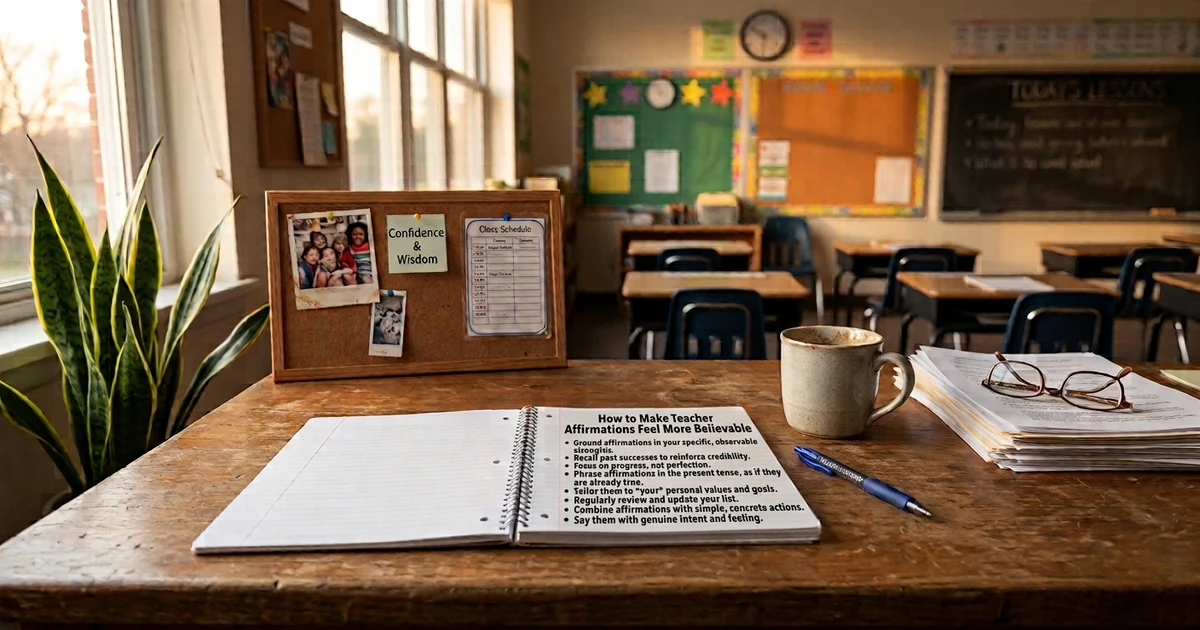
How to Make Teacher Affirmations Feel More Believable
An affirmation does not need to sound impressive. It needs to be something you can consider honestly, even when you are having a difficult day.
For example, if “I never feel stressed in my classroom” feels untrue, choose a statement that recognizes reality while leaving room for a different response.
- Instead of “I handle every situation perfectly,” try “I can respond thoughtfully and learn from difficult situations.”
- Instead of “Every student loves my class,” try “I can create opportunities for students to feel respected and included.”
- Instead of “I finish all my work on time,” try “I can prioritize the most important tasks and ask for help when needed.”
- Instead of “I am always patient,” try “I can pause and choose how to respond.”
- Instead of “I never make mistakes,” try “I can acknowledge mistakes and make corrections.”
This approach keeps positive self-talk grounded in reality. You are not required to deny frustration or pretend that every day is successful.
How to Personalize Affirmations for Your Teaching Needs
The most useful affirmation often reflects a real situation in your classroom. Start by identifying the thought that makes a moment harder, then write a more balanced response.
Use these examples as a starting point:
- Before an observation: “I can demonstrate what I know and learn from the feedback.”
- When a lesson goes poorly: “One lesson gives me information I can use next time.”
- When work piles up: “I can identify my priorities and address them one at a time.”
- When a student struggles: “I can try another approach and seek additional support.”
- When comparing yourself with colleagues: “I can learn from others while developing my own strengths.”
- When you need a break: “Taking care of myself helps me respect my own limits.”
Keep your wording specific, kind, and practical. An affirmation should help you decide what to do next, not make you feel guilty for having a difficult experience.
Printable Positive Affirmations for Teachers
A printable affirmation list can be useful when you want a quick reminder without opening your phone. You can turn your favorite phrases into a small desk card, a classroom planning insert, or a page in your teaching journal.
Consider organizing a printable sheet into four categories:
- Before school: I can begin today with patience and purpose.
- During a challenging lesson: I can pause, assess, and adjust.
- After a difficult interaction: I can reflect without judging my entire day.
- At the end of work: I deserve time to rest and recharge.
Choose a simple, readable design with enough space between statements. Print the list in black and white if you prefer, or use a few calm colors to distinguish each category.
You can also create a small card with three affirmations you genuinely find helpful. Keeping the list short makes it easier to use during a busy school week.
What to Avoid When Using Teacher Affirmations
Positive self-talk should support teachers rather than create pressure to feel cheerful at all times. Certain habits can make affirmations less useful.
- Avoid unrealistic promises. Statements such as “Every lesson will go perfectly” set expectations no teacher can control.
- Do not dismiss difficult feelings. You can acknowledge frustration and still choose a constructive response.
- Avoid comparing yourself with other teachers. Their classroom, responsibilities, and resources may differ from yours.
- Do not use affirmations to excuse unfair conditions. Encouraging self-talk cannot replace appropriate staffing, planning time, or professional support.
- Do not turn affirmations into another obligation. Missing a day does not mean you have failed.
- Pair reflection with practical changes. If a recurring problem needs a new routine, clearer expectations, or assistance, take steps toward addressing it.
The purpose is to encourage a healthier relationship with your work while recognizing that real challenges sometimes require more than a change in mindset.
Conclusion
Positive affirmations for teachers can offer a simple reminder of your skills, values, and limits throughout the school year. Choose a few statements that speak to your current needs, whether you want more confidence before class, a calmer response to challenges, or permission to rest after work. Keep the wording realistic, and connect it with practical steps whenever possible. You do not need to feel positive every moment to be a caring, capable educator. Save your favorite affirmations somewhere easy to reach and return to them whenever a little encouragement would help.
Frequently Asked Questions
1. What are positive affirmations for teachers?
Positive affirmations for teachers are short, encouraging statements that support constructive self-talk. They may focus on patience, confidence, classroom management, professional growth, or personal boundaries. Teachers can use them as reminders before class, during stressful moments, or after a difficult day without expecting themselves to feel positive all the time.
2. Do positive affirmations help teachers?
They may help teachers pause, reflect on their strengths, and approach a situation with a more balanced perspective. Their usefulness depends on the individual and the circumstances. Affirmations work best alongside practical strategies such as planning, setting boundaries, collaborating with colleagues, and seeking support when necessary.
3. How many affirmations should a teacher use each day?
Start with one to three affirmations that match your needs. A short list is easier to remember and use consistently than dozens of statements at once. You can choose a different affirmation each day or keep the same one for a week if it remains relevant.
4. When is the best time for teachers to say affirmations?
You can use affirmations before school, while preparing a lesson, before a challenging class, or at the end of the workday. Choose a time that fits naturally into your routine. A brief pause before students arrive or after you finish grading may be enough.
5. Should teachers say affirmations aloud or write them down?
Both options are reasonable. Speaking an affirmation aloud may help you focus on its message, while writing it in a planner or journal gives you a reminder to revisit. Choose the method that feels comfortable and practical for your schedule.
6. What are the best short affirmations for teachers?
Useful short affirmations include “I teach with purpose,” “I can adapt,” “My effort matters,” and “I deserve a break.” The best statement is one that feels relevant and believable to you. Keep it easy to remember so you can use it during a busy school day.
7. Can new teachers use positive affirmations?
Yes. New teachers may find affirmations helpful when adjusting to lesson planning, classroom routines, student relationships, and feedback. Statements such as “I am allowed to be a beginner” and “I can learn from each lesson” encourage realistic expectations while recognizing that professional skills develop with practice.
8. What should I do if an affirmation feels fake?
Change the wording to something more believable. Instead of saying, “I am completely confident,” try “I can prepare carefully and ask questions when I need help.” You do not need to deny your feelings. Choose a statement that acknowledges your current situation and points toward a constructive next step.
9. Can teachers use affirmations to manage classroom stress?
Affirmations may serve as reminders to pause, use clear expectations, and respond thoughtfully. However, they cannot resolve every classroom management challenge. Teachers may also need appropriate routines, collaboration with colleagues, additional resources, or school-level support to address recurring problems.
10. Can I use these affirmations in a printable teacher journal?
Yes. Select your favorite statements and organize them by situation, such as morning preparation, classroom confidence, difficult days, and evening reflection. You can print them, write them in a journal, or keep them on a desk card. Personalize the wording so the statements remain relevant to your teaching experience.