

The word affirmation is often used in conversations about positive thinking, personal growth, and everyday self-talk. You may have heard it in a podcast, read it in a book, or seen it in a list of positive statements. But if you are unsure how to say it correctly, you are not alone.
Learning how to pronounce affirmation is simple once you understand its syllables, stress, and sound. This guide explains the correct pronunciation, provides easy examples, explores the meaning of the word, and clears up common mistakes. Whether you are learning English, improving your vocabulary, or simply curious about the word, you will find everything you need to say it naturally and confidently.
How to Pronounce Affirmation
The word affirmation is pronounced:
affirmationaf-er-MAY-shunAdd to flashcards
Give feedback
Phonetic spelling: /ˌæf.ɚˈmeɪ.ʃən/ (American English)
Syllables: Af-fir-ma-tion
Number of syllables: Four
Stressed syllable: The third syllable, ma, receives the strongest emphasis.
To pronounce the word naturally, begin with a short sound, move through the middle syllables, and give the strongest emphasis to the third syllable. Finish with the soft shun sound.
You do not need to speak slowly every time you use it. Once you become familiar with the rhythm, the word will feel much easier to say in everyday conversation.

What Does Affirmation Mean?
An affirmation is a positive or supportive statement that expresses a belief, intention, or encouraging idea.
People often use affirmations as a form of positive self-talk. They may repeat a statement to remind themselves of their values, encourage a helpful mindset, or approach a challenging situation with greater confidence.
For example:
- I am capable of learning new things.
- I deserve kindness and respect.
- I can take one step at a time.
- My efforts have value.
- I am allowed to grow at my own pace.
An affirmation does not have to be an unrealistic promise or an absolute claim. It can simply be a statement that helps you focus on a constructive thought.
In everyday language, the word can also refer to an expression of agreement, confirmation, or support.
How to Break Affirmation Into Syllables
Breaking a long word into smaller parts is a useful way to learn its pronunciation.
The word affirmation contains four syllables:
| Syllable | Sound guide |
|---|---|
| Af | Short opening sound |
| Fir | Middle sound |
| Ma | Main stressed syllable |
| Tion | Soft ending sound |
When you put the parts together, they form one smooth word.
A helpful practice method:
- Read the word slowly.
- Identify its four syllables.
- Give extra emphasis to the third syllable.
- Repeat the complete word at a comfortable pace.
- Use it in a sentence to become familiar with its natural rhythm.
Practicing the word in a sentence is particularly useful because pronunciation can feel different when a word is spoken naturally rather than in isolation.

How to Use Affirmation in Everyday Sentences
One of the easiest ways to remember a new word is to use it in meaningful sentences.
Here are some everyday examples:
- An affirmation can help me begin my morning with a positive thought.
- She wrote an affirmation in her journal.
- He repeated a simple affirmation before his presentation.
- My favorite affirmation reminds me to be patient with myself.
- We discussed the meaning of affirmation in our English class.
- A kind affirmation can express encouragement and support.
- She chose an affirmation that reflected her personal values.
- I keep a written affirmation near my desk.
- The teacher explained how affirmation differs from confirmation.
- Learning the pronunciation of affirmation helped me feel more comfortable using the word.
Reading these examples aloud can help you connect the word’s meaning with its sound.
Affirmation Pronunciation Examples to Practice
If you are learning English, practicing related words can help you recognize familiar sounds and patterns.
Here are some useful words and phrases:
| Word or phrase | Meaning |
|---|---|
| Affirmation | A supportive or confirming statement |
| Affirm | To state or confirm something positively |
| Affirmative | Expressing agreement or a positive response |
| Positive affirmation | An encouraging statement |
| Daily affirmation | A statement repeated as part of a daily routine |
| Self-affirmation | Recognition of personal values or qualities |
| Verbal affirmation | Support or confirmation expressed through words |
Notice that affirm, affirmative, and affirmation share the same word family. Learning them together can make vocabulary practice more effective.
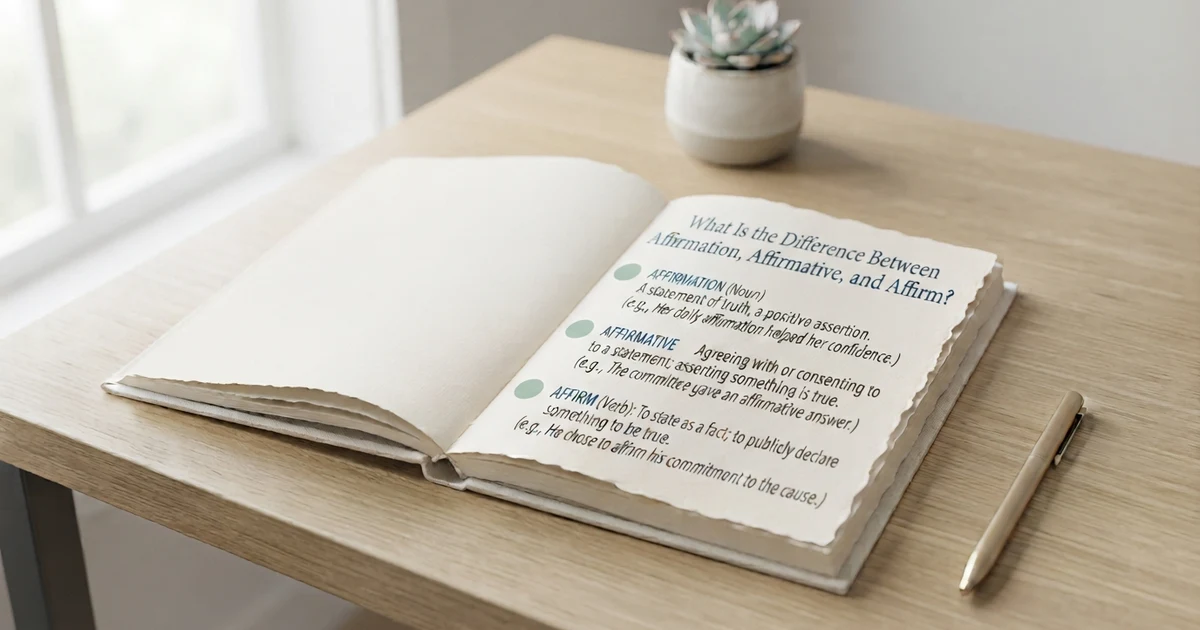
What Is the Difference Between Affirmation, Affirmative, and Affirm?
These words are closely related, but they serve different grammatical purposes.
| Word | Part of speech | Meaning | Example |
|---|---|---|---|
| Affirm | Verb | To state or confirm something | I affirm my decision. |
| Affirmation | Noun | A statement of support or confirmation | Her affirmation encouraged me. |
| Affirmative | Adjective or noun | Expressing agreement or a positive response | He gave an affirmative answer. |
The main difference is how each word functions in a sentence.
- Affirm describes an action.
- Affirmation names the statement or act of confirming.
- Affirmative describes agreement or a positive response.
Understanding these differences helps you choose the correct word when speaking or writing.
How to Use Affirmations Correctly
Knowing how to pronounce affirmation is one part of learning the word. Understanding how affirmations work in everyday life is another.
If you want to use affirmations as supportive self-talk, keep the following principles in mind.
Choose Words You Can Believe
An affirmation should feel meaningful rather than completely disconnected from your experience.
For example, if saying “I am perfect at everything” feels unrealistic, you might prefer:
“I am learning and improving through practice.”
A believable statement can feel more comfortable and easier to use consistently.
Keep Your Statements Simple
Long or complicated statements are not necessary.
Try short phrases such as:
- I can learn.
- I deserve respect.
- I can ask for help.
- My progress matters.
- I can begin again.
Simple language makes affirmations easier to remember and personalize.
Connect Words With Actions
Affirmations can serve as reminders, but they do not replace practical steps.
For example, saying “I am prepared for my exam” can be paired with reviewing your notes, asking questions, and creating a study schedule.
The statement provides encouragement while your actions support your goal.
Make Them Personal
The most useful affirmation is one that connects with your own circumstances, values, or intentions.
Instead of copying every phrase you see online, consider what you genuinely need to hear.
You can adjust the wording until it sounds natural to you.
Common Pronunciation Mistakes to Avoid
Some English words become confusing because their spelling does not perfectly reflect how they sound in everyday speech.
Here are a few common mistakes learners can watch for when saying affirmation.
Putting Stress on the Wrong Syllable
The main emphasis belongs on the third syllable.
Placing equal stress on every syllable can make the word sound unnatural. Practice giving the middle portion more emphasis while keeping the remaining sounds smooth.
Pronouncing Every Letter Too Strongly
English pronunciation often involves reduced vowel sounds. The ending of affirmation is a good example of this.
Avoid treating every written letter as a separate, equally strong sound. Listen to the complete word and imitate its natural rhythm.
Confusing Affirmation With Affirmative
Although these words share a root, their endings differ.
Affirmation refers to a statement or act of confirming, while affirmative describes agreement or a positive response.
Pay attention to the complete word rather than focusing only on the similar beginning.
Rushing Through the Word
When you are unfamiliar with a word, speaking too quickly can make its syllables blend together.
Start at a comfortable pace. As the pronunciation becomes familiar, you can naturally increase your speed.
Practicing Without Context
Repeating a word by itself is useful, but using it in sentences provides additional practice.
Try saying a sentence such as, “My daily affirmation reminds me to stay patient.”
This helps you become comfortable with both the pronunciation and the meaning.
How to Remember the Pronunciation of Affirmation
You do not need a complicated memorization technique to remember this word.
A few simple habits can make practice easier.
1. Practice the syllables. Break the word into four parts and notice where the emphasis falls.
2. Read it aloud. Say the word a few times at a natural pace.
3. Use it in writing. Include it in a sentence, journal entry, or vocabulary note.
4. Learn related words. Practice affirm, affirmative, and affirmation together.
5. Review it regularly. Short, occasional practice sessions can help reinforce what you have learned.
You can also save this pronunciation guide and return to it whenever you need a reminder.
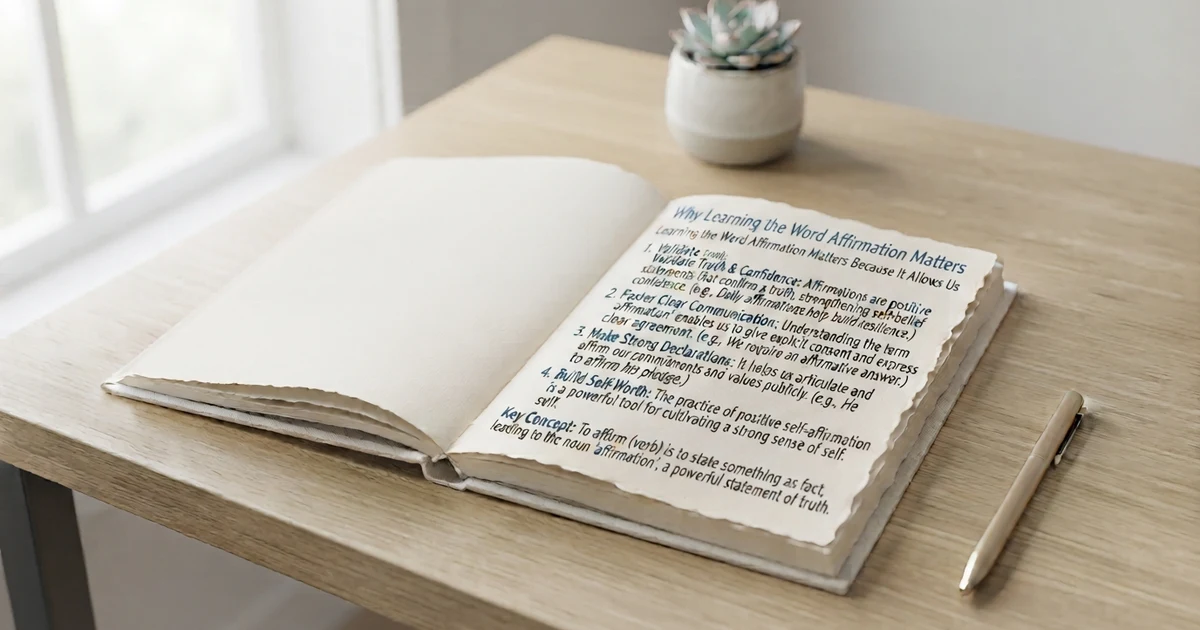
Why Learning the Word Affirmation Matters
Learning a word involves more than memorizing its spelling. Understanding its pronunciation, meaning, and context allows you to use it more naturally.
The word affirmation appears in discussions about communication, education, personal development, and positive self-talk. Knowing what it means can help you understand articles, conversations, and books that use it.
It is also a useful vocabulary word for English learners because it connects to several related terms, including affirm, affirmative, and self-affirmation.
Most importantly, understanding the word allows you to recognize when someone is using it to describe encouragement, agreement, or a supportive statement.
Conclusion
Learning how to pronounce affirmation becomes much easier when you break the word into syllables, recognize its stressed sound, and practice it in everyday sentences. The word has four syllables, with the strongest emphasis on the third, and it refers to a supportive statement or an expression of confirmation. Understanding its meaning also helps you use it correctly in conversations and writing. Save this guide for future vocabulary practice, and remember that becoming comfortable with a new word takes time. A little practice can help you speak more naturally and confidently.
Frequently Asked Questions
1. How do you pronounce affirmation correctly?
Affirmation is pronounced with four syllables: af-fir-ma-tion. The strongest emphasis falls on the third syllable. Practicing the word slowly before using it in a sentence can help you become more comfortable with its pronunciation.
2. How many syllables are in affirmation?
The word affirmation has four syllables. Breaking it into smaller parts makes it easier to understand and remember its pronunciation.
3. What is the phonetic spelling of affirmation?
In American English, the International Phonetic Alphabet (IPA) transcription is /ˌæf.ɚˈmeɪ.ʃən/. This notation represents the word’s sounds and shows where the main stress occurs.
4. What does affirmation mean in simple words?
An affirmation is a positive, supportive, or confirming statement. It can express encouragement, reinforce a personal value, or communicate agreement with something.
5. Is affirmation a positive word?
Affirmation is commonly associated with positive communication and supportive self-talk. However, its broader meaning also includes confirmation or agreement, depending on the context.
6. What is an example of an affirmation?
“I am capable of learning and growing” is an example of a positive affirmation. It expresses encouragement and focuses on personal development.
7. What is the difference between affirmation and confirmation?
An affirmation often expresses support, agreement, or a positive statement. Confirmation specifically refers to verifying or establishing that something is true, correct, or certain. The two words can overlap in some contexts but are not always interchangeable.
8. How can I practice saying affirmation?
Start by identifying its four syllables and the stressed syllable. Repeat the word slowly, read example sentences aloud, and practice using it in conversation. Regular, comfortable practice can help improve familiarity.
9. Can affirmation be used in a sentence?
Yes. For example: “She wrote an affirmation in her journal to remind herself of her personal values.” The word can be used in both everyday conversation and formal writing.
10. What is the difference between affirmation and affirmations?
Affirmation is the singular form, referring to one statement or act of confirming. Affirmations is the plural form, referring to multiple statements or acts. For example, “I read one affirmation each morning” uses the singular, while “I keep a list of affirmations” uses the plural.