

Pricing an affirmation bundle digital product can feel confusing when you are just starting out. You want to offer something valuable, attract customers, and earn a fair amount without making your products too expensive or undervaluing your work. The good news is that you do not need a complicated pricing strategy to get started.
Learning how to price affirmation bundle digital products involves understanding your audience, the value of your content, the number of items included, and the time spent creating them. Whether you sell printable affirmation cards, digital journals, affirmation worksheets, or complete self-care bundles, a thoughtful pricing approach can help you make informed decisions and build a more sustainable digital product business.
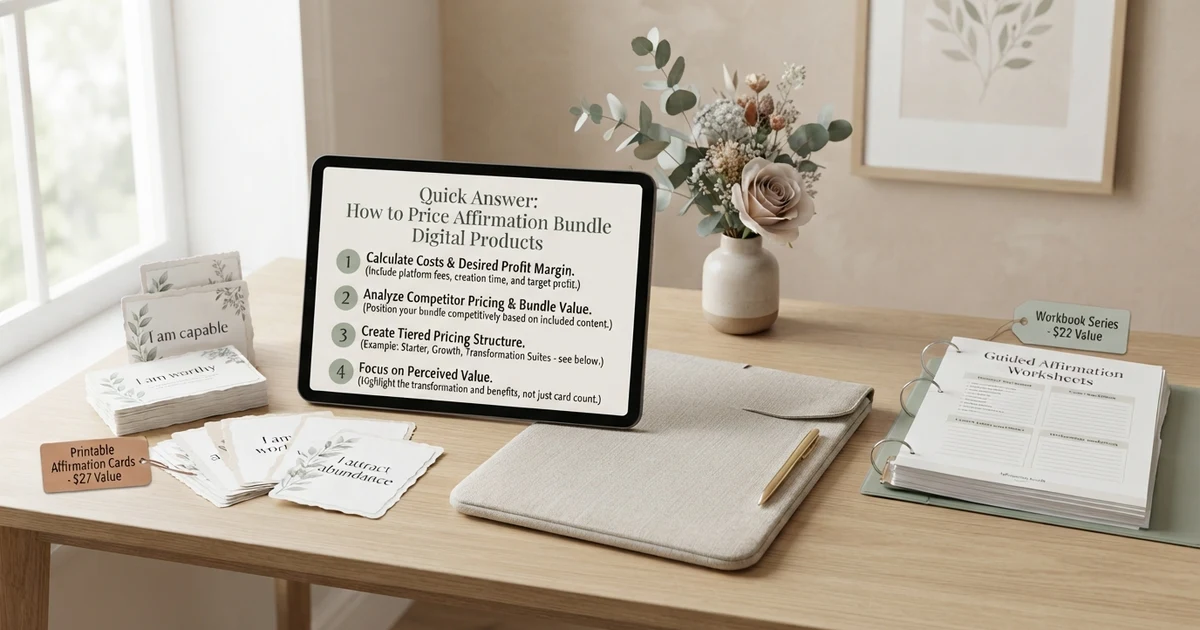
Quick Answer: How to Price Affirmation Bundle Digital Products
To price an affirmation bundle digital product, consider its content, design quality, usefulness, production time, and the needs of your target audience. Start by researching similar products, calculating your costs, and choosing a price that reflects the value of your bundle.
For example, a small collection of printable affirmation cards may have a different price from a comprehensive bundle containing cards, journals, worksheets, and themed affirmation lists. The goal is to create a fair relationship between what customers receive and what they pay.
What Does Pricing an Affirmation Bundle Digital Product Mean?
Pricing an affirmation bundle digital product means deciding how much customers should pay to access a collection of digital affirmation resources.
An affirmation bundle may contain several related products packaged together to provide a convenient and organized experience. Instead of purchasing individual resources, customers receive a collection designed around a particular purpose, theme, or audience.
Examples include:
- Printable positive affirmation cards
- Self-love affirmation worksheets
- Daily affirmation journals
- Morning and evening affirmation collections
- Mindfulness affirmation printables
- Confidence-building affirmation cards
- Digital self-care planners
- Affirmation coloring pages
The price represents more than the number of files included. It also reflects the thought, organization, design, convenience, and practical usefulness of the complete bundle.
For example, a thoughtfully organized collection of 50 affirmation cards with a matching journal may offer a different experience from 50 unformatted phrases in a basic document.
How to Price Affirmation Bundle Digital Products: Examples
Understanding pricing becomes easier when you look at different types of digital bundles.
The following examples are illustrative starting points in US dollars, not verified market averages or guaranteed selling prices. Actual prices should be adjusted based on your audience, product quality, competition, and sales results.
| Digital affirmation bundle | Illustrative starting price |
|---|---|
| Small affirmation card collection | $3–$7 |
| Printable affirmation worksheets | $4–$9 |
| Daily affirmation journal bundle | $5–$12 |
| Self-love affirmation collection | $6–$15 |
| Affirmation cards and matching journal | $8–$18 |
| Complete self-care affirmation bundle | $12–$25 |
| Extensive themed affirmation library | $18–$35 |
These examples can help beginners understand how product scope might influence pricing.
A smaller bundle with a focused purpose may be easier to create and purchase. A larger collection with multiple formats, thoughtful organization, and additional resources may justify a higher price when customers can clearly understand its benefits.
However, adding more pages does not automatically make a product more valuable. A smaller, well-designed bundle can be more useful than a large collection filled with repetitive content.
What Factors Affect the Price of an Affirmation Bundle?
Several factors can influence how much you charge for your digital products. Considering these elements together can help you make a more informed pricing decision.
1. Number of Items Included
The number of resources in a bundle is one factor customers may consider.
For example, a bundle containing 20 affirmation cards is different from one containing 100 cards, a printable journal, and several worksheets.
However, quantity should support usefulness rather than replace it. Customers should be able to understand why each item belongs in the collection.
2. Design and Presentation
Visual presentation plays an important role in printable products.
Consider whether your bundle includes:
- Consistent fonts and colors
- Clear page layouts
- Readable text
- Print-friendly designs
- Organized PDF files
- Different page sizes when useful
- Easy-to-follow instructions
A clean, consistent design can make a digital bundle easier to use and understand.
3. Originality of Content
Original writing and thoughtful organization can distinguish your bundle from generic collections.
For example, a self-love bundle might include affirmations, reflection questions, and practical journaling activities that work together.
The value comes from how the resources support a clear purpose, not simply from the number of affirmations included.
4. Time and Effort
Consider the time you spend researching, writing, editing, designing, formatting, and testing your product.
Although your time does not determine the entire selling price, it helps you understand the resources required to create and maintain your digital products.
5. Target Audience
Different audiences may have different expectations.
A beginner-friendly printable collection, a classroom resource, and a comprehensive self-care journal may appeal to different customers.
Think about who your product serves and what that person expects to receive before choosing a price.
6. Selling Platform Fees
If you sell through a digital marketplace or payment processor, account for applicable transaction fees, payment processing charges, and other platform costs.
Your displayed price is not necessarily the amount you receive after a sale.
Review the current fee structure of your chosen platform before finalizing your pricing.
How to Calculate a Fair Price for Your Digital Bundle
A simple calculation can help you understand your minimum acceptable selling price.
Start by identifying your production costs, estimated platform fees, and the amount you want to earn from each sale.
For example, imagine you create an affirmation bundle with the following estimated expenses:
| Expense | Example amount |
|---|---|
| Design resources | $10 |
| Formatting and preparation | $15 |
| Other production expenses | $5 |
| Total initial cost | $30 |
These figures are hypothetical and are intended only to demonstrate the calculation.
If you sell the bundle for $10, you would need to account for applicable fees and other expenses before determining how much you have earned.
Because digital products can often be sold repeatedly without recreating the entire file, you can also consider how many sales might be needed to recover your initial production costs.
For instance, ignoring platform fees and other variable expenses, three sales at $10 would generate $30 in revenue. That would cover the example’s initial production cost, but it would not necessarily represent your final profit.
The important lesson is to distinguish revenue from profit and include all relevant expenses in your calculations.

Related Terms: Pricing, Value, and Profit Explained
When learning how to price affirmation bundle digital products, it helps to understand several related terms.
| Term | Simple meaning |
|---|---|
| Selling price | The amount a customer pays for your product |
| Production cost | The resources required to create the product |
| Revenue | The total money received from sales before expenses |
| Profit | The amount remaining after relevant costs are deducted |
| Perceived value | How useful or worthwhile customers consider the product |
| Bundle pricing | Offering several related products together for one price |
| Promotional pricing | A temporary price reduction used for a specific offer |
These terms are connected, but they are not interchangeable.
For example, a bundle may generate substantial revenue while producing a smaller profit if its costs and fees are high. Similarly, a low selling price does not automatically make a product attractive if customers cannot understand its usefulness.
A clear pricing strategy considers both the financial side of selling and the experience customers receive.
How to Create an Affirmation Bundle That Supports Its Price
Before setting a final price, make sure your product offers a clear and organized experience.
Here are some practical steps.
Step 1: Choose a Specific Theme
Start with one main purpose rather than combining unrelated resources.
Possible themes include:
- Self-love and self-acceptance
- Daily positive affirmations
- Confidence and personal growth
- Mindfulness and reflection
- Morning motivation
- Evening journaling
- Gratitude and appreciation
A focused theme helps customers understand what they are purchasing.
Step 2: Select Complementary Resources
Choose items that work naturally together.
For example, a daily affirmation bundle might include:
- A printable affirmation card collection
- A morning reflection worksheet
- A simple journaling page
- A weekly self-reflection tracker
- Instructions for using the resources
Each item should contribute something useful to the overall collection.
Step 3: Write Believable Affirmations
Affirmations are most useful as supportive self-talk when the wording feels realistic and personally meaningful.
Instead of relying entirely on exaggerated statements, consider gentle phrases such as:
- I can take one step at a time.
- I am learning to trust my decisions.
- My progress deserves recognition.
- I can approach today with patience.
- I am allowed to grow at my own pace.
These examples can be adapted to match the theme and audience of your bundle.
Step 4: Make the Files Easy to Use
Organize your digital products so customers can quickly find what they need.
Use descriptive file names, consistent formatting, and clear instructions. If your bundle is designed for printing, check that the pages remain readable and properly aligned.
Step 5: Explain What Customers Receive
Your product description should clearly state:
- The number of included resources
- Available file formats
- Whether the product is printable or digital
- The intended audience
- The main themes covered
- Any printing or usage instructions
Customers should not have to guess what is included in the purchase.
Common Pricing Mistakes to Avoid
Even a useful affirmation bundle can struggle if its pricing or presentation creates confusion.
Here are some common mistakes worth avoiding.
1. Choosing a Price Without Research
Setting a price based entirely on personal preference may cause you to overlook customer expectations and competing products.
Research comparable products to understand how sellers present their content, formats, and pricing.
Use this research as context rather than copying another seller’s price without considering your own product.
2. Charging Too Little Without Considering Costs
A low price may seem like an easy way to attract customers, but it can leave little room for platform fees, updates, and other expenses.
Calculate your costs before deciding how low you can reasonably price a product.
3. Assuming More Pages Always Mean More Value
A bundle with 200 repetitive affirmation statements may not be more useful than a carefully organized collection of 50 original statements.
Prioritize clarity, relevance, and practical use over page count alone.
4. Ignoring the Customer Experience
A product may contain excellent content but still frustrate customers if the files are difficult to open, print, or navigate.
Test the complete customer experience before publishing your bundle.
5. Changing Prices Too Frequently
Constant price changes can make it difficult to understand how customers respond to your offers.
Instead, choose a reasonable starting price, observe customer feedback and sales patterns, and make adjustments when you have a clear reason.
6. Making Unsupported Promises
Avoid claiming that an affirmation bundle will guarantee happiness, eliminate anxiety, or solve personal challenges.
Describe your resources honestly as tools for reflection, positive self-talk, and personal development.
Clear expectations help customers understand what your product can and cannot offer.
How to Use Pricing Naturally in Your Digital Product Strategy
Pricing is not a one-time decision. It can be reviewed as your products, audience, and experience develop.
For beginners, a practical approach is to start with a small collection, learn how customers respond, and improve the product based on genuine feedback.
You can also organize your products into different levels.
For example:
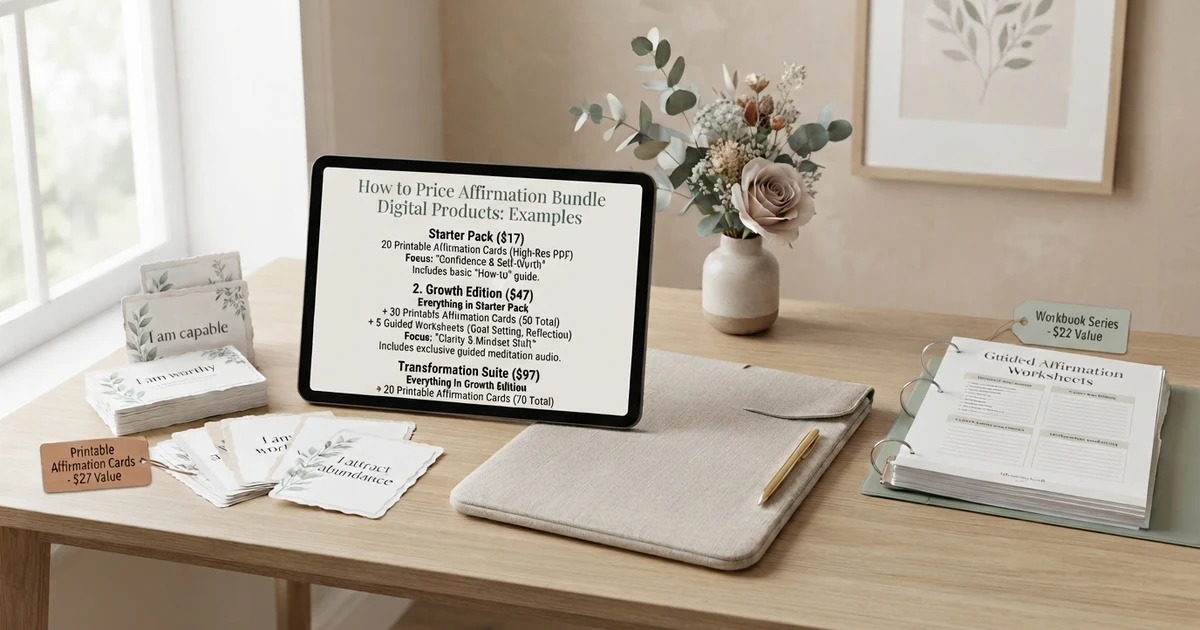
- Starter bundle: A focused collection of affirmation cards.
- Standard bundle: Cards, worksheets, and a matching journal.
- Complete bundle: A broader collection of themed printables and reflection resources.
This structure gives customers a clear understanding of the available options without making the purchasing process unnecessarily complicated.
You can also test different product descriptions, improve preview images, and clarify what each bundle contains. These changes may help customers make more informed purchasing decisions without requiring you to change the price.
The key is to treat pricing as part of the complete product experience rather than an isolated number.

How to Price Affirmation Bundles for Beginners
If you are new to selling digital affirmation products, begin with a simple process.
First, create one focused product. Choose a theme you understand and develop a useful collection rather than trying to build an extensive product library immediately.
Second, research comparable listings. Look at products with similar content, formats, and intended audiences. Pay attention to how sellers communicate their value.
Third, calculate your expenses. Include design tools, platform fees, and other relevant costs.
Fourth, select a reasonable starting price. Choose an amount that reflects your product while remaining appropriate for your intended audience.
Finally, review your results. Consider customer questions, feedback, sales activity, and the time required to maintain your product.
You do not need to have every detail perfected before launching your first bundle. A thoughtful starting point, followed by careful improvements, can help you develop a more informed pricing approach over time.
Conclusion
Learning how to price affirmation bundle digital products is about balancing customer value, product quality, production costs, and your business goals. A fair price should reflect the usefulness of your collection rather than relying only on the number of pages or affirmation statements included.
Start by researching similar products, calculating your expenses, and creating a focused bundle that is easy to understand and use. As you gain experience, review customer feedback and adjust your approach when necessary. Remember that thoughtful content, clear presentation, and honest product descriptions are just as important as the price itself. With a practical strategy, you can make more confident pricing decisions and build digital affirmation products that serve your audience well.
Frequently Asked Questions
1. How much should I charge for an affirmation bundle?
The appropriate price depends on the number of resources, design quality, originality, audience, and associated costs. A small printable collection may be priced differently from a comprehensive bundle containing cards, journals, and worksheets. Research comparable products and use your expenses to establish a reasonable starting point.
2. What is a good starting price for digital affirmation cards?
A small affirmation card collection could use an illustrative starting range of $3–$7, although this is not a verified market average. Consider your design, content, file formats, and audience before selecting a final price.
3. How do I calculate the price of a digital product?
Add your initial production costs and relevant variable expenses, then account for platform fees and the amount you want to earn. Compare your calculated price with similar products to see whether it makes sense for your intended customers.
4. Are affirmation bundles more valuable than individual products?
Bundles can offer convenience by combining related resources in one purchase. However, their value depends on how useful and well-organized the included items are. A bundle is not automatically more valuable simply because it contains more files.
5. Should I offer discounts on affirmation bundles?
Discounts can be useful for specific promotions or product launches, but they should be planned carefully. Consider your costs and the regular price before offering a reduction. Make sure customers understand whether the discount is temporary or part of your usual pricing.
6. How can I make my affirmation bundle worth its price?
Focus on original content, consistent design, practical organization, readable files, and clear instructions. Include resources that complement one another and explain exactly what customers receive.
7. Does the number of affirmations affect the selling price?
It can influence customer expectations, but quantity is only one consideration. Relevance, originality, presentation, and ease of use also contribute to how customers perceive a product.
8. How often should I review my digital product prices?
Review your prices when you make significant product improvements, notice changes in costs, receive meaningful customer feedback, or identify relevant changes in comparable listings. You do not need to change your prices on a fixed schedule if there is no clear reason.
9. Can I sell affirmation bundles as printable PDFs?
Yes. Printable PDFs are one format you can use for affirmation cards, worksheets, and journals. Make sure your product description explains the file format, printing requirements, and whether customers receive physical items or digital downloads.
10. What is the biggest mistake beginners make when pricing digital affirmation products?
One common mistake is choosing a price without considering both the customer’s experience and the seller’s expenses. A thoughtful approach considers product usefulness, presentation, comparable offers, production costs, and realistic business goals.