

Affirmations are simple, positive statements that can help you develop a more supportive relationship with yourself. They give you a way to focus on encouraging thoughts, recognize your strengths, and approach everyday challenges with greater self-awareness. Whether you want to build confidence, practice self-love, reduce negative self-talk, or start a mindful morning routine, the right affirmation can be a helpful place to begin.
You do not need complicated words or a perfect mindset to use affirmations. A short, honest statement that feels meaningful to you is enough. In this guide, you will find affirmation examples for different situations, learn what makes an affirmation useful, and discover how to include these statements naturally in your daily life.
Quick Answer: What Are Some Examples of Affirmations?
Affirmations are short, intentional statements that express supportive beliefs, values, or personal goals. Here are some simple examples:
- I am worthy of love and respect.
- I can learn from my mistakes.
- I deserve to treat myself with kindness.
- I am capable of taking small steps forward.
- My voice and opinions matter.
- I can face today one moment at a time.
- I am allowed to grow at my own pace.
- I choose progress over perfection.
- I can be proud of my efforts.
- I deserve moments of peace and happiness.
These statements can be spoken aloud, written in a journal, displayed on a note, or repeated quietly whenever you need a reminder of what matters to you.

What Are Affirmations? Meaning and Simple Definition
An affirmation is a statement that expresses a belief, intention, or encouraging perspective. In everyday life, affirmations are often used as a form of positive self-talk to help people focus on their values, strengths, and goals.
For example, saying “I can learn something new every day” is an affirmation because it encourages a growth-oriented perspective.
Affirmations do not have to describe something you already feel completely confident about. They can also reflect the kind of mindset you want to practice.
A useful affirmation should feel personal, understandable, and believable enough to work with. It is not about pretending that difficulties do not exist. Instead, it offers a constructive way to respond to them.
150+ Positive Affirmation Examples for Everyday Life
The following affirmation examples cover different areas of daily life, including confidence, self-love, personal growth, relationships, work, and emotional well-being. Choose the statements that connect with your current needs, or use them as inspiration to write your own.
1. Short Affirmation Examples
Short affirmations are easy to remember and convenient to repeat throughout the day. They are particularly useful when you want a simple reminder without a lengthy statement.
- I am enough.
- I am worthy.
- I choose kindness.
- I trust my journey.
- I can grow.
- I deserve respect.
- I welcome new possibilities.
- I am learning.
- I choose hope.
- I can begin again.
- I honor my needs.
- I value myself.
- I embrace progress.
- I am open to change.
- I deserve happiness.
2. Positive Affirmation Examples
Positive affirmations encourage a constructive outlook without requiring you to ignore real challenges.
- I can find something meaningful in each day.
- I welcome opportunities to learn and grow.
- I choose thoughts that support my well-being.
- I can approach challenges with patience.
- I appreciate the good things in my life.
- I am open to positive experiences.
- I can make thoughtful choices.
- I deserve moments of joy.
- I can create a more supportive daily routine.
- I recognize the progress I have made.
- I can respond to difficulties with care.
- I allow myself to enjoy small victories.
- I am grateful for opportunities to improve.
- I can make today meaningful in my own way.
- I choose to notice my strengths.
3. Self-Love Affirmation Examples
Self-love affirmations focus on self-respect, acceptance, and treating yourself with the same consideration you offer others.
- I deserve the kindness I give to other people.
- I accept myself as a person who is always learning.
- My worth is not determined by other people’s opinions.
- I can appreciate myself without being perfect.
- I deserve healthy boundaries.
- I am allowed to prioritize my needs.
- I treat myself with patience and understanding.
- I can celebrate who I am becoming.
- I deserve relationships built on mutual respect.
- I am worthy of care and compassion.
- I can forgive myself for being human.
- I respect my feelings and experiences.
- I do not need to earn my basic worth.
- I can make space for my own happiness.
- I choose to speak to myself with kindness.
4. Confidence Affirmation Examples
Confidence affirmations can help you practice a more encouraging inner dialogue before unfamiliar situations, important conversations, or personal challenges.
- I can trust myself to make thoughtful decisions.
- My ideas deserve to be heard.
- I am capable of learning difficult things.
- I can speak with clarity and respect.
- I do not need to know everything to begin.
- I can handle new experiences one step at a time.
- I recognize the strengths I bring to a situation.
- I am allowed to take up space.
- I can learn from feedback without losing confidence.
- My mistakes do not define my abilities.
- I can be brave while still feeling uncertain.
- I believe in my ability to improve.
- I deserve to be taken seriously.
- I can express my thoughts honestly.
- I am building confidence through experience.
5. Morning Affirmation Examples
Morning affirmations offer a simple way to set an intention for the day ahead. You can repeat one while getting ready, eating breakfast, or writing in your journal.
- I welcome this new day with an open mind.
- I can approach today with patience.
- I give myself permission to start slowly.
- I will focus on what I can control.
- I can make meaningful progress today.
- I choose to meet myself with kindness.
- I am ready to learn from today’s experiences.
- I can adjust my plans when necessary.
- I deserve a balanced and thoughtful day.
- I will recognize my efforts, not just my results.
- I can take one task at a time.
- I welcome opportunities to grow.
- I can make room for rest and productivity.
- I choose to begin with intention.
- I am grateful for another opportunity to try.
6. Daily Affirmation Examples
Daily affirmations are flexible statements that can support a consistent self-reflection practice.
- I can make choices that reflect my values.
- I am learning to trust my own judgment.
- I can take breaks without feeling guilty.
- I deserve to be treated with respect.
- I can make progress at my own pace.
- I am allowed to change my mind.
- I can approach unexpected moments with flexibility.
- I recognize what I have accomplished.
- I can ask for help when I need it.
- I make room for both effort and rest.
- I can learn something useful from today.
- I choose to focus on the next helpful step.
- I am building habits that support my goals.
- I can be proud of small improvements.
- I deserve a life that reflects what matters to me.
7. Self-Esteem Affirmation Examples
Self-esteem affirmations encourage a more balanced view of your value, abilities, and personal identity.
- My worth does not depend on constant achievement.
- I have qualities that make me a valuable person.
- I can respect myself while continuing to improve.
- I deserve to be included and appreciated.
- I can recognize my strengths without comparing myself to others.
- My perspective has value.
- I am more than my mistakes.
- I can accept compliments with gratitude.
- I deserve fairness and consideration.
- I can take pride in my personal growth.
- I am allowed to have different needs from other people.
- I can acknowledge my abilities honestly.
- I deserve to feel comfortable expressing myself.
- I can build self-respect through everyday choices.
- I am worthy of belonging.
8. Growth Mindset Affirmation Examples
Growth mindset affirmations focus on learning, adaptability, and the understanding that skills can develop through practice and experience.
- I can improve through consistent effort.
- Every challenge gives me a chance to learn something.
- I do not have to be an expert to begin.
- I can turn feedback into useful information.
- My abilities can develop with practice.
- I am allowed to learn through trial and error.
- I can approach unfamiliar tasks with curiosity.
- Progress can happen in small steps.
- I can change my approach when something is not working.
- I value learning as much as achievement.
- I can develop new skills over time.
- I do not need immediate results to keep learning.
- I can learn from people with different experiences.
- I am capable of adapting to change.
- I can keep going while allowing myself to rest.
9. Calm and Peaceful Affirmation Examples
These affirmations can serve as gentle reminders to slow down, notice the present moment, and respond thoughtfully.
- I can give myself a moment to pause.
- I do not have to solve everything right now.
- I can focus on one thing at a time.
- I allow myself to take a peaceful break.
- I can respond instead of reacting immediately.
- I deserve moments of quiet.
- I can release the need to control every detail.
- I give myself permission to slow down.
- I can approach uncertainty with patience.
- I make room for stillness in my day.
- I can return my attention to the present.
- I deserve a gentle pace when I need one.
- I can acknowledge my feelings without judging them.
- I choose to make space for calm moments.
- I can take a breath and decide what to do next.
10. Work and Career Affirmation Examples
Work-related affirmations can help you approach responsibilities with intention, recognize your contributions, and maintain a balanced perspective.
- My work has value.
- I can approach my responsibilities with focus.
- I am capable of developing professional skills.
- I can ask questions when something is unclear.
- I deserve respect in my workplace.
- I can manage my tasks one step at a time.
- I am allowed to learn from professional mistakes.
- I can communicate my ideas clearly.
- My progress matters, even when it is gradual.
- I can set reasonable boundaries around my time.
- I recognize the effort I bring to my work.
- I can seek support when a challenge feels difficult.
- I do not need to compare my career path with someone else’s.
- I can celebrate meaningful achievements.
- I am building experience with every opportunity.
11. Relationship Affirmation Examples
Relationship affirmations focus on communication, respect, connection, and healthy personal boundaries.
- I deserve relationships based on mutual respect.
- I can communicate my needs honestly.
- I listen with care and speak with consideration.
- I can maintain my individuality in a relationship.
- I am worthy of genuine connection.
- I can express appreciation for the people I love.
- I respect other people’s boundaries.
- I can set boundaries without dismissing someone else’s feelings.
- I deserve kindness in my relationships.
- I can address misunderstandings with patience.
- I allow trust to develop through consistent actions.
- I can be caring without neglecting myself.
- My feelings deserve thoughtful consideration.
- I can build connections through honesty.
- I welcome relationships that support personal growth.
12. Gratitude Affirmation Examples
Gratitude affirmations encourage you to notice meaningful parts of life, including ordinary experiences that might otherwise go unnoticed.
- I appreciate the people who support me.
- I am grateful for opportunities to learn.
- I can notice beauty in ordinary moments.
- I appreciate the effort I put into my day.
- I welcome moments of connection and joy.
- I can recognize what is going well.
- I am thankful for the lessons I have learned.
- I appreciate the comfort of familiar routines.
- I can find meaning in small experiences.
- I am grateful for chances to begin again.
- I appreciate the kindness I receive.
- I can acknowledge both challenges and blessings.
- I value the time I spend with people I care about.
- I am thankful for my ability to keep learning.
- I can make room for appreciation every day.

Affirmation Examples for Different Situations
Sometimes, the most useful affirmation is one that matches a specific moment. Instead of repeating a general statement, you can choose words that address what you are experiencing.
| Situation | Affirmation example |
|---|---|
| Before a difficult conversation | I can speak honestly and respectfully. |
| When starting something new | I am allowed to learn as I go. |
| After making a mistake | I can learn from this and move forward. |
| When feeling overwhelmed | I can focus on the next manageable step. |
| Before an important task | I can prepare and give this my best effort. |
| When comparing yourself to others | My journey is my own. |
| When setting boundaries | My needs deserve consideration. |
| During a busy day | I can pause and return to what matters. |
| When facing uncertainty | I can make thoughtful choices with the information I have. |
| When celebrating progress | I am proud of the effort I have made. |
The goal is not to find a perfect sentence for every situation. It is to choose a statement that helps you approach the moment with greater awareness and self-respect.
Affirmations vs. Positive Thinking vs. Mantras
These terms are related, but they describe different practices. Understanding the distinctions can help you choose an approach that suits your preferences.
| Practice | Simple meaning | Example |
|---|---|---|
| Affirmations | Intentional statements that reinforce a belief, value, or goal | I can learn from every experience. |
| Positive thinking | Looking for constructive or hopeful perspectives while recognizing reality | This situation is difficult, but I can consider my options. |
| Mantras | Words, phrases, or sounds repeated to support focus or reflection | I am here, in this moment. |
| Gratitude practice | Noticing and appreciating meaningful aspects of life | I appreciate the support I received today. |
| Positive self-talk | The way you speak to yourself internally | I can take this one step at a time. |
An affirmation can be part of positive self-talk, and some affirmations can also function as mantras. However, these practices do not need to be treated as interchangeable.
The best choice depends on what you want to practice. You might prefer a specific affirmation for confidence, a mantra for reflection, or a gratitude statement at the end of the day.
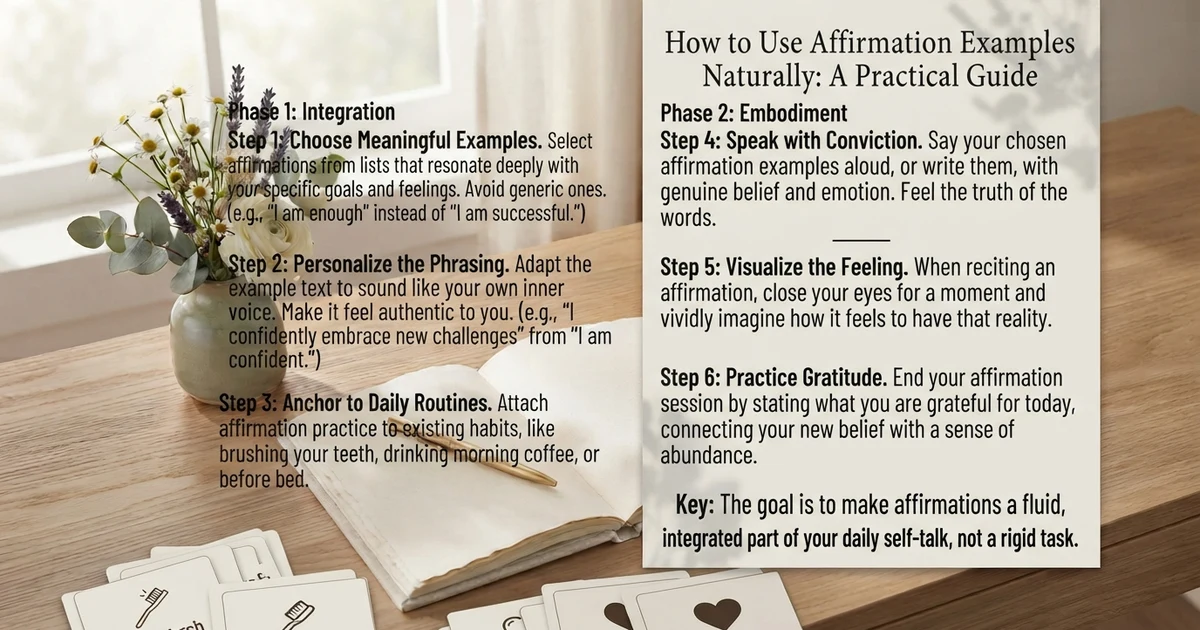
How to Use Affirmation Examples Naturally
Affirmations are most practical when they fit into your existing routine. You do not need to create a complicated schedule or repeat dozens of statements every day.
Here are seven simple ways to use them.
1. Choose One or Two Statements
Begin with a small number of affirmations that relate to your current priorities. For example, if you want to practice self-confidence, choose a statement about trusting your abilities.
A few meaningful words can be easier to remember than a long list.
2. Make the Words Personal
You can adjust an affirmation so that it sounds natural in your own voice.
For example:
- General: I am capable of growth.
- Personal: I am learning to trust myself as I develop new skills.
Personal wording can make a statement feel more relevant to your experiences.
3. Repeat Them at a Convenient Time
You might read an affirmation in the morning, write one before bed, or revisit a statement before a challenging task.
Consistency matters more than choosing a particular time of day.
4. Write Them in a Journal
Writing affirmations gives you an opportunity to reflect on why a statement matters.
You could use a simple journal format:
- Today’s affirmation:
- Why I chose it:
- One small action that supports it:
This approach connects encouraging self-talk with practical behavior.
5. Pair Affirmations With Everyday Actions
An affirmation can remind you of an intention, while your actions help you put that intention into practice.
For example, if your affirmation is “I respect my needs,” you might support it by taking a reasonable break or communicating a boundary.
The statement is a reminder, not a substitute for action.
6. Use Language That Feels Believable
If a statement feels too far removed from your current experience, try a gentler version.
Instead of saying “I am completely confident in every situation,” you might say “I am learning to feel more comfortable in unfamiliar situations.”
A believable statement can be easier to engage with than one that creates internal resistance.
7. Review and Update Your Affirmations
Your priorities can change over time. An affirmation that felt meaningful last month may no longer reflect what you need today.
Review your list occasionally and keep the statements that remain useful. Replace the others with words that better reflect your current goals and values.
How to Write Your Own Affirmations
Creating your own affirmations is a straightforward process. You do not need special writing skills or complicated language.
Follow these steps to develop statements that feel authentic.
Step 1: Identify your focus. Think about the area of life where you want more encouragement. It might be confidence, patience, self-respect, learning, or relationships.
Step 2: Choose a clear message. Decide what you want to remind yourself of. Keep the central idea simple.
Step 3: Use supportive language. Focus on what you want to practice rather than criticizing yourself for what you feel you lack.
Step 4: Make the statement realistic. Choose wording that leaves room for your current circumstances and ongoing growth.
Step 5: Connect it to a meaningful action. Consider one small behavior that reflects the statement.
For example:
- Focus: Personal growth
- Intention: Become more comfortable learning new skills
- Affirmation: I can improve through practice and patience.
- Supporting action: Spend a little time practicing a skill today.
This method helps keep affirmations connected to everyday life rather than treating them as promises of instant change.
Common Mistakes to Avoid When Using Affirmations
Affirmations are simple, but a few common habits can make them feel less useful or less personal.
Choosing Statements That Feel Completely Unbelievable
If an affirmation creates a strong sense of contradiction, try adjusting the wording. A statement about learning or becoming can feel more natural than one claiming immediate perfection.
Repeating Words Without Understanding Them
It is easy to repeat a phrase automatically. Taking a moment to consider its meaning can make the practice more intentional.
Expecting Immediate Results
Affirmations are not guaranteed to change your feelings, circumstances, or behavior. Treat them as one possible self-reflection tool rather than a quick solution.
Using Affirmations to Ignore Difficult Emotions
You do not need to force yourself to feel positive all the time. An encouraging statement can acknowledge difficulty while still offering support.
For example, “This is a challenging day, and I can be kind to myself through it” leaves room for both honesty and encouragement.
Comparing Your Practice With Someone Else’s
There is no single correct affirmation routine. Some people prefer writing, while others find quiet repetition more comfortable. Choose a method that fits your needs.
Forgetting the Role of Action
Affirmations can help clarify intentions, but meaningful goals often require practical steps, patience, and support. Let your statements guide your choices rather than replace them.
Free Affirmation Examples Printable PDF: Save the List

Keeping your favorite affirmations in a convenient place can make them easier to revisit. You can create a simple printable page using the examples in this article.
Consider including:
- Five short affirmations for everyday reminders
- Three statements focused on your current goals
- One affirmation for challenging moments
- A blank section for writing personal affirmations
- A small journal prompt for daily reflection
You can print the page, keep it in a notebook, or save it digitally for easy access.
Save the list: Choose the statements that resonate with you and keep them somewhere you can revisit when needed.
Conclusion
Affirmation examples offer a simple starting point for developing more intentional and supportive self-talk. Whether you choose a short daily statement, a confidence affirmation, or a phrase focused on self-love, the most meaningful words are those that reflect your values and current needs.
You do not have to repeat every affirmation on this list or follow a strict routine. Start with one statement that feels relevant, give yourself time to reflect on its meaning, and connect it with small actions in your everyday life. Save the affirmations that resonate with you, return to them when useful, and allow your practice to grow naturally as you do.
Frequently Asked Questions About Affirmation Examples
1. What are five examples of affirmations?
Five simple examples are:
- I am worthy of kindness and respect.
- I can learn from my experiences.
- I deserve to take care of myself.
- I can make progress one step at a time.
- My efforts have value.
These statements focus on self-respect, learning, personal care, progress, and encouragement.
2. What is a good affirmation for everyday life?
A useful everyday affirmation is “I can approach today with patience and intention.” It is flexible enough to apply to different situations and does not require you to feel positive every moment.
3. What are short positive affirmations?
Short positive affirmations are brief statements that express an encouraging belief or intention. Examples include “I am enough,” “I choose kindness,” “I can grow,” and “I trust my journey.”
4. How many affirmations should I repeat each day?
There is no required number. You can begin with one or two statements and adjust your routine based on what feels manageable and meaningful.
5. Do affirmations have to start with “I am”?
No. Although “I am” is a common opening, affirmations can use many different sentence structures.
Examples include:
- I choose to keep learning.
- I can take the next step.
- I deserve time to rest.
- My efforts matter.
- Today offers a new opportunity.
The message is more important than the opening words.
6. Can I write my own affirmations?
Yes. Personal affirmations can reflect your values, goals, and experiences. Use clear language, choose a realistic message, and focus on the kind of self-talk you want to practice.
7. When is the best time to use affirmations?
You can use affirmations whenever they fit naturally into your day. Morning routines, journaling sessions, quiet breaks, and moments of reflection are all possible times.
8. What is the difference between an affirmation and a quote?
An affirmation is usually a statement you intentionally use to reinforce a personal belief, value, or goal. A quote is a statement created or shared by someone else, often to express an idea or perspective. A quote can become a personal affirmation if you choose to use it that way.
9. Can affirmations help with negative self-talk?
Affirmations may help some people practice more supportive self-talk by offering an alternative to overly critical internal statements. However, they do not work the same way for everyone and are not a replacement for professional support when it is needed.
10. How can I make affirmations feel more meaningful?
Choose statements that reflect your actual experiences and priorities. Use language that feels believable, connect your affirmations to practical actions, and update them as your needs change.