

Have you ever noticed how easily you find evidence that supports something you already believe? Perhaps you think you are not good at a particular task, so you remember every mistake but overlook the times you succeed. This pattern is related to affirmation bias, a term commonly used to describe the tendency to favor information that supports existing beliefs.
Understanding affirmation bias can help you recognize how your thoughts influence your decisions, relationships, and everyday experiences. It also highlights the importance of questioning assumptions and considering different perspectives. In this guide, you will learn the meaning of affirmation bias, explore practical examples, understand its connection to positive self-talk, and discover simple ways to develop more balanced thinking.
Quick Answer: What Is Affirmation Bias?
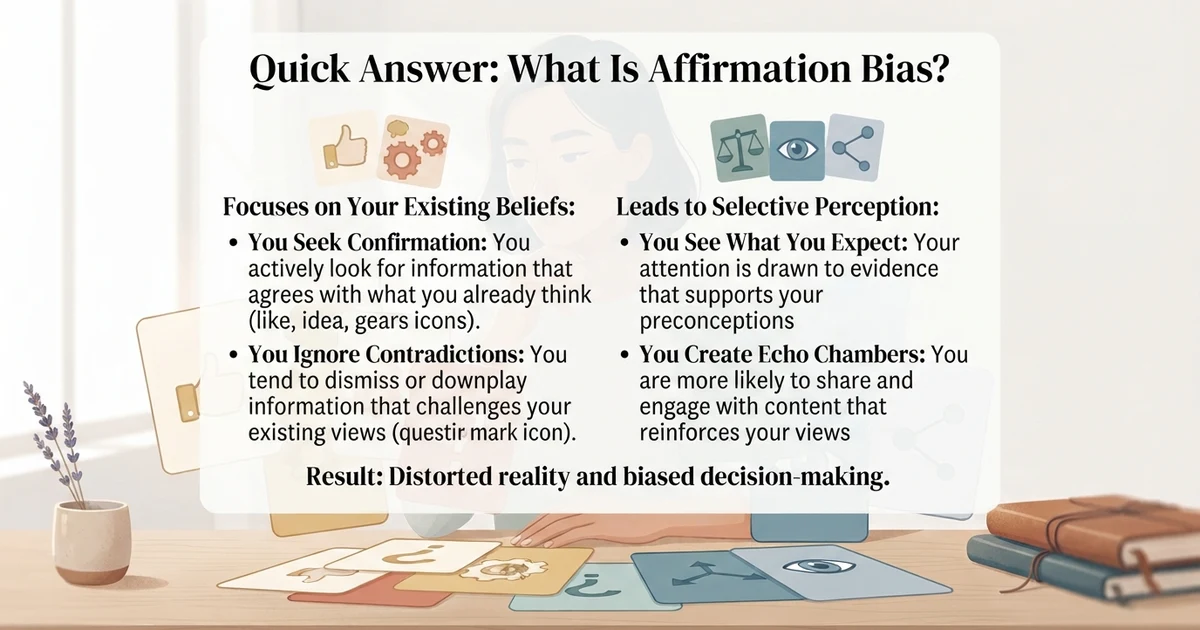
Affirmation bias generally refers to the tendency to seek, notice, interpret, or remember information that supports what you already believe while giving less attention to information that challenges those beliefs.
In psychology, confirmation bias is the more widely established term for this thinking pattern. Although people sometimes use affirmation bias to describe the same concept, it is important to distinguish this cognitive bias from positive affirmations, which are intentional statements used to encourage constructive self-talk.
For example, someone who believes they are bad at public speaking may remember every nervous moment while overlooking presentations that went well. Recognizing this pattern can encourage a more balanced view of personal experiences.
Affirmation Bias Meaning and Simple Definition
Affirmation bias describes a tendency to favor evidence that agrees with existing beliefs, expectations, or opinions.
It can influence three important parts of thinking:
- Information seeking: Looking for information that supports what you already think.
- Interpretation: Understanding unclear situations in a way that agrees with your existing beliefs.
- Memory: Remembering supporting experiences more easily than contradictory ones.
This process can happen without conscious intention. People do not necessarily realize they are overlooking information that challenges their assumptions.
For instance, if you believe a particular study method is the only effective way to learn, you might focus on examples that support your opinion and overlook other approaches that work for different students.
The important lesson is that a strong feeling of certainty does not automatically mean a belief is completely accurate. Taking time to consider different evidence can help you make more thoughtful judgments.
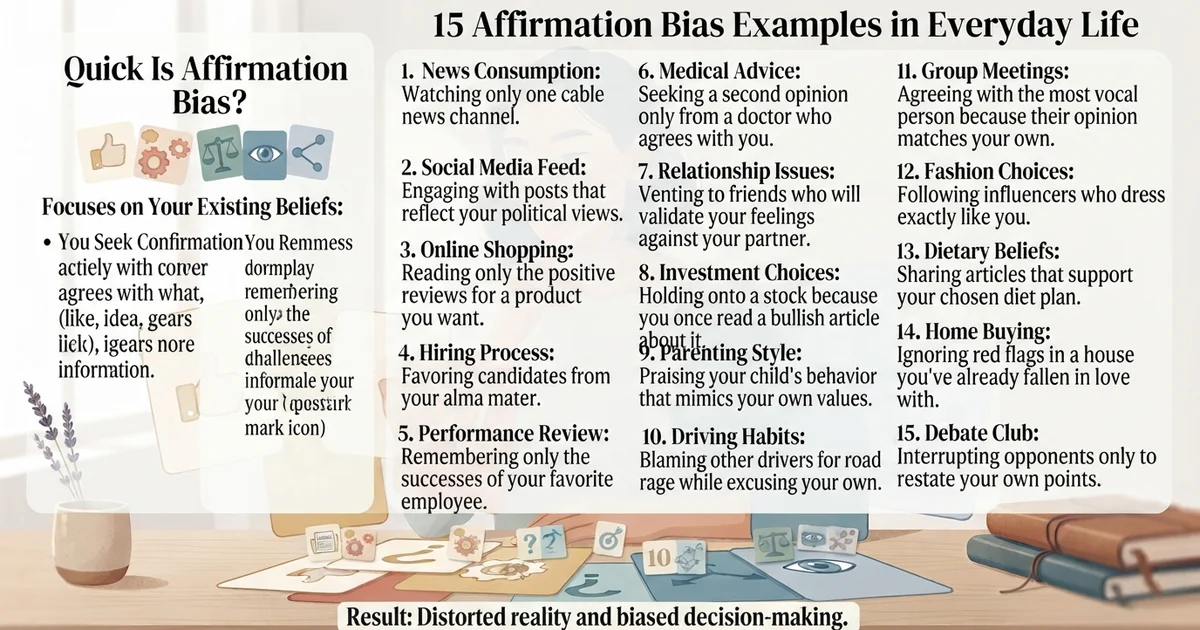
15 Affirmation Bias Examples in Everyday Life
Affirmation bias can appear in ordinary situations, from school and friendships to personal development and online information.
Here are 15 examples that make the concept easier to understand.
1. Self-Confidence
A student believes they are not capable of learning a difficult subject. They remember their mistakes but forget the problems they solved correctly.
2. Friendships
Someone thinks a friend is upset with them. They interpret a short message as proof of that belief, even though the friend may simply be busy.
3. School Performance
A student believes they are bad at mathematics. After receiving a disappointing grade, they treat it as confirmation while overlooking improvements in their understanding.
4. Social Media
A person follows accounts that share opinions they already agree with. Over time, they encounter fewer perspectives that challenge their views.
5. Personal Habits
Someone believes they can never maintain a routine. When they miss one day, they see it as proof that they cannot be consistent, forgetting the days they followed their plan.
6. First Impressions
A person forms an early opinion about someone and then interprets later behavior to fit that initial impression.
7. Group Projects
A student believes a classmate is unreliable. They notice every missed deadline but pay less attention when that classmate completes work on time.
8. Learning New Skills
A beginner believes they have no natural ability for drawing. They focus on imperfect results rather than recognizing gradual progress.
9. Online Reviews
A shopper already prefers a particular product. They pay more attention to positive reviews and dismiss negative feedback without examining its details.
10. Family Conversations
Someone believes a family member never listens. During conversations, they remember interruptions but overlook moments when the family member responds thoughtfully.
11. Workplace Decisions
An employee believes a certain approach is always effective. They highlight successful outcomes while giving less attention to situations where the approach did not work.
12. Personal Appearance
A person feels uncomfortable about a particular feature and notices comments that seem to confirm their insecurity while overlooking neutral or positive interactions.
13. Team Activities
A team member believes another person contributes very little. They focus on visible mistakes rather than considering the full range of that person’s contributions.
14. News Consumption
A reader trusts one source and accepts its supporting arguments quickly while questioning similar claims from sources they disagree with.
15. Goal Setting
Someone believes they are not disciplined enough to reach a goal. They focus on setbacks instead of reviewing the actions they have consistently completed.
These examples demonstrate that affirmation bias is not limited to major decisions. It can shape small interpretations throughout the day.
Short Affirmation Bias Examples to Copy and Paste
The following examples are short statements that illustrate how existing beliefs can influence thinking. They are useful for recognizing the pattern in everyday situations.
- I notice evidence that supports what I already believe.
- I remember my mistakes more easily than my successes.
- I interpret unclear situations according to my expectations.
- I look for information that agrees with my opinion.
- I dismiss evidence that challenges my assumptions.
- I trust familiar ideas without examining them closely.
- I focus on details that confirm my first impression.
- I remember experiences that match my expectations.
- I sometimes confuse strong feelings with facts.
- I pay more attention to opinions that reflect my own.
- I may overlook information that challenges my perspective.
- I interpret other people’s actions through my existing beliefs.
- I notice setbacks more quickly than gradual progress.
- I sometimes search for answers that support my preferred conclusion.
- I can reconsider an opinion when new information becomes available.
Remember: These are illustrative statements, not positive affirmations designed to reinforce a belief. Their purpose is to help readers identify possible thinking patterns.
Positive Affirmation Bias vs. Positive Affirmations
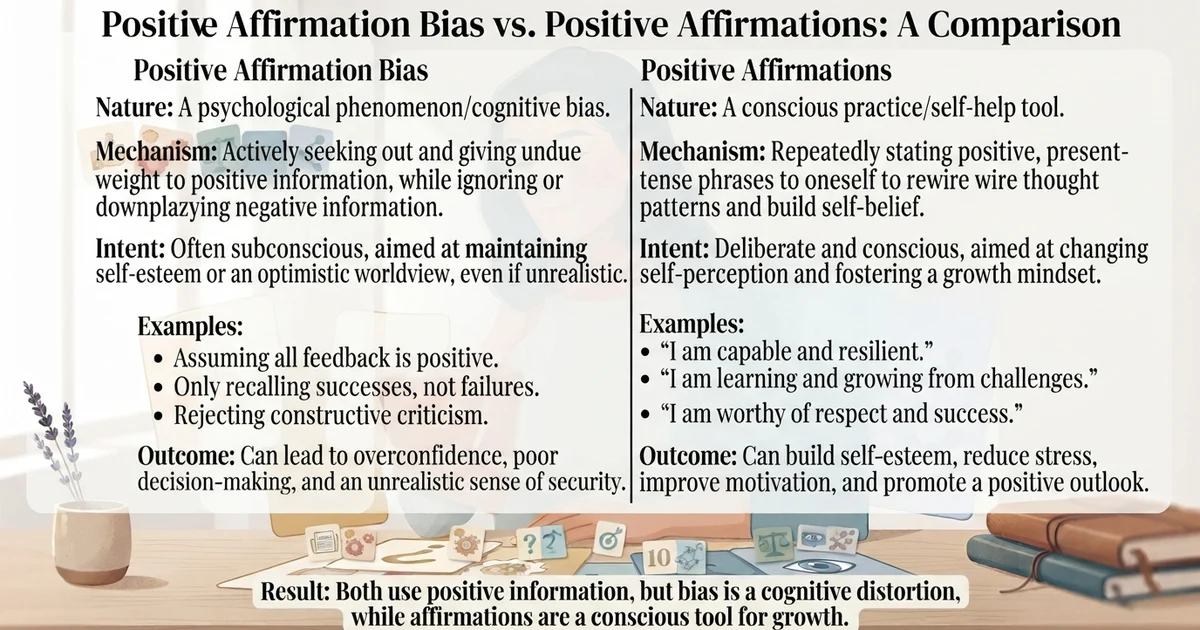
The words affirmation bias and positive affirmations sound similar, but they refer to different ideas.
Positive affirmations are intentional statements used to encourage supportive self-talk. Affirmation bias, when used to mean confirmation bias, describes a tendency to favor information that agrees with existing beliefs.
| Affirmation bias | Positive affirmations |
|---|---|
| A thinking pattern that favors existing beliefs | Intentional statements used for self-talk |
| Can influence how information is interpreted | Can encourage a constructive mindset |
| May cause people to overlook contradictory evidence | Can help people focus on personal values and intentions |
| Often happens automatically | Usually practiced deliberately |
| Benefits from questioning assumptions | Benefits from realistic, personally meaningful wording |
For example:
- Bias-related thought: “I failed once, so I will always fail.”
- Positive affirmation: “I can learn from mistakes and improve with practice.”
The first statement treats one experience as proof of a permanent conclusion. The second encourages a more flexible perspective without pretending that difficulties do not exist.
Positive affirmations are most useful when they feel believable and support realistic actions rather than replacing evidence or practical effort.
Affirmation Bias vs. Confirmation Bias: What Is the Difference?
In everyday use, affirmation bias is often treated as another name for confirmation bias. However, confirmation bias is the established psychological term used in major psychology references.
The American Psychological Association defines confirmation bias in terms of favoring evidence that supports existing expectations while dismissing or failing to seek contradictory information.
APA Dictionary
+1
Here is a simple comparison of related concepts.
| Term | Meaning |
|---|---|
| Affirmation bias | An informal term often used for confirmation bias |
| Confirmation bias | Favoring information that supports existing beliefs |
| Positive affirmations | Intentional statements that encourage constructive self-talk |
| Belief bias | Judging an argument partly by whether its conclusion seems believable |
| Selective attention | Focusing on certain information while overlooking other details |
| Self-fulfilling prophecy | A belief influences behavior in ways that contribute to the expected outcome |
These concepts can overlap, but they are not interchangeable.
Understanding the distinctions helps prevent confusion between a cognitive bias and a personal development practice.
Why Does Affirmation Bias Happen?
Human thinking involves processing large amounts of information. Existing beliefs and expectations can influence which details receive attention and how new experiences are interpreted.
Several factors may contribute to this pattern.
Familiarity
Ideas that feel familiar can seem more convincing because they fit what a person already knows or expects.
Emotional Investment
People may find it difficult to reconsider beliefs connected to important values, personal experiences, or strong emotions.
Selective Attention
When someone expects a particular outcome, they may notice details that support that expectation more readily than unrelated information.
Mental Shortcuts
Using familiar patterns can make everyday thinking more efficient. However, relying too heavily on these shortcuts can sometimes lead to incomplete conclusions.
Social Influence
Friends, family, communities, and online environments can shape which perspectives people encounter and which opinions feel normal or widely accepted.
Recognizing these influences does not mean every belief is incorrect. It simply creates an opportunity to examine conclusions more carefully.
How to Recognize Affirmation Bias in Your Own Thinking
Awareness is a useful starting point for developing more balanced judgment.
You do not need to question every thought or assume that your opinions are wrong. Instead, practice noticing when your interpretation may be influenced by an existing expectation.
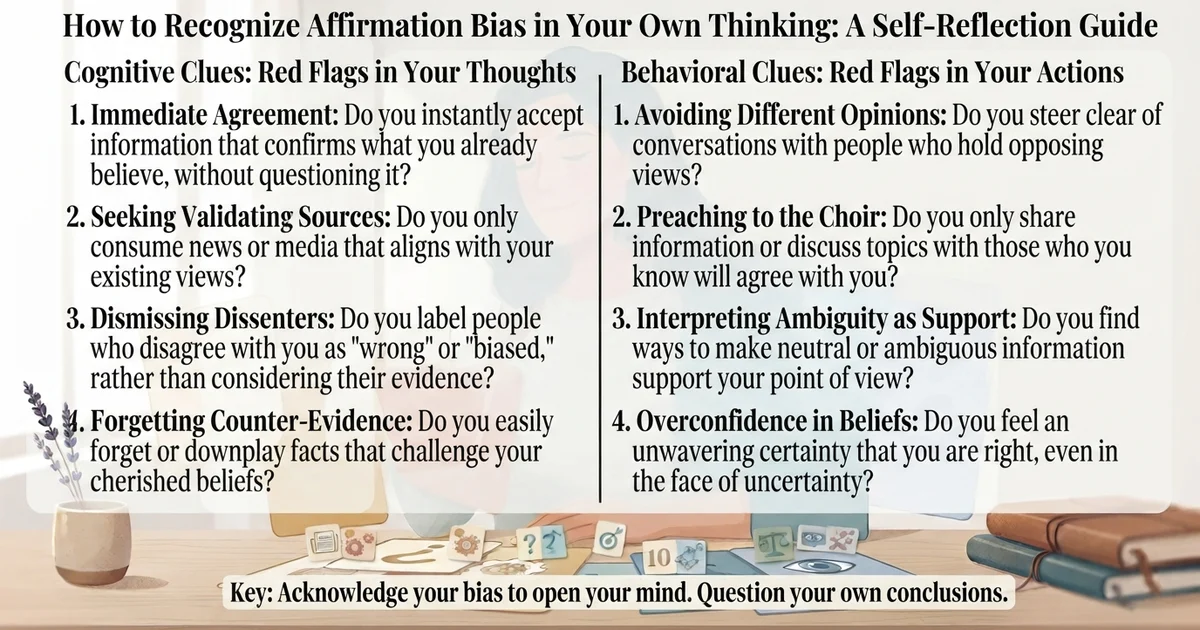
Try asking yourself these questions:
- Am I considering all the relevant information?
- Am I paying attention only to evidence that supports my opinion?
- What information might challenge my conclusion?
- Could there be another explanation for what happened?
- Am I treating one experience as proof of a general rule?
- Would I interpret this situation differently if I held another viewpoint?
- Am I separating what I know from what I assume?
These questions can help you pause before accepting an initial interpretation as the complete truth.
How to Use Affirmation Bias Awareness Correctly
The goal is not to eliminate every mental shortcut. It is to become more thoughtful about how beliefs influence your understanding of the world.
Here are six practical ways to apply this awareness.
1. Separate Facts From Assumptions
Write down what you know for certain and what you are interpreting.
For example:
- Fact: A friend has not replied to my message.
- Assumption: My friend must be upset with me.
Separating these statements creates room for alternative explanations.
2. Look for Different Perspectives
When forming an opinion, consider information that supports your view and information that challenges it.
You do not have to agree with every perspective. The purpose is to understand the available evidence more completely.
3. Ask What Could Change Your Mind
Before reaching a firm conclusion, identify what evidence might lead you to reconsider.
This question encourages flexible thinking and makes it easier to recognize when a belief needs updating.
4. Keep a Balanced Record
When evaluating personal progress, record both challenges and successes.
For example, if you are learning a new skill, note what you found difficult and what improved. This gives you a more complete picture than focusing exclusively on mistakes.
5. Pause Before Reacting
When a situation triggers a strong reaction, take a moment to consider whether your response is based on confirmed information or an interpretation.
A short pause can help you respond more thoughtfully.
6. Use Realistic Positive Self-Talk
If your existing beliefs are overly negative, try replacing absolute statements with flexible, believable alternatives.
Instead of:
“I always make mistakes.”
Try:
“I can make mistakes and still learn something useful.”
This is an example of constructive self-talk, not a method for proving that a particular belief is true.
Common Mistakes When Understanding Affirmation Bias
A clear understanding of affirmation bias requires avoiding a few common misconceptions.
Mistake 1: Thinking Every Supporting Belief Is Biased
A belief is not automatically biased simply because evidence supports it. The concern arises when contradictory information is unfairly ignored or dismissed.
Mistake 2: Confusing Affirmations With Cognitive Bias
Positive affirmations and confirmation bias serve different purposes. One is a deliberate self-talk practice, while the other describes a pattern in information processing.
Mistake 3: Assuming Bias Is Always Intentional
People can favor familiar or supportive information without consciously deciding to ignore alternatives.
Mistake 4: Treating Every Thought as a Fact
Thoughts are interpretations, predictions, and judgments. Some are accurate, while others may need further examination.
Mistake 5: Trying to Replace Every Negative Thought With an Unrealistic Positive One
Balanced thinking does not require pretending that every situation is perfect. A realistic statement can acknowledge a difficulty while leaving room for improvement.
Mistake 6: Believing Awareness Makes Bias Disappear
Recognizing a thinking pattern is helpful, but it does not guarantee that the pattern will never occur again. Continued reflection and careful evaluation remain important.
Affirmation Bias Printable: A Simple Reflection Exercise
Use this short exercise to examine how your beliefs influence your interpretations. You can copy it into a journal, save it as a printable, or use it as a daily reflection activity.
My Balanced Thinking Worksheet
A simple exercise for recognizing assumptions and considering different perspectives.
1. What belief or assumption am I examining?
2. What evidence supports or challenges it?
3. What is another possible explanation?
4. What is one thoughtful step I can take? Copy my reflection
Take your time. The purpose is reflection, not finding a perfect answer.
Conclusion
Affirmation bias is a useful term for understanding how existing beliefs can influence the information we notice, remember, and accept. More precisely, this pattern is commonly known as confirmation bias in psychology. Recognizing it can help you approach personal experiences, relationships, and everyday decisions with greater awareness.
The goal is not to doubt everything you believe but to remain open to new information and alternative explanations. Positive affirmations can also support constructive self-talk when they are realistic and personally meaningful. By combining self-awareness with balanced thinking, you can develop a more flexible approach to learning, personal growth, and daily life. Save this list as a reminder to question assumptions, recognize different perspectives, and give yourself room to grow.
Frequently Asked Questions About Affirmation Bias
1. What is affirmation bias in simple words?
Affirmation bias is the tendency to favor information that agrees with what you already believe. It is commonly used to refer to confirmation bias, a recognized cognitive bias.
2. Is affirmation bias the same as confirmation bias?
The terms are often used interchangeably in everyday writing. However, confirmation bias is the more established psychological term for seeking, interpreting, or remembering information in ways that support existing beliefs.
3. What is an example of affirmation bias?
A student believes they are poor at mathematics and remembers every incorrect answer while overlooking the problems they solve correctly. This selective attention can reinforce their existing belief.
4. Is affirmation bias positive or negative?
It is not inherently positive or negative. It describes a thinking pattern that can influence judgment. However, overlooking contradictory evidence may contribute to incomplete conclusions or poor decisions.
5. What is the difference between affirmation bias and positive affirmations?
Affirmation bias concerns how people process information that supports existing beliefs. Positive affirmations are intentional statements used to encourage constructive self-talk and a supportive mindset.
6. Why do people experience affirmation bias?
Existing beliefs, familiarity, selective attention, emotional investment, and mental shortcuts can influence how people process new information. These patterns may occur without conscious awareness.
7. Can affirmation bias affect everyday decisions?
Yes. It can influence how people interpret conversations, evaluate information, remember experiences, and make personal decisions.
8. How can I recognize affirmation bias?
Notice when you focus mainly on information that supports your opinion. Ask whether you are considering alternative explanations, contradictory evidence, and the difference between facts and assumptions.
9. Can positive affirmations help with negative thinking?
Positive affirmations may support constructive self-talk when they feel believable and connect with realistic actions. They are not a substitute for examining evidence or addressing practical challenges.
10. How can I practice more balanced thinking every day?
Pause before reaching conclusions, separate facts from assumptions, consider different perspectives, and keep a balanced record of experiences. These habits can help you approach everyday situations with greater awareness.