

Affirmations and mantras are both used to guide thoughts, support personal growth, and create a more intentional daily routine. Although people sometimes use these terms interchangeably, they have different origins, purposes, and styles. Understanding affirmation vs mantra can help you choose words that feel natural and meaningful for your needs.
An affirmation usually expresses a positive or supportive belief, while a mantra is a word, phrase, or sound repeated with focused attention. Both can be part of a morning routine, meditation practice, or moment of reflection. The right choice depends on what you want to focus on and how you prefer to practice.
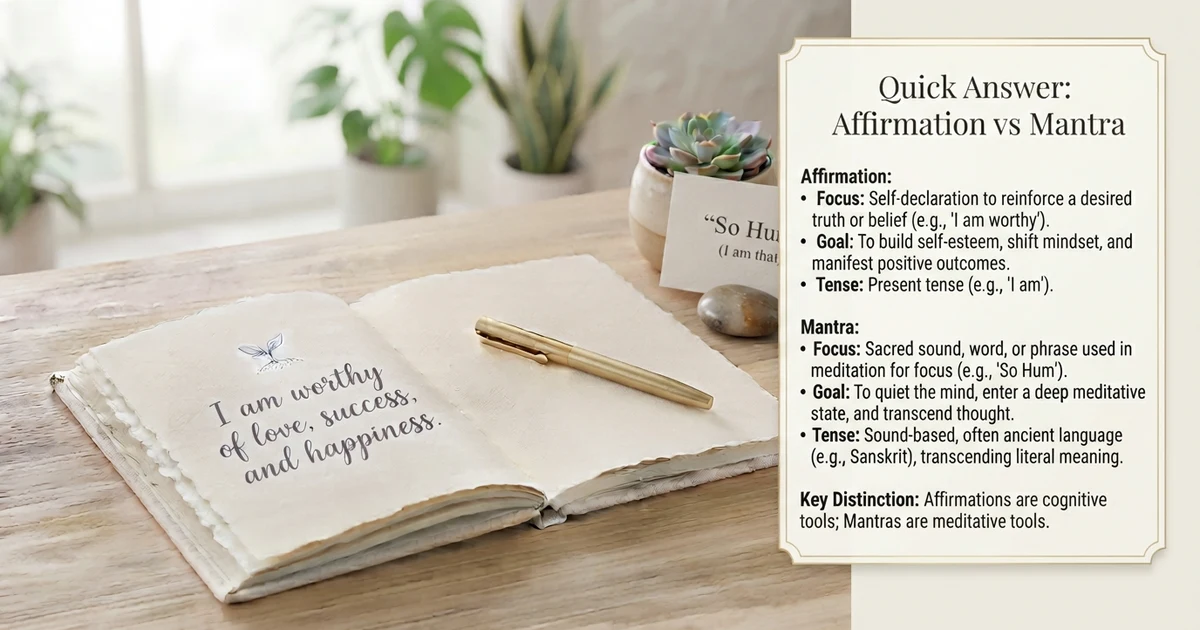
Quick Answer: Affirmation vs Mantra
The main difference between an affirmation and a mantra is their purpose and traditional use.
- Affirmation: A positive or supportive statement used to encourage constructive self-talk, reinforce a belief, or remind yourself of your values.
- Mantra: A word, phrase, or sound repeated to support concentration, meditation, reflection, or spiritual practice.
For example:
- Affirmation: “I trust myself to make thoughtful decisions.”
- Mantra: “Peace begins within.”
An affirmation often focuses on what you believe, choose, or want to practice. A mantra places more emphasis on repetition, attention, and the experience of saying or reflecting on the words.
Neither approach has to be complicated. You can use one or both, depending on your personal preferences and beliefs.
What Is the Difference Between an Affirmation and a Mantra?
The distinction becomes clearer when you look at how each practice is commonly used.
An affirmation is generally a complete statement that expresses a supportive thought. It may focus on confidence, self-worth, motivation, patience, or personal goals.
A mantra is traditionally a repeated word, sound, or phrase. In various spiritual traditions, mantras can have religious or sacred significance. In secular settings, people may also use simple repeated phrases to maintain attention during meditation or reflection.
| Feature | Affirmation | Mantra |
|---|---|---|
| Main purpose | Supportive self-talk and beliefs | Focus, repetition, reflection, or spiritual practice |
| Typical form | A positive statement | A word, sound, or short phrase |
| Common structure | “I am,” “I can,” or “I choose” | A repeated word or phrase |
| Main focus | Thoughts, intentions, and personal values | Attention, presence, or spiritual meaning |
| Common setting | Journaling, daily routines, personal development | Meditation, prayer, reflection, or mindful repetition |
| Personalization | Often written around individual goals | May be traditional or personally selected |
| Example | I can learn from every experience. | Peace and presence. |
These are general distinctions rather than strict rules. Some affirmations are short enough to repeat like mantras, and some modern mantras express personal beliefs similar to affirmations.
12 Affirmation vs Mantra Examples
Examples make the difference easier to understand. The following pairs express similar themes but use different approaches.
Each affirmation is a complete statement, while its paired mantra is shorter and designed for repetition.
| Focus | Affirmation | Mantra |
|---|---|---|
| Confidence | I trust my ability to handle new situations. | Trust yourself. |
| Self-love | I deserve kindness and respect. | I am worthy. |
| Calmness | I can slow down and respond thoughtfully. | Breathe and release. |
| Motivation | I can make progress through small steps. | One step at a time. |
| Patience | I allow myself the time I need to grow. | Patience and grace. |
| Gratitude | I appreciate the good things in my life. | Choose gratitude. |
| Focus | I give my attention to what matters today. | Be present. |
| Resilience | I can learn and adapt when plans change. | Keep moving forward. |
| Self-acceptance | I accept myself while continuing to grow. | I am enough. |
| Courage | I can face uncertainty with an open mind. | Choose courage. |
| Balance | I make room for both effort and rest. | Find your balance. |
| Personal growth | I welcome opportunities to learn about myself. | Grow with intention. |
What these examples show: The affirmation explains a belief or intention in greater detail. The mantra captures a central idea in a few memorable words.
You can use the affirmation when you want to reflect on a thought and the mantra when you want a brief phrase to return to throughout the day.
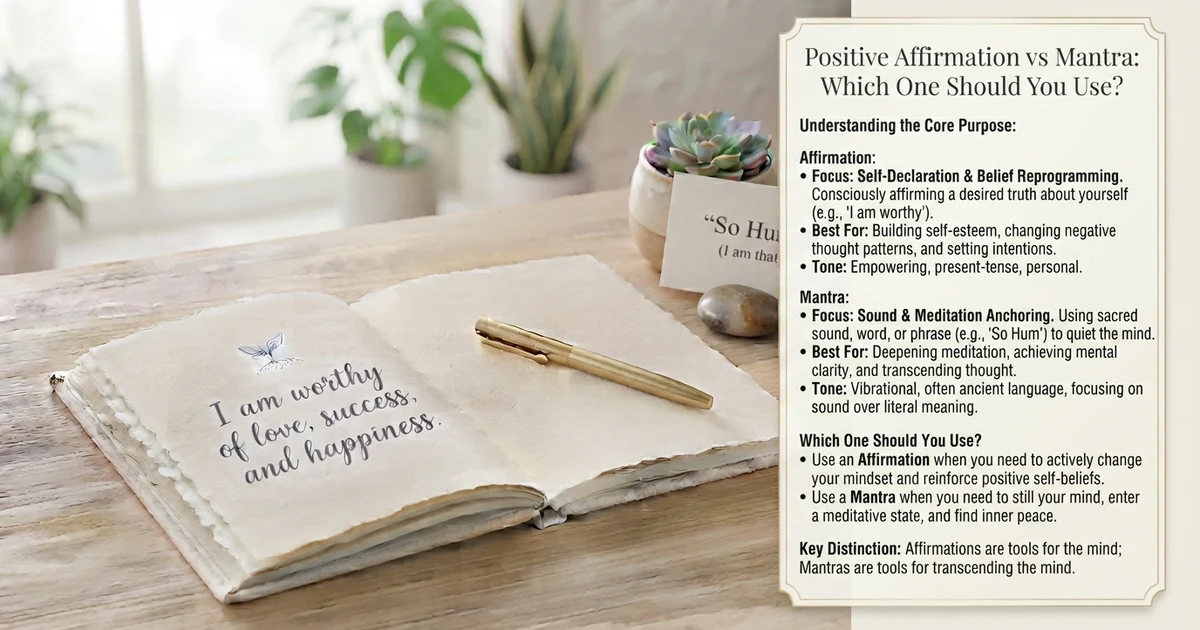
Positive Affirmation vs Mantra: Which One Should You Use?
A positive affirmation may be useful when you want to work with a particular thought, belief, or personal goal. A mantra may suit you when you want a simple phrase to repeat during a quiet moment or meditation.
Consider these situations:
- Building confidence: Use an affirmation that describes the ability or behavior you want to encourage.
- Starting your morning: Repeat a short mantra to establish an intention for the day.
- Reflecting on personal growth: Write an affirmation that captures what you are learning.
- Practicing meditation: Choose a mantra that helps you return your attention to the present.
- Working through a challenging moment: Use a realistic phrase that reminds you to pause and respond thoughtfully.
You do not have to choose one practice permanently. Your needs may change from day to day, and your words can change with them.
Short Affirmation vs Mantra: Understanding the Overlap
Short affirmations and mantras can sound almost identical. Both may contain only a few words, and both can be repeated regularly.
For example:
- “I am capable.”
- “I choose peace.”
- “I trust the process.”
- “I am present.”
- “I welcome growth.”
These phrases can function as affirmations when you use them to reinforce a supportive belief. They can also function like mantras when you repeat them with focused attention.
The distinction is often less about the exact words and more about the intention behind the practice.
If you are using a phrase to remind yourself of a personal belief, you may think of it as an affirmation. If you are repeating it to maintain focus or support meditation, you may be using it as a mantra.
Affirmation vs Mantra Meaning in Everyday Life
Both practices can fit into ordinary routines without requiring special equipment or a lengthy schedule.
An affirmation can help you put a personal intention into words. For example, before a difficult conversation, you might remind yourself, “I can listen carefully and express my thoughts respectfully.”
A mantra can provide a brief point of focus. You might repeat “Steady and present” while taking a quiet moment before the conversation begins.
The difference is practical:
- An affirmation gives you a thought to consider or reinforce.
- A mantra gives you a phrase to return to.
- Both can encourage intentional pauses in a busy day.
- Neither needs to be dramatic or overly positive to feel meaningful.
The most useful phrase is one that fits your circumstances rather than one that sounds impressive.
How to Use Affirmations Correctly
Affirmations work best as intentional self-talk rather than statements you feel pressured to believe immediately.
Try this simple approach:
- Identify your focus. Choose one area, such as confidence, patience, communication, or personal growth.
- Write a realistic statement. Use words that reflect something you can believe or work toward.
- Keep it personal. Choose language that sounds like something you would naturally say.
- Repeat it at a convenient time. You might read it in the morning, write it in a journal, or revisit it before a challenging task.
- Connect it to behavior. Let the statement remind you of one practical action you can take.
For example, instead of saying, “Everything in my life is perfect,” try, “I can find useful lessons in the situations I face.”
The second statement leaves room for real experiences while encouraging a constructive perspective.

How to Use Mantras in Daily Life
A mantra can be incorporated into meditation, quiet reflection, or a simple daily pause.
You do not need to repeat a phrase for a specific number of minutes. Start with a short period that feels comfortable and adjust it to your routine.
Here is one simple method:
- Choose a word or phrase that feels meaningful.
- Find a comfortable place to sit or stand.
- Repeat the phrase silently or aloud.
- Give your attention to the words rather than rushing through them.
- If your attention wanders, gently return to the phrase.
Some people prefer a traditional mantra connected to their spiritual practice. Others choose a secular phrase such as “Be here now” or “Calm and steady.”
If you use a mantra from a religious or cultural tradition, take time to understand its meaning and context rather than treating it as an interchangeable motivational slogan.
Generic vs Realistic Affirmations and Mantras
Words can feel less useful when they are disconnected from your actual circumstances. Choosing realistic language can make a phrase easier to relate to and apply.
Compare these examples:
| Less realistic wording | More grounded alternative |
|---|---|
| I never make mistakes. | I can learn from my mistakes. |
| Nothing can upset me. | I can practice responding calmly. |
| I succeed at everything. | I can give my best effort to this task. |
| My life is always peaceful. | I can create small moments of peace. |
| I have no doubts. | I can move forward even when I feel uncertain. |
The same principle applies to mantras. A phrase such as “I must always be calm” can create unnecessary pressure. “Pause and breathe” offers a simple reminder without demanding a particular emotional state.
Choose words that support your intentions without denying your feelings or experiences.
Common Mistakes When Choosing Affirmations or Mantras
Both practices are simple, but a few common habits can make them feel less natural.
1. Choosing words that do not feel believable
You do not have to make sweeping claims about yourself. Begin with a statement that feels possible or reflects a value you want to practice.
2. Repeating phrases without understanding them
Take a moment to consider what the words mean to you. Understanding your phrase can make the practice more intentional.
3. Treating repetition as a substitute for action
A phrase about improving communication does not replace listening, practicing, or having an honest conversation.
4. Using too many phrases at once
A small selection is often easier to remember and revisit than a long list that becomes difficult to maintain.
5. Expecting immediate results
Neither affirmations nor mantras guarantee a particular emotional or practical outcome. Treat them as supportive habits rather than promises.
6. Ignoring personal beliefs and preferences
A traditional mantra may be meaningful to one person and unfamiliar to another. Choose a practice that respects your values and feels comfortable to you.
How to Combine Affirmations and Mantras
You can use both practices together without making your routine complicated.
A simple combination involves choosing one affirmation for reflection and one mantra for repetition.
For example:
Affirmation
I can approach today’s challenges with patience and care.
Read this statement when setting your intention for the day.
Mantra
One moment at a time.
Repeat this phrase when you need a brief pause or a reminder to stay present.
Practical action
Choose one task, give it your attention, and take a manageable first step.
This approach gives each phrase a distinct role. The affirmation helps you clarify your intention, while the mantra offers a short reminder you can return to during the day.

How to Create Your Own Affirmations and Mantras
Personal phrases do not need to be poetic or complicated. Start with an idea that matters to you and express it in a way that feels natural.
Creating an affirmation
Use this simple structure:
Personal focus + supportive belief or intention
Examples:
- I can speak honestly while remaining respectful.
- I am learning to trust my decisions.
- I make time for the things that matter.
- I can improve through consistent effort.
Creating a mantra
Reduce the central idea to a few memorable words.
Examples:
- Speak with kindness.
- Choose steady progress.
- Breathe and begin.
- Stay open.
- Let the moment be.
Read your phrases aloud. If they sound awkward, simplify them. If they feel too broad, connect them to a specific situation.
You can also save your favorite phrases in a journal, on a note, or in a printable collection for convenient daily use.
Conclusion
Understanding affirmation vs mantra comes down to recognizing the different ways these practices support reflection and intention. Affirmations generally express supportive beliefs or personal goals, while mantras use repetition to encourage focus, meditation, or spiritual connection. Their purposes can overlap, and neither approach needs to be rigid.
Choose words that feel meaningful, realistic, and appropriate for your life. You can repeat a mantra during a quiet moment, write an affirmation in your journal, or combine both with practical action. Consistency and personal relevance matter more than finding a perfect phrase. Start with a few words you genuinely connect with and adjust your practice as your needs change.
Frequently Asked Questions
1. Are affirmations and mantras the same thing?
No. Affirmations generally express positive or supportive beliefs, while mantras are traditionally repeated words, sounds, or phrases used for focus, meditation, or spiritual practice. However, the two can overlap, particularly when a short affirmation is repeated regularly.
2. What is the main difference between an affirmation and a mantra?
An affirmation typically communicates a thought or intention, such as “I trust my decisions.” A mantra is often a shorter phrase repeated with attention, such as “Trust and breathe.” The primary distinction is how the words are intended to be used.
3. Can an affirmation also be a mantra?
Yes. A phrase such as “I am present” can serve as an affirmation when used to reinforce a personal intention. When repeated during meditation to maintain focus, it can also function like a mantra.
4. Which should beginners start with: affirmations or mantras?
Either can be a comfortable starting point. Beginners who enjoy reflective writing may prefer affirmations, while those who want a short phrase for quiet repetition may prefer mantras. Start with whichever feels more natural and manageable.
5. How many affirmations or mantras should I use each day?
There is no required number. One or two meaningful phrases may be easier to remember and use consistently than a lengthy collection. Choose an amount that fits your schedule and does not make the practice feel like an obligation.
6. Is it better to say affirmations aloud or write them down?
Both are options. Speaking affirmations aloud can make them part of a verbal routine, while writing them down allows you to reflect on their meaning. You can also read them silently. Choose the method that feels comfortable and convenient.
7. Can I use affirmations and mantras in the morning?
Yes. You can begin the day with an affirmation that expresses your intention and a mantra that reminds you to stay focused. For example, read “I can approach today with patience” and repeat “One step at a time.”
8. What should I do if my affirmations feel fake?
Try changing absolute statements into realistic ones. Instead of “I am completely confident,” use “I am learning to trust myself.” You can also focus on a behavior, such as preparing carefully or asking thoughtful questions, rather than forcing yourself to feel a certain way.
9. Do affirmations and mantras have to be spiritual?
No. Affirmations are commonly used as a secular self-talk practice. Mantras also have important roles in spiritual and religious traditions, but some people use simple, nonreligious phrases for meditation or personal reflection. The meaning depends on the phrase and the context in which it is used.
10. Can affirmations and mantras replace practical action or professional support?
No. They can serve as reminders or supportive habits, but they do not replace taking practical steps toward goals or seeking qualified support when needed. A phrase about managing a challenge can accompany preparation, communication, or professional guidance rather than standing in for them.